Why Amur Falcons Choose to Stop in Northeast India: The Answer Lies in the Termites Found in the Region
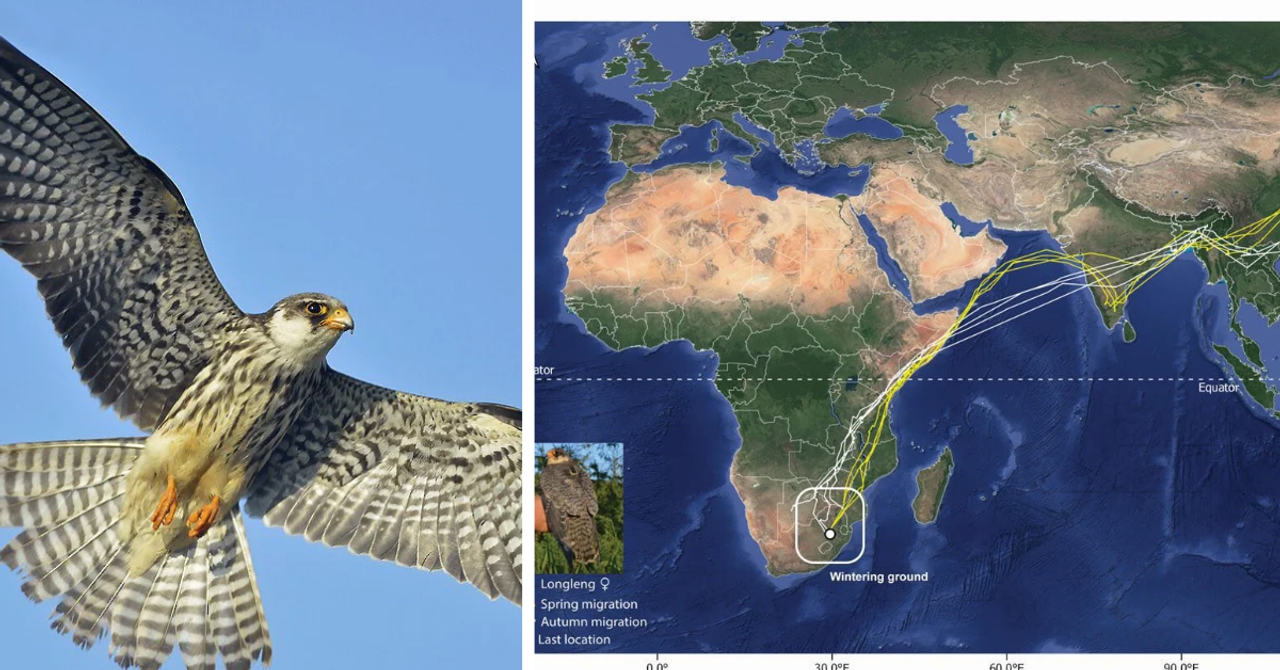
Apapang, Alang and Ahu may weigh just 150 grams each, but they have some serious frequent-flyer miles to clock. They are Amur Falcons.
In November 2025, these three Amur falcons were fitted with satellite tags by scientists from the Wildlife Institute of India (WII) in Tamenglong district, Manipur, to track their epic journey from Northeast India to Africa.
Every November, thousands of these tiny birds of prey take off from roosting sites in Manipur and Nagaland, cross the Indian mainland and head over the Arabian Sea. Their itinerary? Thousands of kilometres, days over open water and no airport lounges in sight.
Since the Amurs have created a mini-sensation with their incredible journey, I did a short Q&A with Dr Suresh from @wii_india who leads this remarkable tracking project. Here are a few fascinating insights Q. Why do Amur Falcons migrate? A. Migration is a natural survival strategy. Many species, including the Amur Falcon, move seasonally to escape harsh weather, seek richer feeding grounds, or find suitable breeding habitats. Over evolutionary time, individuals that migrated had higher survival and reproductive success which is why migration persists in certain species even today. Q. Why is tracking their migration important? A. Tracking with lightweight electronic tags helps scientists understand the exact routes and flight paths these birds follow, the environmental factors influencing their journey, and the critical stopover sites they depend on. It also helps identify threats along the way from habitat loss to hunting and provides vital insights into how Climate Change is shifting migration patterns worldwide. Q. How do Amur Falcons survive such long flights without food or water? A. Before they begin their transcontinental journey, Amur Falcons stop over at select sites in Northeast India, especially Nagaland and Manipur. Their arrival coincides with the mass emergence of termites a rich, high-protein food source. Here, they undergo hyperphagia or intense pre-migratory fattening, building reserves that sustain them through their nonstop oceanic flights where no food or water is available. Q. Do they take breaks while crossing the sea? A. No. Amur Falcons are terrestrial birds and cannot land on water. Once they leave the Indian coast, they undertake an uninterrupted flight across the Arabian Sea, a remarkable non-stop journey covering nearly 3000 km.
— Supriya Sahu IAS (@supriyasahuias) November 17, 2025
Their journey revealed how a bird barely heavier than a smartphone can cross thousands of kilometres of open sea. It also highlighted why Northeast India is an important stopover along their migratory route.
A journey tracked across continents
On 11 November 2025, WII scientists fitted Apapang, an adult male, Alang, a young female, and Ahu, an adult female, with lightweight satellite transmitters weighing approximately 3.5–4 grams. The birds took flight the following day.
The tracking updates were shared by Supriya Sahu, Tamil Nadu's Additional Chief Secretary for Environment, Climate Change and Forests, on social media.
Apapang covered approximately 6,100 kilometres in six days and eight hours. Alang travelled around 5,600 kilometres in six days and 14 hours, while Ahu covered approximately 5,100 kilometres in five days before reaching the Horn of Africa.
Their routes differed, but all three completed remarkable journeys across the Indian mainland and the Arabian Sea. Subsequent tracking updates placed Apapang in Tanzania, Alang in Kenya and Ahu in northern Somalia.
The birds' journeys provided researchers with valuable information about their movements, flight durations and stopover behaviour.
Why do they stop in Northeast India?
The answer lies in an insect that emerges in enormous numbers after the monsoon: termites.
Amur falcons breed in parts of eastern Russia, northeastern China and Mongolia before migrating south towards their wintering grounds in Africa. During their autumn journey, Northeast India provides an important opportunity to feed and build up the energy reserves needed for their demanding flight.
A 2024 study published in the Journal of Raptor Research, titled Prey Species in the Diet of the Amur Falcon (Falco amurensis) During Autumn Passage Stopover in Northeast India, investigated what the birds eat at their stopover sites.

Led by researchers including Suresh Kumar of WII, the team examined approximately 1,200 regurgitated pellets collected at Pangti, Yaongyimchen and Hakhizhe in Nagaland during October and November 2017 and 2018.
These pellets contained indigestible remains of the birds' prey. By examining them, researchers found that two species of subterranean termites, Odontotermes feae and Odontotermes horni, formed a substantial part of their diet.
The findings help explain why the birds congregate in the region. Termites provide protein and energy that the falcons convert into fat reserves before embarking on their long oceanic flight. Researchers estimated that a million falcons could consume two billion termites in just over a fortnight.
A stopover that matters beyond autumn
The importance of Northeast India extends beyond the autumn migration.
In a second study, published in the Journal of Threatened Taxa on 26 March 2024, researchers Tapak Tamir, Abprez Thungwon Kimsing and Daniel Mize documented repeated summer sightings of Amur falcons in D'Ering Memorial Wildlife Sanctuary in Arunachal Pradesh.
Here is the New Year Amur Falcon Migration -Very long Q&A Part II Q1. What is the longest non-stop distance covered by these satellite-tagged Amur Falcons? A: Published tracking shows Amur Falcons can do multi-day, non-stop flights of approx. 5,600–6,000 km during the India→Africa leg, depending on the individual & year. Also, peer-reviewed/technical tracking confirms their open-sea crossings can be about 2,364–3,138 km (Somalia↔India), typically completed in roughly 44–80 hours. Q2. Do satellite tags interfere with their flight, health, or mating? A: Properly fitted tags are designed to minimise interference, but no tag is “zero-impact.”. Best practice is to keep transmitter mass very small relative to body weight and use well-tested harness designs; the recent India work has been described as using very lightweight transmitters (a few grams). However, ethical review, careful fitting, and post-deployment evaluation should be done & is being done Q3. Do jet streams or high-altitude winds help them on this journey? A: Yes winds are a major part of the “physics” that makes the journey possible. The best-documented help is from seasonal monsoon tailwinds and strong, persistent wind systems over the Arabian Sea/Indian Ocean that can provide sustained push. Q4. How many other falcons are “accompanying” these famous three? A: These famous three are just the tagged individuals we can follow in reality, Amur Falcons migrate and roost in huge aggregations, often tens of thousands to over 100,000 at key stopovers, and broader estimates discuss movements involving very large numbers of birds across the flyway. Q5. Why have these three gone to different destinations? A: It’s common for individuals of the same species to winter in different areas within southern/eastern Africa. Differences can be driven by wind and weather, refuelling success and timing at stopovers, individual strategy/experience (age, condition, learned routes) etc. Q6. When will they return and what route will they take? A: In broad terms, Amur Falcons winter in Africa and then move north in late winter/early spring, reaching breeding regions in northeast Asia around May–June. Routes can differ between autumn vs spring, and tracking shows spring and autumn ocean crossings can follow different lines. Q7. Does part of the falcon’s brain “sleep” during the long flight? A: We have strong evidence that some birds can sleep in flight (including unihemispheric sleep) famously shown in frigatebirds. For Amur Falcons specifically, it’s not proven. Q8. How do they decide their destination, and do they return to the same places each year? A: The best-supported explanation is a mix of: Innate navigation programmes (genetically guided ) Environmental cues (winds, weather, geography, magnetic and celestial cues), learning/experience (older birds often show more consistent routes). Satellite work indicates the species follows remarkably consistent large-scale timing and corridors, even though individuals may vary. Q9. What do they eat to fuel such massive journeys? A: During the crucial Northeast India stopover, studies show they are highly insectivorous, with termites often dominant, along with other insect groups exactly the kind of high-abundance prey that allows rapid fattening before an ocean crossing. This is why protecting stopover habitats (and the insect “boom” they depend on) is so important. Q10. Is Ahu expected to move further? Why she is stationery ? A. Periods of little movement usually indicate resting or feeding in suitable habitat. This is normal behaviour and not a cause for concern Q11. How long does the GPS tag stay on the bird? A. The tag is fixed as a backpack & expected to stay for long, however this may come off from prolonged wear and tear, the tags may also stop transmitting after prolonged battery use. As told to @supriyasahuias by @sureshwii @wii_india #AmurFalconMigration video - The stopover tagging site in Manipur
— Supriya Sahu IAS (@supriyasahuias) January 4, 2026
The sanctuary, in East Siang district, covers approximately 190 square kilometres and consists largely of grasslands, alongside riverine and subtropical forests.
The researchers documented sightings, including one in May, that suggested the sanctuary could serve as a refuelling site during the birds' return towards their breeding grounds.
From hunted birds to protected visitors
The falcons' journey has also become a story of community-led conservation.
In 2012, large-scale hunting of Amur falcons around Pangti village in Nagaland drew national and international attention. In response, the Wildlife Institute of India, forest departments and local communities worked to understand the birds' migration and protect their stopover sites. Tracking efforts began in 2013.
Over time, communities in parts of Nagaland and Manipur became important partners in protecting the birds. The falcons, once hunted in large numbers, increasingly became a source of local pride.
Their migration demonstrates how wildlife conservation depends on connected habitats and people working across regions. A bird may breed in Asia, refuel in Northeast India and spend the winter in Africa, but its survival depends on the safety of each place along the way.
For the Amur falcon, the seasonal emergence of termites is more than a feeding opportunity. It is a chance to prepare for a flight across continents. Protecting the landscapes where that preparation happens is essential to ensuring the journey continues.
Sources:
‘6,000 km in six days: How WII tracked a trio of Amur falcons across continents’: By Malavika Jayadeep,Published on 26 November 2025
‘Prey Species in the Diet of the Amur Falcon (Falco amurensis) during Autumn Passage Stopover in Northeast India’: By Amarjeet Kaur, Alex Jacob, Deven Mehta, R. Suresh Kumar, Published on 13 June 2024
‘D’Ering Memorial Wildlife Sanctuary, a significant flyway and a preferred stopover (refuelling) site during the return migration of the Amur Falcon Falco amurensis’: By Tapak Tamir, Abprez Thungwon Kimsing, Daniel Mize, Published on 26 March 2024
This content is published by The Better India and has not been created or edited by Hello Headlines. View original