Before Kashmir Labels a Child Lazy
Kashmir, Observer, Jammu, Srinagar, Latest Kashmir News, Kashmir News, Kashmir Latest News
ByDr Satish Prasad Rath
A child who cannot read the blackboard clearly may spend years being called a slow learner. Another who struggles to stay awake through morning classes may be told to pay attention. A child who falls behind classmates may hear that he needs to work harder.
Such judgments often come before anyone thinks of checking the child’s health in Kashmir classrooms. And that is a costly mistake.
Many childhood health problems remain hidden because children have no way of knowing that something is wrong. They grow accustomed to blurred vision, tired mornings and difficulty concentrating. Adults see the behaviour, attach a label to it and move on.
By the time someone looks for a medical explanation, valuable years may have passed.
The numbers from Jammu and Kashmir’s National Family Health Survey, conducted between 2019 and 2021, show how much can remain unseen.
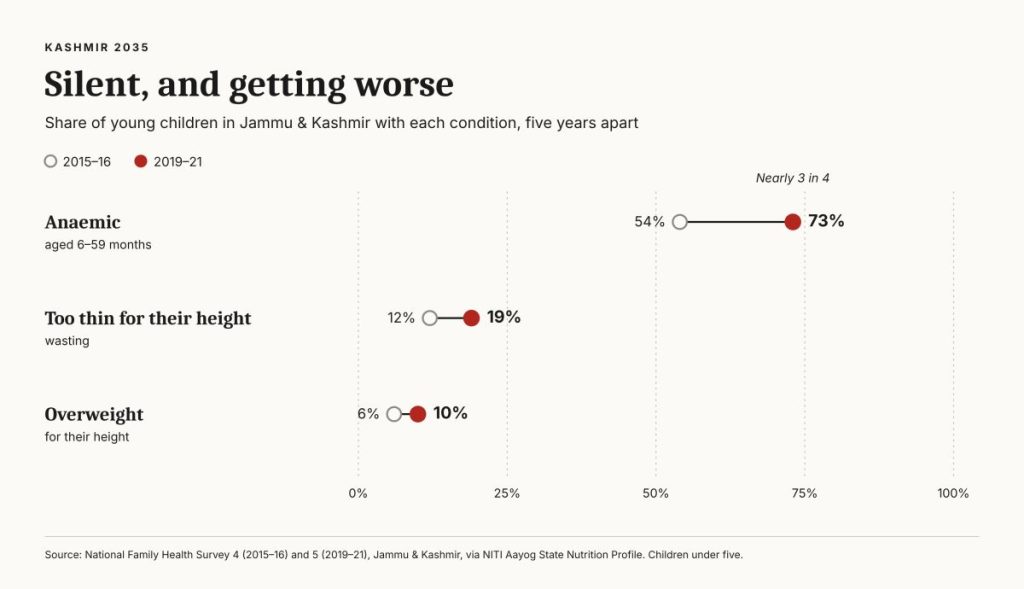
Nearly three out of four children aged six months to five years, or 73 per cent, were anaemic. Five years earlier, the figure was 54 per cent. The share of young children who were too thin for their height rose from 12 to 19 per cent, while the proportion who were overweight increased from 6 to 10 per cent.
More than one child in four was shorter than expected for their age.
These figures describe children growing up with nutritional problems that may go unnoticed at home and in school. They also challenge the common assumption that a child who looks healthy is necessarily well.
A classroom can appear perfectly ordinary while several children struggle with conditions that affect their learning and development.
Screens have made the problem worse.
Children today spend long hours with smartphones and computers, often with little supervision. Kashmir’s long winters, when families spend more time indoors, can make screen habits harder to control.
A 2021 review of research published in The Lancet Digital Health linked heavy smart-device use with higher odds of short-sightedness, particularly when combined with computer use. Paediatricians are also seeing concerns involving poor sleep, irritability, aggression, anxiety and difficulty paying attention.
A child who becomes upset when a phone is taken away may be treated as stubborn or badly behaved. The possibility that excessive screen use has become part of a larger health problem rarely drives the discussion.
Other countries, meanwhile, have started addressing the elephant in the room.
Australia’s ban on social media for children under 16 took effect in December 2025. Britain announced a similar measure in June 2026, expected to begin in spring 2027. Seattle’s public school system sued major social media companies in 2023 over the effects of their platforms on students’ mental health.
The American Academy of Pediatrics encourages families to develop media plans, while the Indian Academy of Pediatrics advises parents to avoid screens before age two and limit use to an hour a day for children up to five.
Rules can help, but parents and teachers need practical guidance too.
Many adults raising children today never grew up with smartphones, and medical training has often left doctors unprepared to advise families on digital habits. Digital parenting needs to become part of ordinary child healthcare, alongside nutrition, eyesight and hearing.
Some countries have already made school health checks a routine part of childhood.
Japan has required annual examinations under its School Health and Safety Act since 1958. The checks cover growth, nutrition, eyesight, hearing, teeth, heart health and other conditions. Families receive results within 21 days, and schools must respond, whether by advising treatment or moving a child closer to the blackboard.
New Zealand provides free health checks for four-year-olds before they begin school, covering vision, hearing, growth and development, with teachers also contributing their observations.
In 2021, the World Health Organization and UNESCO called on countries to make schools health-promoting institutions.
India has its own guidelines. The Central Board of Secondary Education’s School Health Manual, issued in 2008, calls for annual medical examinations, individual health cards and school health clubs.
Jammu and Kashmir introduced Student Health Cards in government schools in 2021, with two annual check-ups planned through the Mid-Day Meal mission and National Health Mission.
Medical blocks have two Rashtriya Bal Swasthya Karyakram teams to screen children for birth defects, diseases, deficiencies and developmental delays. Government schools are also expected to have two teachers trained as health and wellness ambassadors.
The difficulty lies in implementation. A health department review in November 2022 found that screening teams had covered about two-thirds of government schools and fewer than half of anganwadi centres during the year. Private schools remain outside much of this arrangement.
The Jammu and Kashmir Board of School Education oversees examinations and syllabuses, while government screening programmes largely serve government institutions. Children in private schools depend on their managements to arrange medical checks.
Even where screenings take place, the next step is often uncertain. A medical report has little value if a family cannot find the right specialist or act on the advice.
My team and I saw this during a screening of 600 children at Green Valley School in Srinagar. Most looked healthy, and their parents would probably have said the same.
But the examinations found children with anaemia, untreated eyesight problems, ear, nose and throat conditions, and concerns about weight and growth.
A smaller group was screened for early signs of attention-deficit hyperactivity disorder, autism and speech delay, conditions that can easily be mistaken for poor behaviour or slow learning.
The findings came from an ordinary school, where children attended classes and went about their day without raising health complaints.
Parents were invited to take children needing further attention to specialists in Srinagar. That follow-up will tell us far more about the value of the exercise than the number of children screened.
The experience also points to an idea Kashmir should take seriously: turning schools into children’s primary health screening centres.
Building a clinic in every village or sending mobile hospitals to remote settlements cannot solve the problem alone, particularly when winter closes roads and many paediatric specialists work in Srinagar. Schools already exist in almost every village, remain open six days a week and bring children together in one place.
Portable technology can now screen eyesight, hearing, heart function and growth within minutes. Newer tools can identify early signs of autism, ADHD and speech delays in five to ten minutes, helping doctors decide which children need a specialist assessment.
These tools do not replace a medical diagnosis. They only help identify children who might otherwise wait years before receiving one.
The model would bring teachers and parents into the first line of child healthcare, supported by doctors and hospitals responsible for follow-up. Government could set standards and fund basic checks, while private providers bring specialist services and technology. Government and private schools would follow the same system.
Kashmir should aim to screen every child annually from birth to 18 by 2035, either at school or at a health centre. A simple health record should follow the child, with a clear referral route whenever a problem is found.
Parents must receive reports in plain language, and children identified during screening must have a named place for treatment.
Parents can begin by watching for signs such as squinting, sitting too close to the television, constant tiredness, difficulty hearing instructions or sudden changes in attention.
Teachers can treat falling marks as a reason to investigate rather than a verdict on a child’s ability. Schools can set aside a health day in their academic calendar, while the government can connect screening teams with hospitals and specialists.
The children who will be adults in 2035 are already sitting in Kashmir classrooms. Some are struggling with blurred vision, poor nutrition or developmental difficulties that nobody has recognised.
A child should not have to explain an illness he does not know he has.
The responsibility belongs to the adults who see him each morning, and to the institutions that have the means to look a little closer.
- The author is a paediatrician-scientist and founder of SKIDS, a child health screening platform. He writes the weekly column Kashmir 2035 for Kashmir Observer.
The post Before Kashmir Labels a Child Lazy appeared first on Kashmir Observer.
This content is published by Kashmir Observer and has not been created or edited by Hello Headlines. View original