This Arunachal Frog Eats Entire Snails & Scientists Just Found It After 5 Years Of Searching
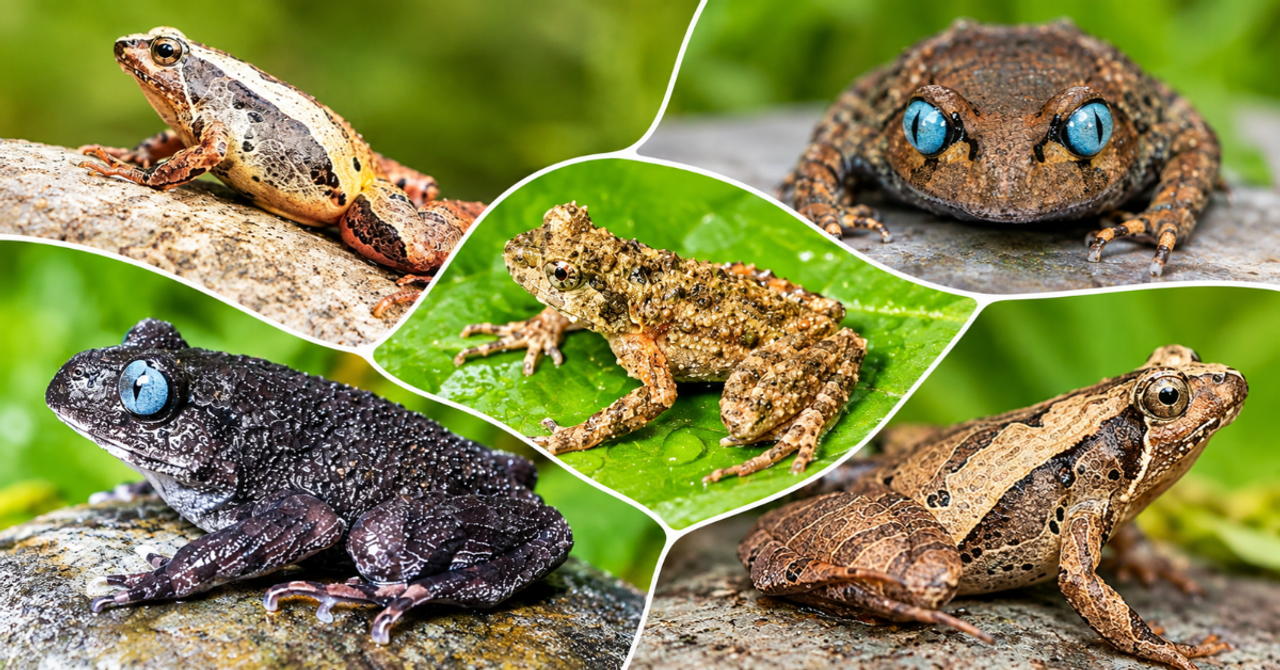
Imagine walking through a forest in the Eastern Himalayas after sunset. The ground is damp, fallen leaves gather beneath towering trees, and the sounds of insects fill the night air. Somewhere among the undergrowth, a tiny frog sits almost unnoticed, blending into its surroundings.
In forests like these, some of nature's most fascinating discoveries are easy to miss. And a recent scientific study has brought five such hidden inhabitants into the spotlight.
Researchers from the University of Delhi and Harvard University have identified five previously unknown species of horned frogs in Arunachal Pradesh, following five years of fieldwork in the Eastern Himalayas. The discovery has also revealed something unusual about one of them: it feeds on land snails, making it the first known snail-eating frog recorded in India.
The research offers a fascinating glimpse into the biodiversity that India's forests continue to hold.
Meet the five newly discovered frogs
All five species belong to the genus Jingophrys, commonly known as diminutive horned frogs. These tiny to medium-sized amphibians are distinguished by horn-like projections of skin around their eyes, which give them their distinctive appearance.

Photograph: (The Times of India)
The five newly identified species are:
-
Tanii horned frog (Jingophrys taniitatii): Named after the Tanii tribe of Arunachal Pradesh, the name also incorporates 'tatii', the Apatani word for frogs and toads.
-
Snail-eating horned frog (Jingophrys tanogogo): Named after the Apatani word for snails, this species has an especially unusual diet.
-
Siang horned frog (Jingophrys siangensis): Named after the Siang region of Arunachal Pradesh, where it was discovered.
-
Hrdy's horned frog (Jingophrys hrdy): Named in recognition of a long-time supporter of herpetological research and conservation biology at Harvard University.
-
Wu-Larson's horned frog (Jingophrys wularsoni): Also named to recognise supporters of research and conservation at Harvard.
The names of three species acknowledge the region's local communities, language and geography, while the other two honour individuals who have supported scientific research.
A frog that eats snails, shells and all!
Among the five discoveries, Jingophrys tanogogo stands out for its unusual feeding behaviour.
While examining the species, researchers used advanced three-dimensional micro-CT imaging to study its internal anatomy. They found entire land snail shells inside the frog's gut.

This makes it the first known snail-eating frog recorded in India and the first documented instance of snail-eating behaviour in the family Megophryidae.
It is a remarkable finding because it expands what scientists know about the feeding habits of this group of amphibians.
Five years of research in challenging terrain
Identifying these frogs was no easy task. The research team included Sonali Garg, S D Biju, Tage Tajo, Radhakrishna Upadhyaya K, and James Hanken, who carried out extensive explorations across the Eastern Himalayas.
The researchers encountered temperatures as low as minus 4 degrees Celsius while navigating the mountainous terrain. Since these frogs are nocturnal, much of the fieldwork involved searching for them at night, often without a place to stay.

Local tribal communities also played an important role, sharing their knowledge of the region and supporting the researchers during their field explorations.
Beyond identifying new species, the team used DNA analysis to understand their evolutionary history. Their findings suggest that the diversification of these frogs coincided with the rise of the Himalayan mountain ranges and the intensification of the Asian monsoon millions of years ago.
Why these discoveries matter
The findings draw attention to the Eastern Himalayas as an important centre of biodiversity and evolution. The number of Jingophrys species recorded in India has increased seven-fold through this research, while the known diversity of the genus worldwide has more than doubled.
Yet, there is still much to learn. Some of these frogs are extremely secretive and appear in remote forests only during short breeding seasons. Further research will be needed to understand their ecology, behaviour and conservation needs.

For now, these five discoveries offer a reminder of how much life remains undocumented in India's forests. Sometimes, finding an entirely new species does not require looking beyond a distant wilderness. It simply requires looking a little closer at the world beneath our feet.
Sources:
'New frog species found in Arunachal, Keralam scientist part of team' by K S Sreejith for The New Indian Express, Published on 14 November 2026.
'Two-fold hidden diversity of diminutive horned frogs (Megophryinae: Jingophrys) highlights overlooked in situ diversification in the Himalayas' by PUBMED.
This content is published by The Better India and has not been created or edited by Hello Headlines. View original