Memory Costs Become A Headache. How Are Indian Startups Coping?
Samsung’s entry-level Galaxy A07 5G now costs ₹22,999, up ₹2,000 from ₹20,999, under revised prices that took effect on November 16. And that’s not it. Eight days after Diwali, on November 15-16, the prices of around 48 Samsung and Xiaomi smartphone variants rose by ₹1,000-₹4,000. These price hikes are the result of the rising cost of memory chips and other components.
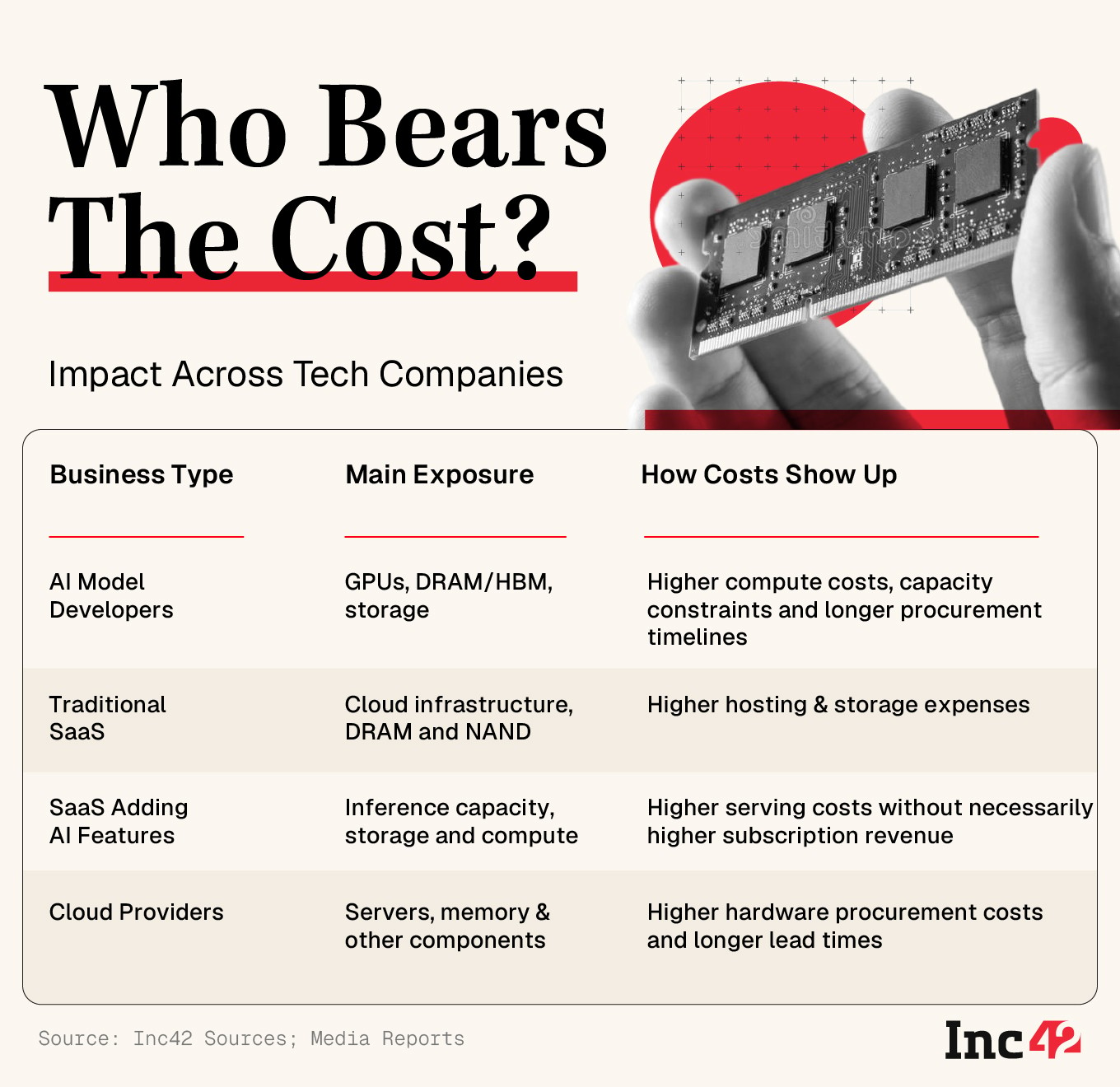
But rising memory chip costs are now hurting more than just the consumer electronics industry. The ripple effects have extended well beyond chip giants like NVIDIA, AMD and Qualcomm, and cloud behemoths such as AWS, Microsoft Azure and Google Cloud. Consequently, cloud hosting, storage and hardware procurement costs have started to burn holes in the pockets of SaaS companies.
For Indian AI startups, too, rising memory costs means that building and running compute infrastructure is getting more expensive, even as limited GPU availability continues to delay deployments.
For startups already investing heavily in AI capabilities, the memory crunch raises a pressing question. How are businesses factoring in the changing economics of computing? Let’s dive in…
When Compute Becomes A Bottleneck
For AI companies, memory is becoming a cost across the entire model lifecycle, from training and data storage to deployment and inference.
Training datasets need to be stored, versioned and kept close to computing infrastructure. As companies work with increasingly large volumes of text, images, audio and video, storage requirements grow. Once a model is deployed, platforms also accumulate user-generated data, including prompts, conversation histories, documents, embeddings and audit logs.
Inference, or the process of running a trained model to generate responses, adds another layer of memory requirements. Longer conversations and more users accessing a model simultaneously increase the memory needed to maintain the model’s key-value (KV) cache that stores information from earlier parts of a conversation so that the model can use it while generating subsequent responses.
But the pressure is not limited to memory prices alone.
AI companies are also combating the rising cost and limited availability of GPUs, which are needed to run AI workloads (training and running the model).
Subhashish Banerjee, cofounder of Bharat1 AI, which works with startups and infrastructure providers, said the economics of accessing GPUs have changed sharply over the past few months. Earlier, some AI startups could book GPUs for a few hours each day, depending on availability and price, and run customer workloads during that window. That flexibility has reduced.
According to him, GPU prices have risen 30-35% since February 2026, while availability has tightened. Startups that previously booked capacity for 10-11 hours at a time are being asked to commit for three or six months.
This has raised a new problem: companies are being asked to pay for capacity before they are sure customer demand will materialise. Simply put: A startup expecting to onboard a customer in June may have to reserve computing resources in March or January.
Subhashish said the problem is particularly staring at smaller startups that lack the capital to make long-term commitments. However, this does not mean enterprises with deep pockets can avoid the shocks.
A case in point is Bengaluru-based payments technology company Juspay, which reported a net loss of ₹90 Cr in FY26, compared with a net profit of ₹62 Cr in the previous year, as it stepped up investments in AI capabilities and international expansion. Its revenue, however, grew 30% to ₹664 Cr.
The company is also waiting for GPU capacity. Cofounder and COO Sheetal Lalwani said Juspay wants to increase its GPU investments but is constrained by allocation, with delivery commitments stretching three to six months. The company is awaiting a larger 72-GPU rack.
Then, Indian companies are vulnerable to currency fluctuations. “Almost all of our compute is bought in dollars, which compounds the problem. A price rise that hurts a US company hurts an Indian company more,” said Abhijeet Zilpelwar, the cofounder and CTO of pi-labs, an AI native cybersecurity company.
Cloud Over SaaS Profitability
Traditional SaaS companies are facing a different set of challenges. The pressure is growing as these businesses continue to add AI features to their products. While they are less exposed to rising memory costs than AI model developers, given their limited reliance on high-end GPUs and specialised memory chips, they are not immune to the broader cost pressures.
Their dependence on cloud infrastructure, which runs on servers equipped with DRAM and storage systems using NAND flash, makes them vulnerable to rising memory costs. As cloud providers face higher infrastructure expenses, some of these costs get passed on to SaaS companies.
Applications that once relied largely on conventional computing now need additional capacity to process AI workloads, store larger volumes of data, and support inference. This can increase infrastructure spending even as companies try to keep subscription prices competitive.
The challenge is particularly acute for companies with fixed or per-seat subscription models. Their infrastructure costs can increase with usage, while revenue may not rise at the same pace. For smaller SaaS businesses already operating on thin margins, even a modest increase in hosting and storage expenses can make a difference.
The scale of the increase is visible in cloud spending.
According to industry estimates cited by Financial Express, a growth stage Indian startup that spent ₹8-20 Lakh a month on cloud infrastructure two years ago now typically spends ₹18-45 Lakh. For late stage and enterprise-scale companies, monthly spending has risen from ₹50-80 Lakh to ₹1.5 Cr. These increases reflect the growing complexity of workloads, AI experimentation and GPU computing.
But cloud providers are not necessarily passing every increase on to customers. CloudPe cofounder Karan Jaju said the company has kept prices for older-generation cloud instances unchanged, while newer configurations with updated CPUs and RAM have become more expensive. The pressure comes amid rising memory costs, with TrendForce forecasting computer memory, also called DRAM, contract prices to increase 10-15% quarter-on-quarter in Q4 2026.
He added, new hardware (memory chips, CPUs, GPUs, etc.) purchases among some customers have fallen 5-10%. Some are instead exploring virtual desktop infrastructure (VDI), which lets employees access cloud-hosted desktops without companies having to buy and maintain physical machines.
Subhashish said Series B and Series C companies with substantial computing needs may consider buying hardware through infrastructure providers or loans, while earlier stage startups are likely to continue relying on cloud services and shorter-term rentals.
Smaller Models, Lighter Hardware
Another response to rising computing and memory requirements is to make AI models smaller and more efficient. This is happening not just among startups trying to reduce inference costs, but also among companies building AI features for consumer devices.
The shift towards smaller language models (SLMs) is helping companies run selected AI workloads on smartphones and laptops, instead of sending every request to large models hosted in data centres.
Google’s Gemini Nano, for instance, is designed to run directly on Android devices through its AICore system. It can support tasks such as summarisation and smart replies without sending every prompt to the cloud. Apple has made its on-device foundation model available to developers through its Foundation Models framework, while Microsoft’s Phi Silica is designed to run locally on Copilot+ PCs.
For AI application companies, another approach is to reduce the amount of computing required for every interaction.
Apurv Agrawal, the cofounder and CEO of SquadStack, a voice AI agent maker, said the company has managed to reduce its costs by moving away from general-purpose models for its core voice AI workloads.
SquadStack’s AI agents make more than 50 Lakh calls a day, often switching between Hindi, English and regional languages during conversations. The company built its own speech recognition model, Arth, trained on Indian phone audio, and its Sales LLM, Maya, which is post-trained on more than 40 Cr sales interactions collected over six years.
“Fewer tokens per conversation means less compute per call, which is why our costs have come down even as hardware got more expensive,” Agrawal said.
SquadStack rents dedicated GPUs in India and does not currently plan to buy hardware. Agrawal said owning infrastructure would make more sense at a much larger scale, when utilisation remains high around the clock.
Other companies are looking at similar efficiency measures. Pi-labs’ Zilpelwar said startups are increasingly using smaller, domain-specific models, quantisation and pruning to reduce the amount of memory and computing power needed to run AI workloads.
Similarly, some are ensuring that frontier models are used only when necessary. Routine tasks can be routed to smaller, quantised models, while more complex requests are sent to larger models. This means Indian startups are not focused on deploying the most powerful models, but on extracting the most value from every rupee spent on compute.
[Edited by Shishir Parasher]
The post Memory Costs Become A Headache. How Are Indian Startups Coping? appeared first on Inc42 Media.
This content is published by Inc42 and has not been created or edited by Hello Headlines. View original