Hala Mobility combines EV rentals, delivery jobs, and financial services for gig workers
Delivery riders can cover 100 to 120 km a day, often on petrol vehicles that aren’t designed for such intensive use. Rising fuel prices add to their operating costs.
Electric vehicles (EVs) can reduce these expenses, and delivery companies are encouraging riders to make the switch. However, riders who cannot afford or access an EV have little choice but to continue using petrol vehicles.
Access to a vehicle is only part of the problem. Riders also need to know how far it can travel on a charge, where to charge it, and where to get it serviced. For companies managing large EV fleets, the challenges extend to monitoring battery health, battery swaps, energy consumption, and maintenance schedules.
Hyderabad-based Hala Mobility aims to address these gaps through an EV fleet-as-a-service and multi-modal shared mobility platform that allows riders and delivery companies to use EVs without purchasing them.
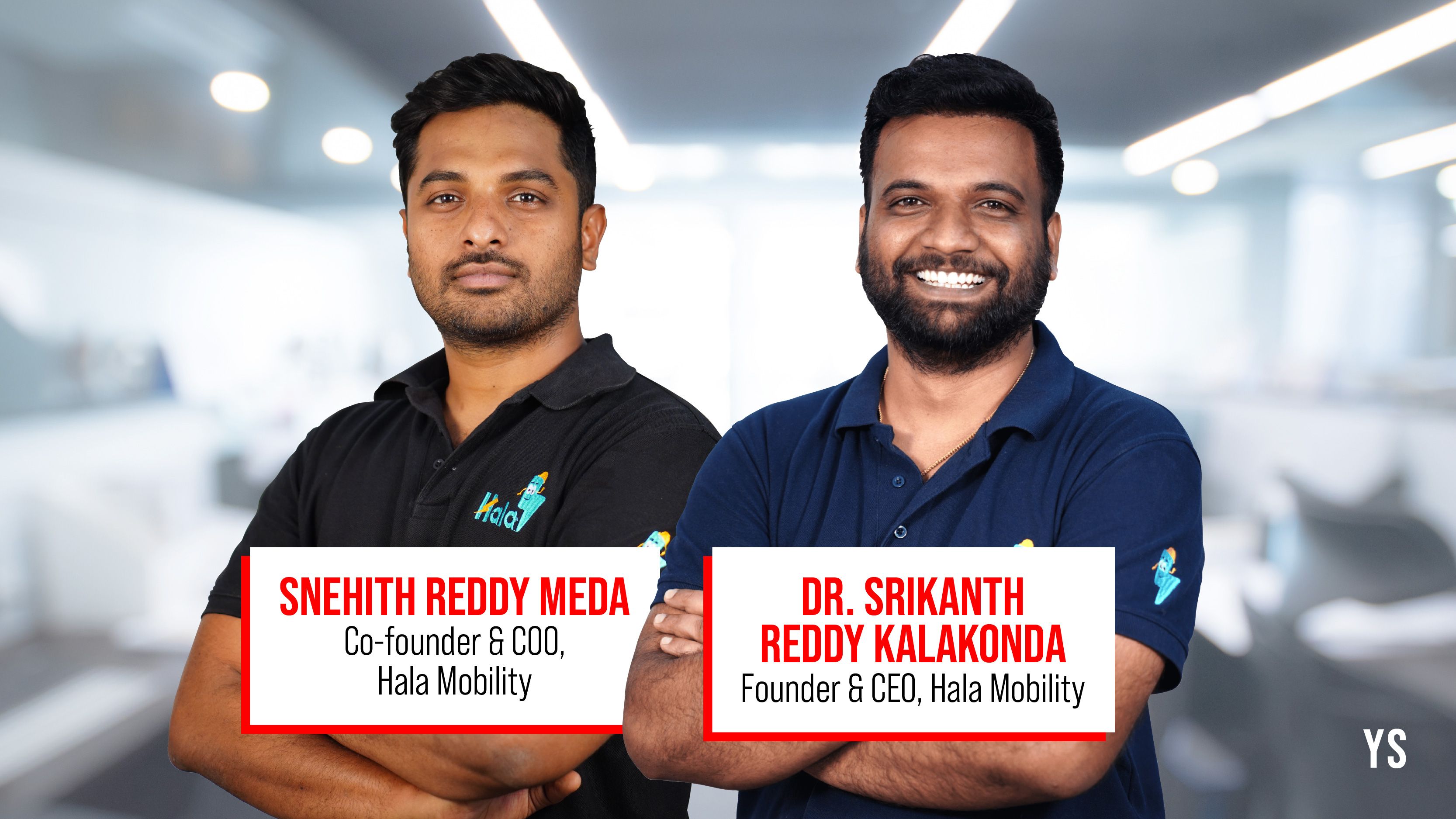
Through the Hala app, riders can rent, lease or finance vehicles. Hala was founded in 2019 by Srikanth Reddy Kalakonda, Founder and CEO, and Co-founder Snehith Reddy Meda.
Kalakonda studied computer science at Jawaharlal Nehru Technological University and completed master's degrees at the University of Padua and the Polytechnic University of Madrid. He later pursued a PhD, during which he developed Chippy, a mobility aggregator app.
Meda studied electronics and communication engineering at Manipal Institute of Technology and founded the agritech company OneBasket.
Vehicles, jobs, and financial support
Hala works with riders through two models.
For delivery companies such as Zomato, Swiggy and Zepto, it provides both riders and electric vehicles and manages operations. Delivery companies pay Hala for each order completed. Hala deducts vehicle rental and related costs and passes the remaining amount, including incentives, to the rider.
“Everything is passed on. There is no commission,” Kalakonda says.
Riders who already have delivery jobs can subscribe to a vehicle for a week, 15 days or a month. Hala’s website lists rentals starting at Rs 189 a day and three-month leases from Rs 13,999.
Kalakonda describes the business as a combination of vehicle rentals, logistics, and platform services, designed to keep vehicles in use.
Hala also allows riders to work with at least three delivery companies, enabling them to switch between platforms depending on order availability. According to Kalakonda, the average rider on its platform earns close to Rs 32,000 a month.
The startup uses data such as timely rental payments, order volumes, and customer ratings to score riders. These scores help connect them with financiers offering early-salary advances.
Kalakonda says every rider also receives accident insurance, underwritten using the same data, with Rs 5 lakh in coverage in the event of death.
About 90% of Hala's customers are gig workers who have migrated from other parts of the country and lack stable housing, which Kalakonda says affects their health.
To address this, Hala is developing Blue Base, a community hub offering charging, parking, vehicle servicing, and housing for riders.
Blue Base also plans to operate vehicles in shifts of eight to nine hours, allowing another rider to use a vehicle while the first rider rests.
Managing the fleet with data
Hala uses an internal software platform called Circle OS to track vehicles throughout their lifecycle, from deployment and servicing to refurbishment or scrapping.
Kalakonda says the system uses AI to analyse nine to 10 inputs, including data related to drivers, vehicles, charging stations, service centres, inventory, and order patterns.
The software helps Hala predict and extend vehicle life, determine when a vehicle can be refurbished instead of scrapped, and compare operating costs with rental income.
Each vehicle is fitted with an Internet of Things (IoT) telematics device that transmits data every five seconds.
Riders use this information to check a vehicle’s remaining range, identify faults, and locate the nearest service station. When a battery runs low, the app directs them to a nearby charging station and shows how many drivers are waiting.
“Every data point has to be tracked, traced, monitored, and controlled,” Kalakonda says.
He puts fleet utilisation at nearly 88% and uptime at 94%.
What growth looks like
Hala's business clients include Zomato, Swiggy, Zepto, Blinkit, BigBasket, Amazon, Flipkart, and Porter. Individual riders account for the rest of its customers.
Its fleet grew from 2,484 vehicles in March 2025 to more than 8,100 in March 2026. The company now operates nearly 18,000 vehicles across nine cities.
Kalakonda says Hala has been EBITDA-positive since its inception and profit-after-tax positive for the past two financial years. The startup reported revenue of Rs 96 crore in the last financial year and is targeting Rs 262 crore to Rs 270 crore this year.
It has raised approximately Rs 21 crore in equity and Rs 70 crore in debt. Hala is also part of the 2025 cohort of the ClimaFii Alliance, a programme run in India by Upaya Social Ventures. The startup is currently raising a Rs 135-crore Series A round to fund its financing, insurance and housing initiatives.
Kalakonda expects Hala to have around 50,000 vehicles on the road within a year and aims to build a profitable listed company by 2030 or 2031.
Beyond rentals, leasing, and delivery services, he wants Hala to become a broader support system for gig workers. “This is my safety net, and this is where I belong,” Kalakonda says, describing how he wants riders to feel about the platform.
This content is published by YourStory and has not been created or edited by Hello Headlines. View original