A Red Hexagon Could Change What Kashmir Eats
Kashmir, Observer, Jammu, Srinagar, Latest Kashmir News, Kashmir News, Kashmir Latest News
By Syed Arsalan Abid
A shopper picks up a packet of biscuits from a grocery store in Srinagar and turns it around to read the label. There are figures for sugar, fat, salt and calories, along with a list of ingredients and recommended daily allowances. The information is there, but understanding it is another task.
Most people do not have the time or knowledge to work out what those numbers mean while shopping.
This is the problem the Supreme Court has now taken up.
In its November 26 judgment in 3S and Our Health Society v. Union of India (2026 INSC 1275), a Bench of Justices J.B. Pardiwala and K. Vinod Chandran directed the Food Safety and Standards Authority of India (FSSAI) to introduce warning labels on packaged food.
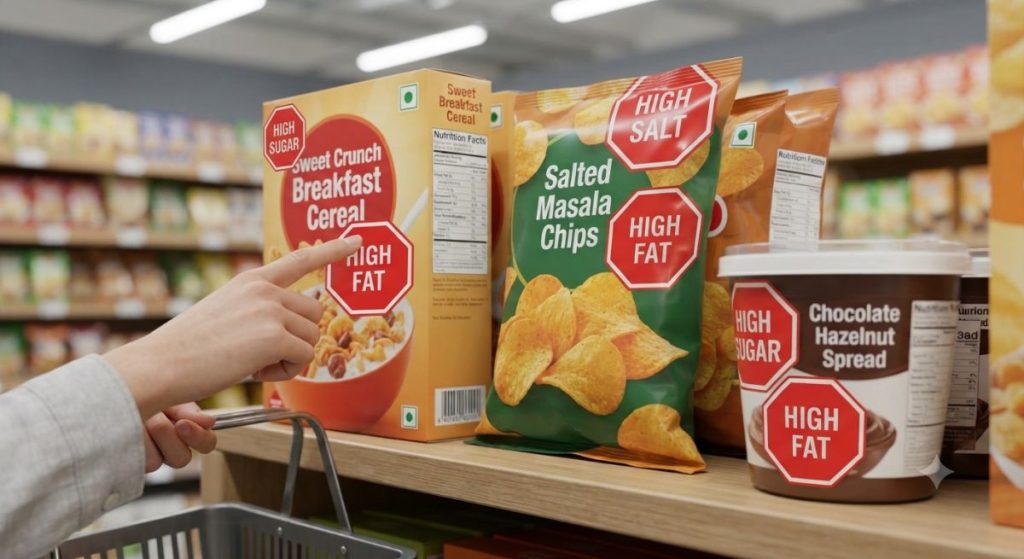
The proposed red hexagons, carrying words such as “High Sugar”, “High Fat” and “High Salt”, are intended to help consumers understand what they are buying without having to study the fine print.
The legal directive is important because food companies may already print nutritional information on their packets, but it means little if consumers cannot understand what it says.
A person buying a bottle of juice should be able to see at a glance whether it contains excessive sugar. The same should apply to biscuits, snacks, bakery products and other packaged foods.
The Court has also addressed a technical problem that could have weakened the new rules.
It has directed FSSAI to use total sugars and saturated fat instead of added sugar and added fat, along with salt, as the basis for the warnings.
Laboratories cannot reliably separate sugar added during processing from sugar naturally present in a finished product. Manufacturers could also use fruit pulp or concentrates to avoid an added-sugar threshold.
A rule that cannot be properly tested would be difficult to enforce. The Court also pointed out that added fat is not used as a standard criterion anywhere in the world. FSSAI’s own expert discussions in 2021 and 2022 had favoured total sugars and saturated fat.
The regulator must now reconsider its proposed limits because Table 15.1 of the Dietary Guidelines for Indians, 2024, uses figures based on added sugar and added fat.
Those limits will decide how useful the warnings become.
A study cited in the judgment found that 94.1 per cent of packaged products would exceed at least one of the proposed thresholds. If almost everything on a supermarket shelf carries a red warning, consumers may eventually stop paying attention. The Court has described this as “label fatigue”.
Setting the limits too high would create a different problem. Products containing excessive amounts of sugar, fat or salt could escape the warnings. The Court has asked FSSAI to use scientific evidence to find a reasonable balance and gradually tighten the limits, as Chile and Mexico have done.
The design of the labels will also influence how people use them.
The Court wants separate red hexagons for high sugar, high fat and high salt, rather than one combined warning. Standardised pictures must accompany the words so that people who cannot read the text can also understand the message.
Size and visibility are equally important.
The Court has directed FSSAI to make the warnings occupy at least 4-5 per cent of the main display panel, with clear and readable text. Any departure from this standard must be supported by reasons under Section 18(2)(a)(ii) of the Food Safety and Standards Act, 2006.
The rules must also work for people shopping online.
A warning that can be read on a physical packet may become almost invisible when the same product appears as a small image on a mobile screen. FSSAI must account for this while preparing the final regulations. It must also prevent sweetened beverages that do not cross the warning thresholds from using symbols that look like the red hexagons.
Exemptions need similar care, as FSSAI has proposed excluding single-ingredient foods and products such as ghee, edible oil, salt, sugar, jaggery and honey. The Court has asked it to prepare a complete list of exempted solid and liquid foods, explaining why particular products qualify. Broad exemptions could allow products that should carry warnings to escape the rules.
Manufacturers may also try to avoid the labels by changing their recipes. A company could reduce sugar or salt and replace them with artificial preservatives, additives or other ingredients that are no healthier.
Such changes would defeat the purpose of the exercise. The Court has directed FSSAI to monitor product reformulation and change existing rules where needed. Consumers should not assume that a product without a red warning is automatically healthy.
The regulator has about four months to complete consultations and publish the final regulations. Businesses will then get 365 days to comply. The Court has accepted this transition period but has warned against its misuse.
Companies should not print large quantities of old packaging or accumulate unlabelled products to avoid the new rules. FSSAI must monitor preparations, and further extensions should ordinarily be avoided.
The case will return before the Court after ten weeks, when FSSAI must submit an update on its progress.
These changes will also affect food businesses in Jammu and Kashmir. Local manufacturers producing apple juice, fruit-based drinks, jams, preserves, bakery products and other packaged foods will need to examine their ingredients and nutritional values. The use of total sugars could be particularly important for fruit-based products, which naturally contain sugar.
A product made from apples will not automatically escape a high-sugar warning simply because its sugar comes from fruit. Whether a particular juice or preserve needs a red hexagon will depend on the final limits, its classification and the exemptions FSSAI approves.
Local processors should study the proposed rules and present their concerns with supporting evidence when the draft regulations are opened for public comments.
The new rules will involve additional work and expense for businesses. Manufacturers may have to arrange nutritional testing, review recipes, change packaging and examine how they classify their products. Loose food sold over the counter will generally fall outside these regulations, which apply to pre-packaged foods.
Still, local businesses could use the changes to improve their products and give buyers clearer information. Those who begin preparing early will have more time to adjust their recipes and packaging. Better labelling could also help local brands build trust with consumers who want to know what goes into their food.
The Court has linked clear nutrition labels with the rights to health, food and informed choice under Article 21 of the Constitution. It has also directed the Union to enforce existing rules on safe food and balanced diets for children in schools. Schools should strengthen nutrition education through classroom lessons, workshops and other activities.
A child may learn about sugar, fat and salt in school, but that knowledge needs to make sense when the child sees a packet of chips or a bottle of a sweetened drink.
Parents face the same challenge when choosing food for their families. Better information can help them make those decisions, provided the labels are clear and the rules are properly enforced.
The red hexagon is a small change to the front of a food packet. Its success will depend on what happens behind it: whether manufacturers follow the rules, whether regulators check their claims and whether consumers learn to use the information.
A shopper should be able to pick up a packet, look at its front and understand what the food contains before placing it in the basket.
- The author is a corporate lawyer based in Mumbai.
The post A Red Hexagon Could Change What Kashmir Eats appeared first on Kashmir Observer.
This content is published by Kashmir Observer and has not been created or edited by Hello Headlines. View original