Memory, Loss And The Places We Carry: Exploring Kashmir Through Photographs And Forgotten Family Histories
Agar firdaus bar ru-ye zamin ast,
Hamin ast-o hamin ast-o hamin ast.
If there is Paradise on Earth, it is this, it is this, it is this.
— Attributed to Amir Khusrau
Some losses cannot be undone. Growing older means discovering how much we took for granted. What once seemed ordinary becomes precious; what seemed permanent vanishes. Sometimes all that remains of a lifetime is a photograph, an object, a fragment of a story.
That fragile bond between memory and loss lies at the heart of Will the Bulbul Sing to the Flowers Again?, a photographic exhibition (on till December 20) by Anita Khemka and Imran Kokiloo at the Dilip Piramal Art Gallery, NCPA, Mumbai. Its title comes from a nazm by Ghulam Ahmad Mahjoor celebrating the Valley's landscape. The artists ask a harder question than the poem: can that beauty be separated from the violence that has marked it?
The Persian couplet above has long been Kashmir's calling card, a traveller's sigh of wonder. Beside this exhibition it reads differently. Paradise is a promise a place is asked to keep through decades of conflict, exile and loss. A landscape is never merely a view; it is made of childhood paths, familiar seasons and family histories. When it becomes inaccessible, home stays vivid in the imagination even as return grows uncertain.
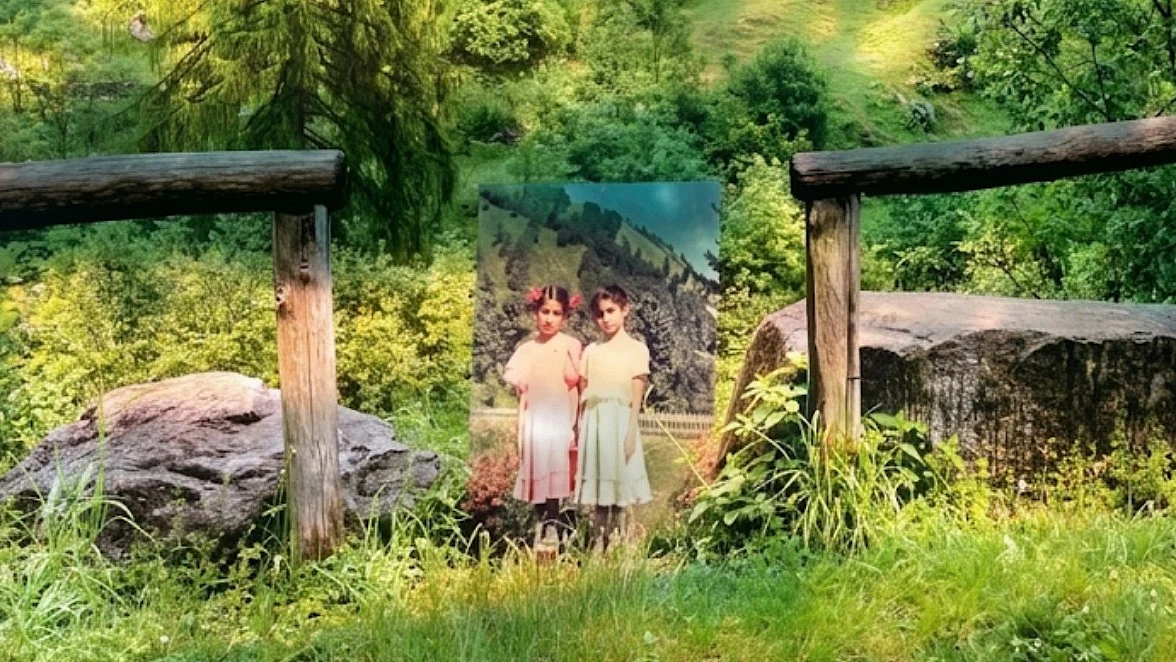
Khemka and Kokiloo approach this history through the intimate rather than the monumental. Archival photographs from family albums are set into staged portraits made during a Pro Helvetia, New Delhi-supported residency in Verzasca, Switzerland, a landscape that echoes Kashmir. One geography stands in for another, and the distance between them becomes the subject.
The strongest gesture is also the simplest. Old album pictures, printed as small acrylic panels, stand in the Swiss grass or lean against a rock like visitors from another time. In one, two girls stand between boulders and a wooden rail, one in a green frock, the other in pink with red ribbons. Here staging becomes remembering: the viewer must supply what is missing, as families do when retelling a story from an album. Such pictures preserve what official histories leave behind: a gesture, a gathering, the unselfconscious happiness of an ordinary day.
Other artists take a different route. At this year's Venice Biennale, India's pavilion, Geographies of Distance: Remembering Home, includes a work in which an artist's demolished family home in Delhi is reconstructed in embroidered thread. It rebuilds the lost house itself, stitch by stitch. Khemka and Kokiloo borrow another landscape instead. Both admit that home cannot be recovered as it was; they differ in how much weight the substitute can bear.
The Inverted Mantra: Reena Saini Kallat’s Spectral Frequencies And The Sound Of What We’ve LostYet the idea is stronger than its execution. The Swiss valley is so lush and photogenic that the distance never quite hurts, and the handsome mirrored portraits mostly feel composed. A contact-sheet wall repeats one father-and-daughter pose across near-identical frames, and the variations are too slight to carry meaning. The wall text promises tension, detachment and a challenge to the "happy family" cliché. A few frames deliver it, notably a portrait in which a girl stares out while the adults look away from a ruined wall. But the question of whether Kashmir's beauty can be separated from its violence is asserted rather than felt, because nothing in these images carries the violence.
The artists describe this as the first part of a three-part series, moving next into folktales and then abstract performance. The title asks whether a wounded place can recover its music. But the exhibition leaves the question largely where it found it.
To preserve a fragment is to refuse its disappearance. The past cannot be undone. It can, however, be remembered, its fragments gathered and given somewhere to survive. Often, that is where art begins.
(Sonal Motla is an Art Educator & Curator)
This content is published by Free Press Journal and has not been created or edited by Hello Headlines. View original