Oh! Shillong!
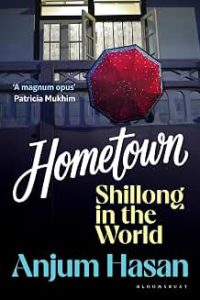
A book review by Glenn C. Kharkongor Hometown by Anjum Hasan Bloomsbury India 2026 456pp Rs 899
Hometown is a perceptive and affectionate, yet plain-speaking account of our city. Strands of history, literature, and homespun truths ravel together in a telling way. It bridges the past to the present, and leaves us there. Like the creaky Ward’s Lake bridge, now unsafe, waiting hopefully for repair and renewal.
Every page rings true. The truisms in this account take us from folktales to modern day allegories. Or as Margaret Lyngdoh puts it, “urban legends,” on wealth, jealousy, and unrequited love, that take their antecedents from the thlen and ka Likai stories. Does anyone know of a Khasi folktale that has a happy ending?
The many stories in the book, are ferreted from old tomes, elderly citizens, and her young contemporaries who are struggling to eke an existence in this unforgiving, hardscrabble city. Cutting through the eons of time and the lived experiences of generations, Hometown assembles a palimpsest of neighbourhood lore. But the past lurks close to the surface, in a way that only Shillongites know.
Anjum Hasan is the quintessential insider-outsider, a kindly interface with the world beyond the Chicken’s Neck. Many books of this ilk have immigrant stories, of strangers and transients. But the nuances of this book will be intelligible only to the local. To the casual tourist, as they all seem to be, Shillong yields its real self unwillingly, the vacationer goes back home only with anecdotes of natural beauty and women who rule.
In a matrilineal society, women are prominent protagonists. As so it is in this book. As the author says, “Shillong is in many ways a women-driven society, where women can still have a hard time”. This seeming contradiction gets it so right. Many women have paid a tragic price for matriliny, with all its purported advantages. The chapter named Desire has all too familiar stories of star-crossed double-crossed young women, abandoned with toddlers in tow.
The history and habitus of Shillong are inextricably bound to colonialism, with layers of the military, the missionary, and the musician. The lurid stain of colonialism entered our belief system, our culture, and our genes. War, poverty, and handouts made us beholden to the colour white. WWII was a party, the Tommies and Johnnies making merry with the local populace. But the main partygoers left long ago, leaving imprints that have lasted for generations. No other hill station suffered these consequences. “Shillong in the World”? There’s not much of that, but plenty of the world in Shillong.
The inexorable ingress of colonialism, proselytization, a world war, and non-tribals of many hues changed  the nature of the hill people. Add to that, our own traditions and politics at cross-purposes, rival and revival religious denominations, the despoilation of the environment, and the landscape of our hills has been desecrated forever.
Take myself, even though I was born elsewhere and came to live in Shillong only at the age of 56, the long fingers of Shillong had already given me my religion, my education, my predilections, and even my name. None of it was my choice. I too, am a child of the party-goers. You can’t take Shillong out of the boy.
As one sojourner put it, Shillong is an enchanted forest and a fool’s paradise. At once flippant and harsh, it has a measure of truth. It’s in a chapter titled Utopia, but the promise remains unfulfilled.
We seem besotted with culture, religion, and performative social theatre, at the cost of the substantive. Perhaps in some future, there will be Camelot, even for one brief shining spot.
Beneath the gloss, glitter, and glitz of festivals, and five-star hotels, is a seamy underbelly of coal, drugs, trafficking. Youth who dodge these bullets face unemployment, poverty, and despair. Our mixed-up history has given us more caricature, less character. Would tribals have done better, if, according to Nehru’s Panch Sheel, they were allowed to “develop according to their own genius”?
This book will open many conversations and conclude most debates. She has read, she has listened, she has astutely connected the dots. Anjum has probed the ins and outs of every lane and locality. In a heartfelt, hardnosed way, the book says it all.
I opened the book one misty, chilly morning, ensconced warmly under a duvet. Outside my window, a magpie robin sang its fluty notes from a myrtle tree. The reading began with a song. I closed the book with a sigh.
This content is published by The Shillong Times and has not been created or edited by Hello Headlines. View original