Opinion: Telangana’s decade of growth and fiscal prudence under Dr GR Reddy
By J R Janumpalli
The formation of Telangana on June 2, 2014, marked the beginning of one of the most closely watched experiments in State-level economic governance in India. As a newly created state, Telangana inherited both significant opportunities and formidable challenges. On one hand, it possessed Hyderabad, one of India’s dynamic urban economies; on the other, it faced the task of restructuring the new State from the stagnation in the former Andhra Pradesh, building institutions, expanding infrastructure, meeting developmental aspirations, and establishing a sustainable fiscal framework for future growth.
Over its first decade of coming into existence, Telangana emerged as one of the fastest-growing State economies in the country. It witnessed substantial growth in income, tax revenues, public investment, infrastructure creation, agricultural support, information technology exports, and welfare delivery. While political leadership under Chief Minister K Chandrashekhar Rao (KCR) was central to this process, the role of financial and policy advisers was equally important.
Among them, Dr GR Reddy occupies a high place. As the financial adviser to the Government of Telangana during this formative period, he helped shape the fiscal architecture that enabled the State to combine economic growth, welfare expansion, infrastructure creation, and financial discipline.
Fiscal Framework
The fiscal strategy adopted during this period sought to balance several economic growth objectives through a combination of revenue growth, disciplined budgeting, capital investment, and careful debt management.
Rather than viewing welfare and fiscal discipline as competing objectives, Telangana’s policymakers attempted to make them complementary. Strong revenue growth was visualised to support larger developmental expenditures while maintaining acceptable fiscal indicators.
The State began its journey with a revenue surplus of approximately Rs 369 crore in 2014-15. Despite undertaking large-scale expenditure programmes, Telangana continued to maintain revenue surpluses in most years until the unprecedented Covid-19 incidence.
Revenue Mobilisation, Tax Growth
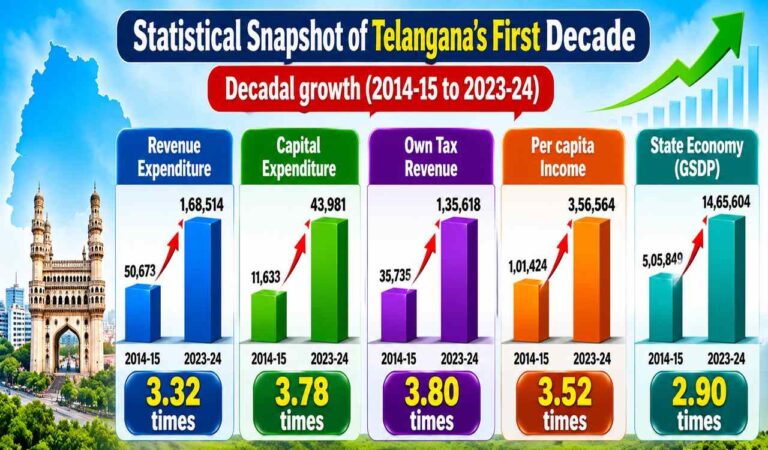
The foundation of Telangana’s fiscal performance was its remarkable growth in own-tax revenues. State Own Tax Revenue (SOTR) increased from approximately Rs 35,735 crore in 2014-15 to more than Rs 1,35,618 crore by 2023-24, a growth of 3.52 times within a decade.
Several factors contributed, including Hyderabad’s economic dynamism, the IT sector, expansion of pharmaceuticals and life sciences, urbanisation, real estate, improved tax administration and better compliance systems.
Strong revenue growth created the fiscal space required to support both welfare programmes and infrastructure investments. The development of a robust internal revenue base reduced dependence on external transfers and enhanced fiscal autonomy.
The economy as a whole expanded rapidly during this period. Telangana’s Gross State Domestic Product (GSDP) is estimated to have grown from roughly Rs 5 lakh crore at State formation to nearly Rs 15 lakh crore by 2023-24. Per capita income also increased substantially. Within a decade, it increased 3.52 times and remained significantly above the national average, making Telangana one of India’s higher-income States. In 2022-25, the State topped in per capita income.
Debt Management
Perhaps the most debated aspect of the State’s fiscal experience concerns public debt. Telangana’s GSDP-Debt ratio increased substantially from 2014-15 to 2023-24. Critics point to the growth in outstanding liabilities, while supporters emphasise the assets created through public investment. A balanced assessment requires examining debt relative to economic capacity rather than focusing solely on absolute borrowing.
Although debt ratios increased over time, it is also true that the economy itself expanded rapidly. Much of the borrowing financed productive assets and infrastructure rather than routine consumption expenditure. The fact that the State maintained revenue surpluses through most of the decade strengthens this argument, as it implies borrowings were largely directed toward capital formation.
A remarkable feature of fiscal management during 2014-15 to 2023-24 was that fiscal prudence was achieved alongside an unprecedented expansion of public expenditure. Revenue expenditure increased from about Rs 50,673 crore in 2014-15 to nearly Rs 1.69 lakh crore by 2023-24, reflecting the expansion of welfare schemes, education, health, agriculture and local governance. Simultaneously, capital expenditure rose from about Rs 11.633 crore to nearly Rs 44,000 crore, financing major infrastructure initiatives such as Mission Bhagiratha, irrigation projects, roads, power infrastructure and urban development. Importantly, these increases were accompanied by sustained revenue surpluses in most years, interrupted only by the extraordinary economic disruption caused by the COVID pandemic. This combination of higher welfare spending, substantial asset creation, and rational fiscal balances contributed significantly to Telangana’s reputation as one of India’s better-managed State economies during its first decade.
Contribution of Dr GR Reddy
Public attention naturally gravitates toward political leadership, but large-scale economic transformation depends equally on institutional design and financial stewardship. Dr GR Reddy, a distinguished economist, was mostly responsible for the positive outcome of the State’s economy. Dr Reddy’s contribution can be viewed in three dimensions.
First, he helped develop a coherent fiscal framework for a newly formed State. Second, he contributed to a budgeting approach that aimed to balance welfare expenditures with infrastructure creation and long-term sustainability. Third, he played a proactive role in building Telangana’s reputation for prudent financial management as observed by policymakers, investors, and economic observers.
While assessments of individual policies will continue to be debated, there is little doubt that Telangana’s first decade represents an extraordinary experiment in fiscal management and development strategy.
The partnership between the political leadership of K Chandrashekar Rao and the financial stewardship provided by Dr Reddy helped shape that experience. Researchers examining Telangana’s economic history are likely to view this period as a defining chapter in the State’s evolution, characterised by rapid growth, ambitious public investment, and an enduring emphasis on fiscal management.
(The author is a freelance journalist)
This content is published by Telangana Today and has not been created or edited by Hello Headlines. View original