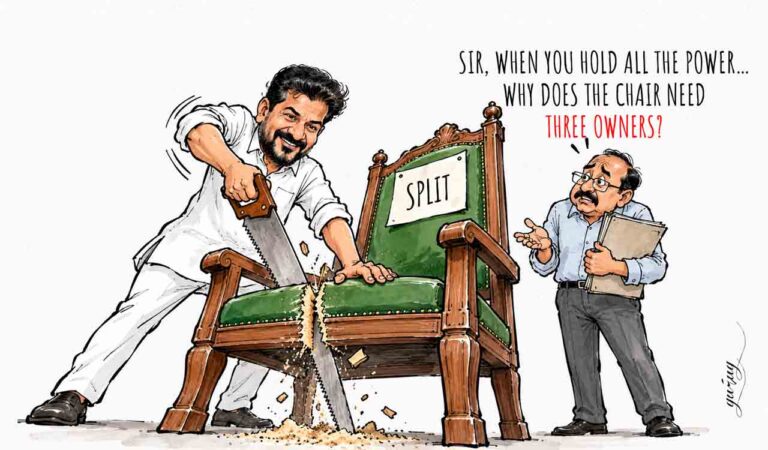
Telangana irrigation crisis raises questions over water management and project utilisation
Hyderabad: The Revanth Reddy government’s warning that irrigation water may not be available for the coming Yasangi season has raised questions about whether Telangana’s water crisis has been aggravated by the failure to utilise available river flows and existing infrastructure. But the real reason appears to be the Congress government’s determination to discredit the previous regime’s irrigation projects, which has taken precedence over farmers’ needs.
The El Nino impact and rainfall deficit is real. The State received 615.5 mm of rainfall against a seasonal normal of 740.6 mm during the recently concluded Southwest monsoon and recorded a deficit of 17 per cent. But Karnataka recorded a deficit of around 35 per cent, while Andhra Pradesh suffered a reported shortfall of over 29 per cent.
Yet Telangana faces restrictions on water-intensive cultivation during the coming Yasangi season, while Andhra Pradesh continued supplying its irrigation commands. Even the upstream Karnataka did not impose any restrictions on cultivation.
Weak inflows and El Nino conditions undoubtedly aggravated the shortage in Telangana. But the contrast with neighbouring States had left many wondering why did Telangana fail to make optimum use of available flows and its extensive irrigation infrastructure, while downstream Andhra Pradesh continued lifting and diverting water.
According to the State government, Krishna basin inflows stood at around 80 TMCft against an expected 270 TMCft, while Godavari inflows were about 100 TMCft against 150 TMCft. The combined shortfall was approximately 240 TMCft.
The latest aggregate figures put storage across 87 monitored major reservoirs in Telangana at 465.8 TMCft, or 43.97 per cent of their combined capacity of 1,059.3 TMCft. Andhra Pradesh’s wider water-resource network held about 503.74 TMCft against 1,161.357 TMCft of capacity, while Karnataka’s key monitored reservoirs held 256.63 TMCft against 535.44 TMCft. Though these datasets cover different reservoir networks, they underline the regional water stress. The key issue is how effectively each State responded to it.
Andhra Pradesh’s cautious approach
Official sources said Andhra Pradesh operated the Pattiseema lift scheme for about 100 days, diverting 65 TMCft of Godavari River water to the Krishna delta. It supplied irrigation to 13.08 lakh acres in the delta, used another 22 TMCft from the Nagarjuna Sagar Right Canal and delivered about 150 TMCft to the Godavari delta through Dowleswaram.
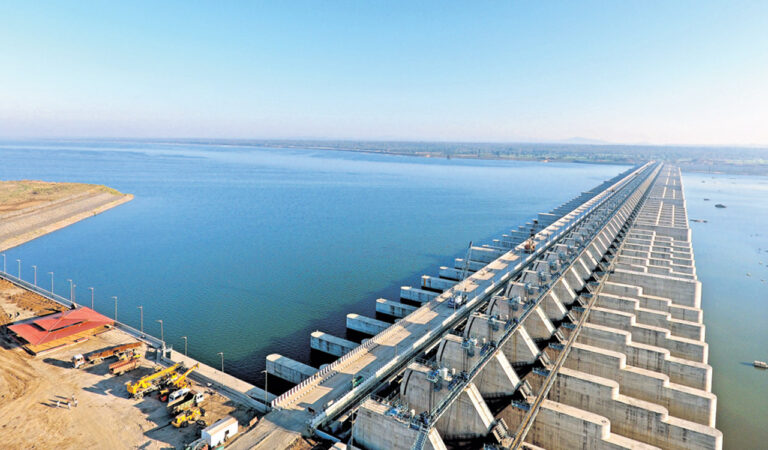
Pattiseema pumps were switched on on July 9. Inflows from Pranahita River at Medigadda stood at around 750 TMCft, which were allowed downstream without being lifted by Telangana. More than 58 TMCft reportedly flowed into the Sripada Yellampalli reservoir, of which Telangana utilised about 21 TMCft during the season.
Andhra Pradesh mobilised its lifting infrastructure, while Telangana’s farmers are being asked to curtail cultivation despite substantial flows reportedly passing through its river system. The comparison is not proof that every Andhra Pradesh command escaped distress, but it exposed a difference in operational response, raising question over how Andhra Pradesh moved to divert available Godavari water to sustain its irrigation commands, while Telangana failed to make fuller use of flows in its own river system.
Infrastructure, politics and delayed decisions
The Kaleshwaram Lift Irrigation Scheme illustrates the accountability gap. The Congress government kept key components idle amid concerns over the condition of the barrages, before resuming pumping through the Nandi system at Yellampalli in July. The limited resumption showed that parts of the inherited infrastructure could still be used, even as the government continued to criticise the previous BRS regime over Kaleshwaram.
The BRS repeatedly warned that failure to lift available water would jeopardise irrigation, particularly in erstwhile Palamuru and commands dependent on Krishna River. BRSLP deputy leader T Harish Rao questioned the government’s claims of utilising 280 TMC of Krishna water and demanded a white paper. He reminded that around 20,000 cusecs water was flowing at Kannepalli pump house as on Monday and lifting the water could ensure adequate drinking water. The party also demanded for operation of Kannepalli pumps and also those at Annaram and Sundilla to lift water, but in vain.
BRS leaders also alleged that Andhra Pradesh drew 664 TMCft against its claimed allocation of 512 TMCft, while Telangana utilised only about 20 per cent of its allocated 299 TMCft. They argued that concerns over damaged Medigadda barrage might justify restrictions on unsafe structures, but the government must explain why water could not be lifted through safe, operational components when conditions permitted.
Farmers bear the cost
Telangana has warned that irrigation cannot be assured for the coming Yasangi season and advised farmers to avoid water-intensive crops. However, Andhra Pradesh continues supplying its Krishna and Godavari delta commands without declaring comparable crop holidays in those areas. Even the upstream Karnataka did not impose any restrictions on cultivation.
The crisis is partly hydrological. But with Telangana recording a lower rainfall deficit than its neighbours while facing severe irrigation curbs, the government must establish whether delayed decisions and underutilisation deepened the shortage. Farmers facing the loss of a crop season deserve more than warnings about El Nino and criticism of the previous regime. They deserve an account of how the State managed the water it had, and what immediate measures it will take to protect their livelihoods.
This content is published by Telangana Today and has not been created or edited by Hello Headlines. View original