Opinion: CURE Bill 2026—reform or centralisation?
By Prof T Prabhakar Reddy
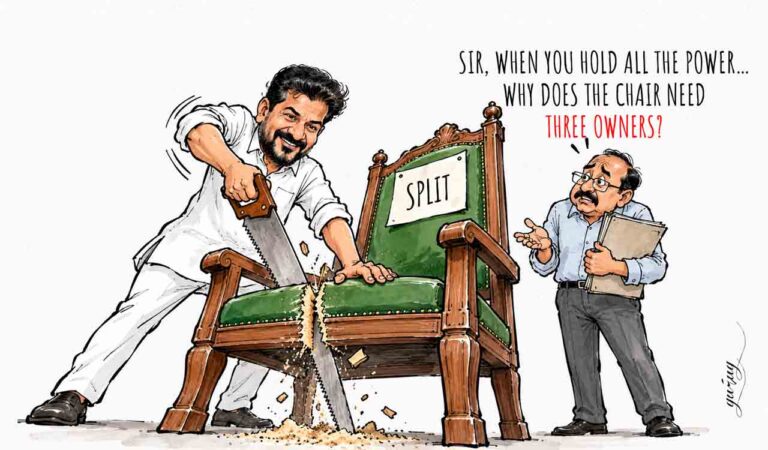
The Core Urban Region (Integrated Governance) Bill, 2026, known as the CURE Bill, was passed in the Telangana Legislative Assembly on September 12, 2026, to overhaul Hyderabad’s 70-year-old municipal framework. If the GHMC is divided into three municipal corporations—Greater Hyderabad, Cyberabad and Malkajigiri—based on a ‘decentralised framework’ with ‘independent governance’, it would be a welcome feature that would serve the purpose immensely.
However, integrating governance across the three corporations may pose practical challenges in coordination, planning, and service delivery, particularly given their previous failure to ensure basic civic amenities across all areas.
This would contradict the tenets of the 74th Constitutional Amendment Act, 1992, which argued that one can decentralise administration by dividing GHMC into three municipal corporations, devolving 18 powers (functional, financial, and functionaries), and giving them full freedom to function independently. As a result, the newly created corporations will run autonomously and efficiently, maintain close contact with local people, and ensure public participation.
Property Tax Reforms
Secondly, Article 243X of the Constitution leaves it to State legislatures to determine, by law, matters relating to the financial powers of municipalities, including the imposition of taxes. However, such changes should be preceded by consultations with the existing GHMC or the three proposed corporations, as well as deliberations involving the people.
The property tax reforms, as they claim, shift the focus from the Annual Rental Value System to a Capital Value System linked to market value. As a result, the property tax rate would increase, although the maximum annual hike is capped at 10 per cent, placing a significant burden on homeowners in Hyderabad.
Homeowners may pass on the additional costs to tenants through higher rents, making accommodation increasingly unaffordable for people with limited income. If rental demand declines because of higher rent, property owners may choose to sell their houses.
Concerns over property taxes, financial sustainability, civic services and local democracy demand wider public consultation and closer scrutiny of the Bill
Such developments could have far-reaching implications for Telangana’s economy. The real estate sector could also suffer if prospective buyers postpone or abandon property purchases, bringing construction activity to a standstill. Construction workers could lose their livelihoods, with an adverse impact on other related sectors of the economy.
These developments could also lead to the emergence of ‘ghost cities’, particularly given Hyderabad’s huge inventory of unsold flats. Some homeowners may also choose to sell their properties in Hyderabad and return to their native villages, where improvements in road connectivity, technology, internet access and other services may make rural living more attractive. Therefore, the proposed tax changes must be viewed from the perspective of a household/family at the micro level and the broader State economy at the macro level, taking into account their wider implications and complexities.
Democratic Governance
Thirdly, the central question is how the government can justify raising property tax rates without first ensuring the provision of basic civic amenities and establishing benchmarks for service delivery across all areas. Such a move is legally and morally indefensible, as no government has the authority to impose taxes without providing services to the people. Further, there is no consultation with the people, local leaders and representatives of Resident Welfare Associations, who play an active role in Hyderabad’s civic affairs.
Fourthly, the proposed Bill, when it becomes an Act, would result in the centralisation of powers and the erosion of local autonomy. The formation of an Apex Governance Council headed by the Chief Minister would lead to concentration of power, which is against the principles of ‘democratic governance’ and ‘decentralised administration’.
Further, the significance of Ward Committees will be diluted, and they will become null and void as the Bill does not adequately provide for their role. Similarly, there is no mention of the Standing Committees in the CURE Bill, which are critical to overseeing accounts, education, public health and sanitation, town planning, public works, taxation and finance.
Financial Sustainability
Critics have also questioned the government’s urgency in introducing the Bill, while failing to give equal priority to holding elections to Mandal and Zilla Panchayats and constituting District Planning Committees. More importantly, the financial sustainability of the three corporations presents a serious challenge. Under an integrated governance model, they may struggle to function equitably, given Hyderabad’s diverse urban landscape, resulting in disparities in the provision of civic amenities and inadequate financial resources.
Drawing on my research experience in the finances of Panchayats and Urban Local Bodies, I argue that Cyberabad is likely to sustain itself given its resource potential, while Malkajgiri may struggle to mobilise adequate resources. Greater Hyderabad, meanwhile, could face severe financial difficulties, particularly if it fails to collect the taxes proposed under the CURE Bill, 2026.
The solution, therefore, is to create decentralised corporations in true spirit and empower them to manage their functions and deliver services independently, rather than concentrating authority in a single body. The Bill risks becoming a fiasco if implemented in its present form, as it lacks sustainability in raising resources, planning and managing critical services such as drinking water supply, drainage, internal roads and waste management.
Finally, it would be appropriate if the government revisits the contents of the Bill and brings about necessary changes after conducting direct consultations with residents across all three proposed corporations.
(The author is social policy expert, UNICEF, Bangkok, and ROSA, Nepal, and a development economist based in Hyderabad. He is a former Senior Advisor [Research and Training] at Dr MCR HRD Institute of Telangana, Hyderabad)
This content is published by Telangana Today and has not been created or edited by Hello Headlines. View original