A Sal Leaf, Some Clay & a Water Conservation Lesson: How Odisha’s Children Are Learning From the Forest
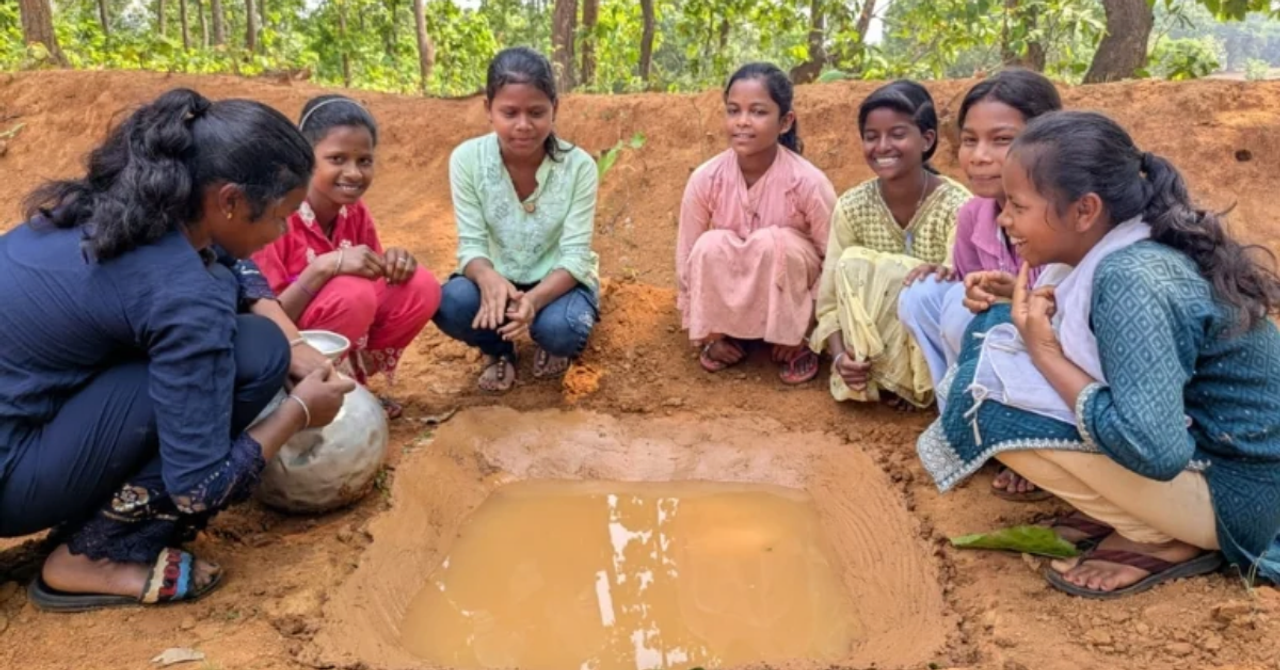
A curled leaf, a handful of clay and a shallow depression in the earth have become the starting point for an unusual water conservation experiment in the forests of Keonjhar district. The idea is: can children learn to hold on to water by observing how nature does it?
A lesson hidden in a leaf
On a walk through the dry forest slopes around Haladipani, a village in Odisha’s Keonjhar district a local elder stopped beside a curled sal leaf. Inside its cupped surface, a thin film of dew had collected, holding on to moisture even as the surrounding ground dried in the heat.
For the children accompanying him, it was a small observation with a larger question behind it. If a leaf could catch and retain a little water, could they recreate that ability on the ground, where water was harder to come by?
The elder, known locally as the ‘jungle master’, encouraged them to try. Instead of using plastic sheets or manufactured containers, the children began experimenting with sal leaves and clay to make small pits that could collect and retain water.
View this post on Instagram
The experiment was documented by Biswabijayini Mohanty in a report published by Village Square on 16 September 2026, titled A Lesson in Water Conservation from a Leaf. The report describes how an observation made during a forest walk developed into a practical exercise in water conservation, with the children learning through trial, error and close attention to their surroundings.
How the children made the pits
The children dug shallow depressions near the forest edge using simple tools, sticks and their hands. But they soon encountered a problem: the loose soil absorbed the water poured into the pits before it could remain there for long.
The jungle master helped them rethink the design.
First, they laid broad sal leaves across the bottom and sides of each depression, overlapping them like roof tiles. They then spread clay soil over the leaves, pressing and smoothing it until the hollow took the shape of a shallow bowl.
The two materials served different purposes. The leaf layer helped support the clay as it dried, while the compacted clay formed a lining intended to slow the movement of water into the surrounding soil.
The children repeated the process, allowing the clay to set before filling the pits. Within about two weeks, they had created a network of small water-holding depressions along the forest edges. According to Village Square, the pits were generally no deeper than a forearm and rarely wider than a large dining plate.
There was no plastic lining, costly equipment or elaborate construction involved. The materials came from the landscape around them, and the method evolved through observation and experimentation.
When the rains put the idea to the test
The pits were intended to hold water during the dry months. But after several days of rain, runoff carried loose soil down the slopes, turning surrounding water sources muddy. The pits, however, appeared to retain relatively clearer water.

The explanation lies partly in the way water behaves when it is allowed to settle. Rainwater flowing over exposed ground can carry suspended particles of soil and other sediment. When that water collects in a relatively still depression, heavier particles can gradually settle at the bottom, leaving the water above them less cloudy.
The report also records visits by wildlife, including barking deer, rabbits, mongooses and squirrels, which were seen drinking from the pits.
There is an important distinction, however, between water that looks clear and water that is safe to drink. The report does not provide laboratory test results establishing the potability of water collected in these pits.
What science tells us about sal leaves and water
The principle behind the experiment has parallels in traditional agricultural practices documented elsewhere in Odisha
A study compiled by Dr Prasanta Kumar Mishra, a principal scientist at the Central Research Institute for Dryland Agriculture, describes how tribal farmers in Pakanagaon village in Kandhamal district use sal leaves as mulch in turmeric fields. The account, published by LEISA India, notes that farmers spread a layer approximately 20–25 cm thick over their fields before the monsoon. The leaf cover helps conserve soil moisture, reduce runoff and soil loss, suppress weeds and protect the soil from the direct impact of raindrops.
Mulching works by covering the soil surface, reducing its exposure to direct sunlight and wind and helping slow evaporation. It can also reduce the force with which raindrops strike the ground, limiting the displacement of soil particles. Depending on the soil and rainfall conditions, this cover can allow more water to remain available in the soil.
The Haladipani experiment uses sal leaves differently: rather than spreading them over agricultural land, the children place them beneath a compacted clay lining in small depressions.
Both of these practices show how locally available sal can be used to manage moisture and soil.
The children are not simply being told that water is scarce or that forests must be protected. They are being encouraged to observe a leaf, understand what it does, test an idea and learn from what happens next.
It is a practical starting point for environmental learning.
Sources:
‘Farmers’ practices of improving soil health by mulching in semi-arid india’: By Dr Prasanta Kumar Mishra
‘Ground Report-A lesson in water conservation from a leaf’: By Biswabijayini Mohanty, Published on 16 September 2026
This content is published by The Better India and has not been created or edited by Hello Headlines. View original