‘Workers Were Risking Their Lives’: The Nagpur Architect Fighting for Their Safety, Toilets & Rights
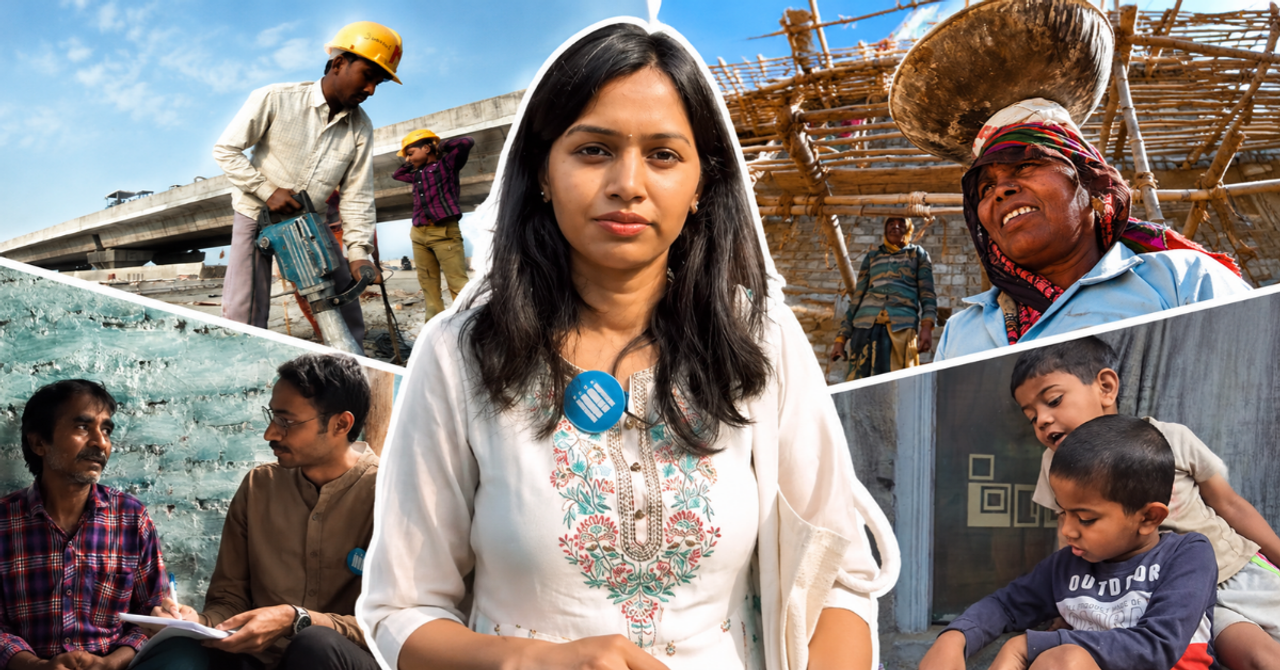
When architect Samruddhi S Chaphale took a group of construction workers to a park in Nagpur for yoga, their smiles stayed with her.
“One day, I took some of the workers to a park in Nagpur and got them to do yoga,” she recalls. “I could see how relaxed they became. There was a small smile on their faces, and that stayed with me.”
She had met workers who spent their days worrying about wages, their families and the dangers of their jobs. That visit made her consider how rarely anyone asked about their wellbeing.
“I realised that many of them had never really stopped to celebrate their own lives. They were constantly thinking about work, earning their daily wages and getting through the day. Earlier, their attitude was often, ‘Just give us the kit and let us go. We don't need anything else.’ But I realised they needed much more than a safety kit. They needed someone to ask how they were doing.”
For Chaphale, founder of the Nagpur-based Levellers Foundation, this was a turning point. She began looking beyond the buildings she was trained to design, towards the people building them.
When danger feels like part of the job
Her concern began on construction sites, where she saw people working on roofs and at heights without adequate protective equipment. At first, she believed explaining the risks would help.
“I realised that something was seriously wrong and extremely risky,” Chaphale tells The Better India. “I would see workers doing roofing work without safety kits. Initially, I thought it was simply a matter of explaining to them why they needed the equipment. I would tell them to wear their safety gear, but many of them were not willing to. They would just say, ‘Give us the kit and we will leave.’”
As she spoke to more workers, she understood that providing equipment was only one part of the problem.

“They had become so accustomed to risk that they had stopped thinking about their own safety. It wasn't that they didn't understand that something could go wrong. It was almost as if they had accepted that this was how their lives were going to be.”
Chaphale is an architect, educator and advocate for socially responsive design. Through Levellers Foundation's Project Salamati, she works with architects, doctors, activists and community organisations to address the lives and working conditions of construction and garden workers.
A helmet helps protect a worker's head, but it cannot provide a toilet at the site. Gloves cannot ease years of back pain, and a safety briefing cannot resolve anxiety about wages or housing. Salamati's approach grew out of listening to these connected concerns.
When pain threatens a day's earnings
Construction workers lift, carry, bend and climb for hours. Over time, repetitive work and injuries can leave them with aching backs, damaged joints and fatigue. For someone who earns through physical labour, pain can mean missed work and less money at home.
A 2016 study in the Indian Journal of Occupational and Environmental Medicine identified musculoskeletal disorders as a major occupational health concern and described them as the largest cause of work-related illness.
There were burdens Chaphale could not see as easily. She knew of a construction worker whose wife had died. He still had to earn while dealing with loss and the responsibility of feeding his family. The site, and the need for an income, carried on.
Mental health became an essential part of her work.
A 2016 study of 404 male construction workers in Kolar, Karnataka found that 27.5% had probable psychological distress and 14.6% reported poor quality of life. The lowest scores concerned their surroundings, including living conditions, healthcare and recreation.
In a 2023 study involving 75 migrant construction workers in India, researchers identified 64% as potentially needing psychosocial care. Among those surveyed, 83% reported feeling unhappy and nervous, 75% had sleep disturbances, 71% struggled to think clearly and 69% felt tired or had frequent headaches. Thirty-nine percent reported having thought about ending their lives.

These were small, specific groups, so their findings cannot represent every construction worker in India. They do, however, point towards pressures that discussions about workplace safety can miss.
Chaphale says Salamati's own screenings revealed distress too. “In one of our screenings, more than 80% of the workers screened positive for depression,” she says. “One male worker was severely depressed.”
“They are dealing with physical pain, financial pressure, uncertainty, migration, difficult living conditions and the constant pressure to keep earning. We talk about whether they have helmets and gloves, but we also need to ask whether they are mentally okay.”
The questions women were beginning to ask
For women on construction sites, Chaphale encountered concerns around washrooms, working hours, menstrual health and clothing.
“I would see women working on construction sites where there were no proper washrooms,” she says. “Some of them were working late into the night. They wouldn't necessarily complain about it because they had already accepted those conditions as normal.”
“I realised that sometimes I had to speak to the contractors because the workers themselves would not. They had normalised these conditions so much that they didn't always feel they could question them.”
Conversations about menstrual health required patience and trust.
“There was almost no awareness around menstrual health among many of the women workers I interacted with,” Chaphale says. “It was not simply about giving them information. We had to sit with them, talk to them patiently and understand their circumstances.”
View this post on InstagramA post shared by Levellers Foundation (@levellersfoundation)
She also spoke to women who wore sarees while working.
“I remember having conversations with women who were working in sarees and explaining that while a saree is what they are comfortable wearing, it may not always be practical or safe for certain kinds of physical work. I would tell them, ‘Please consider wearing something that gives you greater mobility and safety, because your clothes can also become a risk at a construction site.’”
She knew these discussions had to begin with understanding the workers' choices and circumstances.
“You cannot walk into a community and tell people that everything they have been doing is wrong. You first have to build trust and understand why they do things the way they do. Once that trust develops, they start asking questions themselves.”
Soon, some women wanted her to reach others in their neighbourhoods.
“They started telling me, ‘Please come to our jhopadpattis [informal settlements] and talk to the other women too.’ That was important for me because it meant that they were no longer just receiving information from us. They had started recognising these issues themselves and wanted other women to know about them.”
A safe place to live, and someone to care for the children
Many workers Chaphale met had migrated to Nagpur and other cities from states including Madhya Pradesh and Bihar. Uncertain employment often went hand in hand with insecure housing.
“They are migrant workers, and many of them live with the constant uncertainty that they could be asked to leave their settlement at any time,” she says. “When you don't have secure housing, you are constantly fighting for your rozi-roti [livelihood]. You are thinking about where your family will sleep, and whether you will still have work tomorrow.”
India has a system of welfare boards for building and other construction workers, with protections now covered by labour codes that took effect in November 2025. According to the Union Labour Ministry, around 5.7 crore workers were registered with state and Union Territory welfare boards as of 30 June 2024. The boards had collected approximately Rs 1.15 lakh crore in cess and spent more than Rs 66,000 crore on benefits.
But reaching those benefits can be complicated.
“It is not enough to tell someone that a government housing scheme exists. We have to help them understand whether they are eligible, what documents they need, how they can register and what the process actually looks like.”
Levellers Foundation has worked with organisations such as YUVA to build awareness of welfare schemes, housing programmes and land rights, and to help workers register with Building and Other Construction Workers welfare boards.
“For them, registration can become a gateway to a number of benefits,” Chaphale says. “But if they don't know that these schemes exist or don't know how to access them, then the scheme might as well not exist for them.”
The foundation is also exploring childcare support.
“We are now looking at a creche for the workers' babies because childcare is another issue that people don't think about. If both parents are working on construction sites, what happens to their small children? These are all connected problems.”
‘Their lives matter’
One conversation with a 70-year-old worker showed Chaphale how deeply some workers had learnt to live with danger.
“I once spoke to a 70-year-old worker about wearing safety equipment,” she recalls. “I told him that he had to wear a safety kit because the work he was doing was dangerous.”
“He told me that he knew a friend who had fallen from a high-rise building and suffered a devastating head injury. And then he simply said, ‘It is okay. These things can happen.’”
“There is a kind of nonchalance that comes from living with risk for so long. They start believing that accidents are simply part of their lives. They don't always feel that their own lives are important enough to protect.”
Salamati is trying to challenge that acceptance of danger, while recognising that workers need support well beyond a construction site.

“We want them to understand that their lives matter. Their health matters. Their safety matters. They deserve to go home safely to their families. They deserve healthcare, decent working conditions, housing and knowledge about their rights.”
A completed building may reveal the ambitions of a growing city. Its design shows how people will live and move within it. Behind it are the temporary shelters, missing toilets, workers balancing childcare and wages, ageing bodies still doing demanding work, and families unsure how long they can stay where they live.
For Chaphale, the people who build India's cities deserve the same attention as the spaces they create. Their safety, health and dignity matter long after the building is finished.
This content is published by The Better India and has not been created or edited by Hello Headlines. View original