How Zocket is building the brain behind enterprise marketing
For the last three years, enterprise AI has been told one story: pick the most powerful model and you win. Every launch brought a new benchmark, a bigger context window, and a sharper reasoning score. Boardrooms debated which model to bet on as if it were a once-in-a-decade infrastructure decision.
That story is running out of road. The gap between the leading models is narrowing every quarter, and most enterprises can now access near-frontier intelligence through a single API call. When everyone has access to the same brain, the brain stops being the advantage.
The next battle in enterprise AI will be won in context: the proprietary knowledge, history, signals and judgement that tell a model what your business actually needs. Models are becoming the engine. Context is becoming the fuel, the map and the destination.
The model is becoming a commodity
Consider how quickly the landscape has shifted. A capability that felt magical 18 months ago, such as summarizing a 100-page contract or writing production-ready code, is now table stakes across multiple providers. Open-weight models have closed much of the gap with proprietary ones. Inference costs keep falling. Switching from one model to another, once a painful migration, is increasingly a configuration change.
This is the classic arc of any foundational technology. Electricity, cloud computing and bandwidth all followed it: a period of scarcity and differentiation, followed by abundance and standardization. Nobody today wins because they have a better power supply. They win because of what they build on top of it.
For enterprise leaders, the implication is uncomfortable but liberating. If your AI strategy rests mainly on which model you chose, your competitors can replicate it in a weekend. A durable advantage has to come from somewhere else.
What ‘context’ really means
AI models are powerful, but intelligence alone is not enough to understand how an enterprise operates. What makes AI genuinely useful is the context surrounding every decision: the brand, its customers, its business priorities, and the processes that govern how work gets done.
For enterprise marketing, context goes beyond feeding information into a model. It means connecting four critical layers of intelligence:
Data context: Customer behavior, campaign performance, product information, consumer interactions, and historical trends. These signals help AI understand what is working, what is changing, and where opportunities exist.
Brand and institutional context: Brand guidelines, tone of voice, positioning, compliance requirements, past decisions, and business priorities. This is the knowledge that ensures every AI-generated action reflects the organization it represents.
Workflow context: Understanding how marketing operates across teams, from creative development and campaign execution to approvals, governance, and reporting. AI needs to recognize not just what to do, but how decisions move through an organization.
Real-time context: Consumer sentiment, emerging market trends, competitor activity, and live campaign performance. This allows AI to respond to changing conditions rather than relying entirely on historical information.
The challenge is that most AI tools operate with only fragments of this intelligence. A creative tool may understand brand guidelines but lack campaign performance data. A media platform may optimize spending without understanding consumer sentiment. A research tool may identify emerging trends without connecting those insights to the next marketing decision.
The result is fragmented intelligence across an increasingly connected marketing ecosystem.
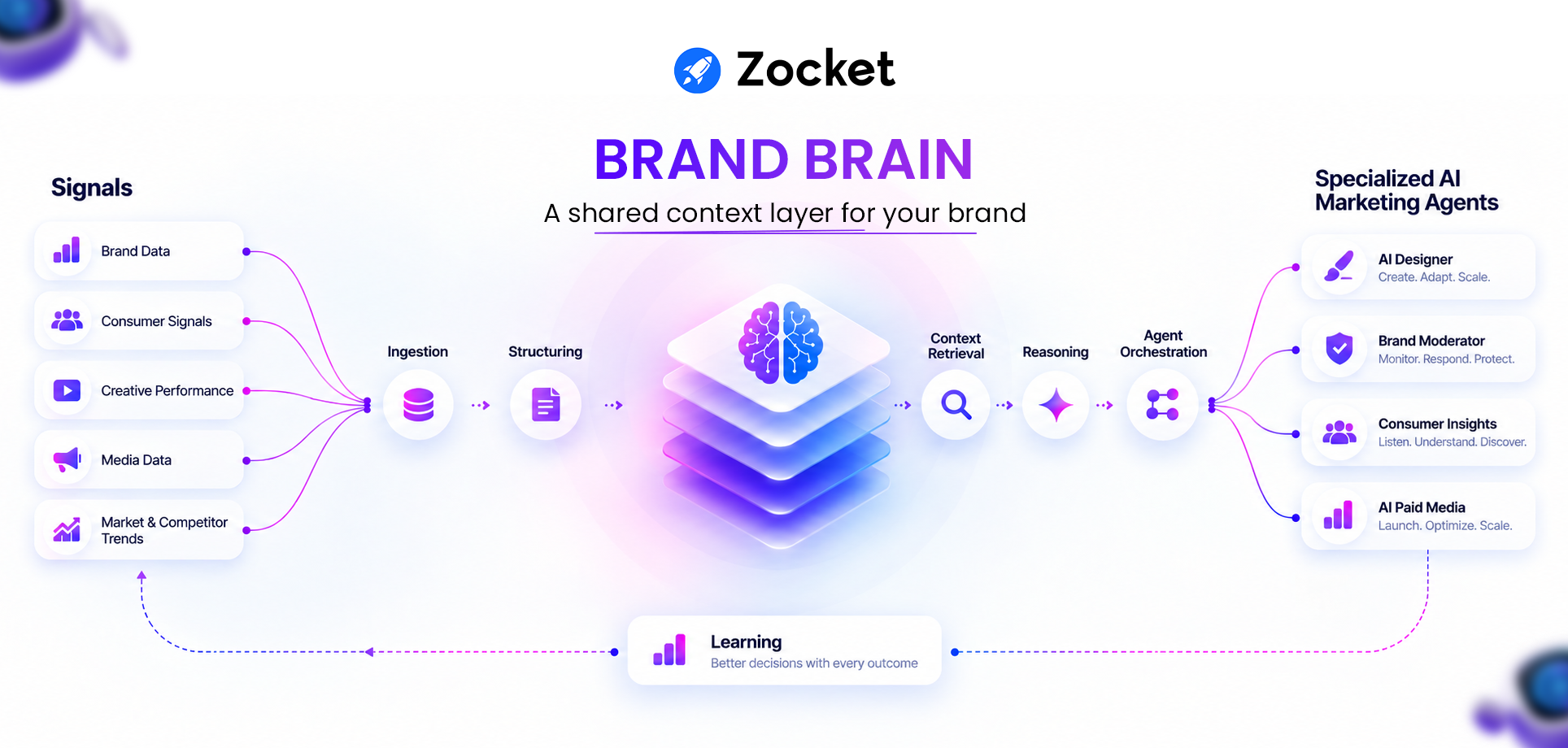
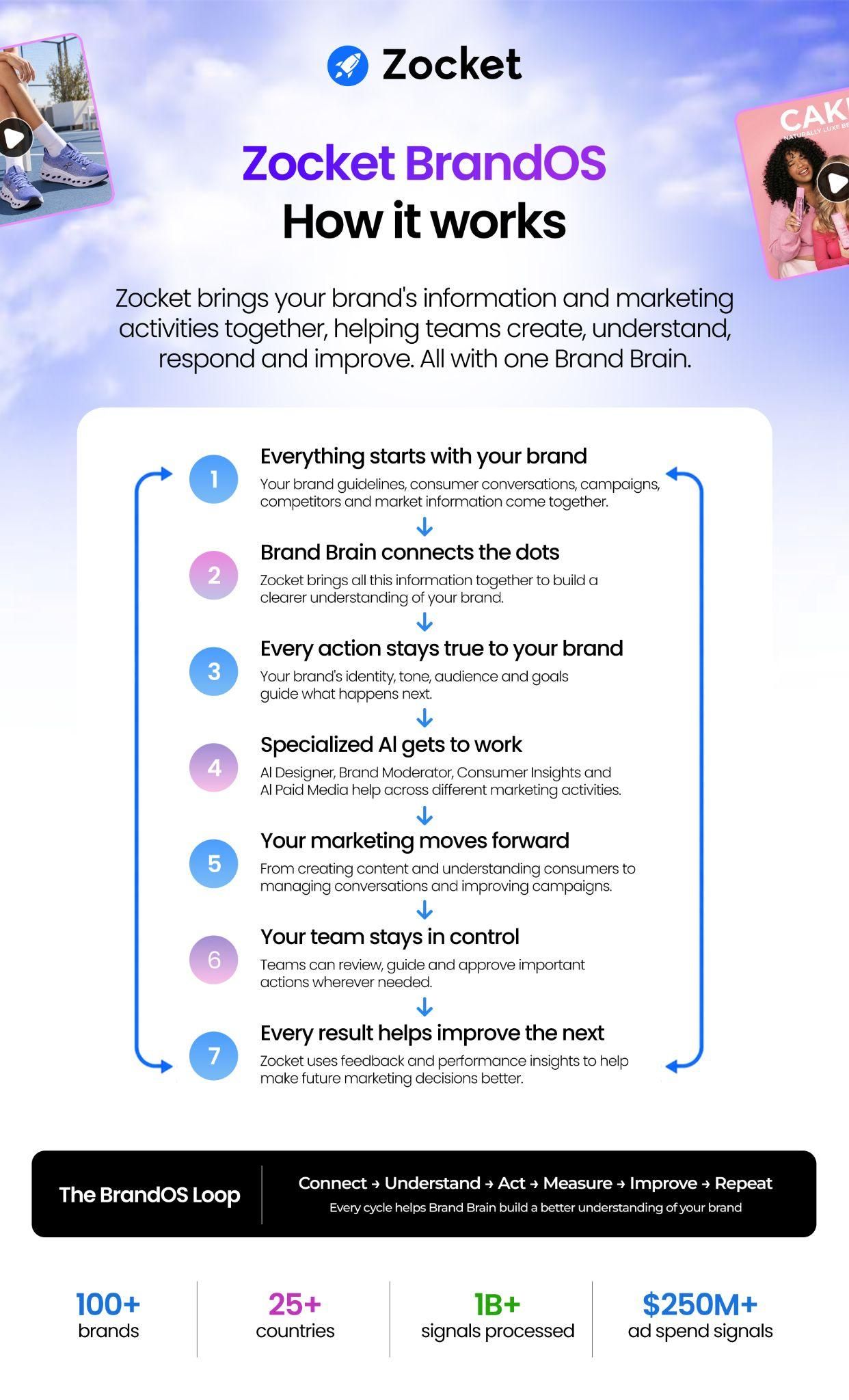
This is where Zocket's Brand Brain introduces a different approach. Rather than treating every marketing function as an isolated AI workflow, Brand Brain brings brand knowledge, consumer intelligence, performance signals, and governance into a shared context layer that powers specialised AI marketing capabilities.
The underlying principle is simple: AI becomes more valuable when it understands not just the task it has been asked to perform, but the business behind it. For enterprises, that is the shift from AI that generates outputs to AI that can support informed, consistent, and connected marketing decisions at scale.
Why context is the moat that lasts
Models can be bought. Context has to be built, and that is precisely why it is defensible.
First, context is proprietary by nature. No competitor can download your ten years of customer interactions or the hard-won lessons of your last hundred campaigns. Second, context compounds. Every decision an AI system makes, and every outcome it observes, becomes a new context that sharpens the next decision. An organization that starts capturing this loop today will be meaningfully ahead of one that starts in two years.
Third, context is hard. In most enterprises, valuable knowledge is scattered across CRMs, spreadsheets, ad platforms, email threads and the heads of a few senior employees. It is siloed, inconsistently labelled, and often outdated. Getting it into a form an AI system can reliably use requires investment in data infrastructure, governance and integration, work that is unglamorous but decisive.
This is why so many enterprise AI pilots look impressive in a demo and disappoint in production. The model was rarely the problem. The missing piece was context: the system simply did not know enough about the business to make the right call.
"Enterprises often ask us which model is best. The better question is how quickly your systems can turn scattered data into something an AI can trust and act on. The model is the easy part to swap. The context layer, with its integrations, retrieval and feedback loops, is what takes real engineering, and it is where performance is won or lost," says Mukund Srivathsan, Co-founder and CTO, Zocket
A view from marketing and advertising
At Zocket, this shift is seen most clearly in marketing, where AI adoption has been fast and the cost of generic output is immediately visible.
Any model today can generate an ad headline, a product description or a campaign plan in seconds. But a generic headline is not a good headline. A good one reflects the brand's voice, speaks to a specific audience segment, learns from which creatives converted last month and adapts to what is trending on each platform this week.
The difference between an ad that performs and one that burns budget is almost never the raw writing ability of the model. It is the context behind the prompt.
The same is true for budget allocation, audience targeting, and performance optimization. An AI agent that understands a brand's historical cost per acquisition, its seasonal patterns, its margins and its competitive landscape will consistently outperform a more powerful model working blind. The biggest gains for marketers come not from upgrading the model but from enriching what the model knows.
This is why Zocket believes the future of AI in marketing is agentic and context-rich: systems that continuously learn from a brand's own data and outcomes, rather than tools that start from zero with every request.
"Every brand now has access to the same AI. What it does not have is the same understanding of its customers. Our focus at Zocket is helping businesses turn their own data and results into an AI that gets smarter about them every single day. That is the advantage nobody can copy,” says Karthik Venkateswaran, Co-founder and CEO, Zocket
What enterprise leaders should do now
If context is the new battleground, the playbook changes. Five priorities stand out.
Treat context as a strategic asset. Audit where your most valuable knowledge lives and who owns it. Customer data, performance history, and institutional rules deserve the same rigour as financial data.
Stay model-agnostic. Build architectures that let you swap models as the market evolves. Lock-in to a single model is a risk; lock-in to your own context is an advantage.
Close the feedback loop. Design AI systems that capture outcomes, not just outputs. Knowing which recommendation worked, and why, is what makes context compound over time.
Invest in the plumbing. Data integration, retrieval systems, governance, and access controls are not back-office chores. They are the foundation of AI performance.
Encode judgement, not just data. Capture the rules, guardrails, and preferences your best people apply instinctively, so AI can apply them consistently at scale.
The winners will be the ones who know the most
The first chapter of enterprise AI was about access: who could get their hands on capable models and put them to work. That chapter is almost at an end. The next one will be about understanding whose AI knows their customers, their markets, and their own business most deeply.
In that world, the question in the boardroom shifts from "Which model are we using?" to "What does our AI know that nobody else does?" The companies with a compelling answer, built on rich, connected, and continuously improving context, will set the pace for their industries.
Models will keep getting better, and that is good news for everyone. But because they are getting better for everyone, they cannot be what sets you apart. Context can. The enterprises that start building it seriously today will not just use AI more effectively. They will own an advantage that no model upgrade can buy.
To learn more, visit www.zocket.com
This content is published by YourStory and has not been created or edited by Hello Headlines. View original