antimattr is building voice AI wearables that cut through the noise
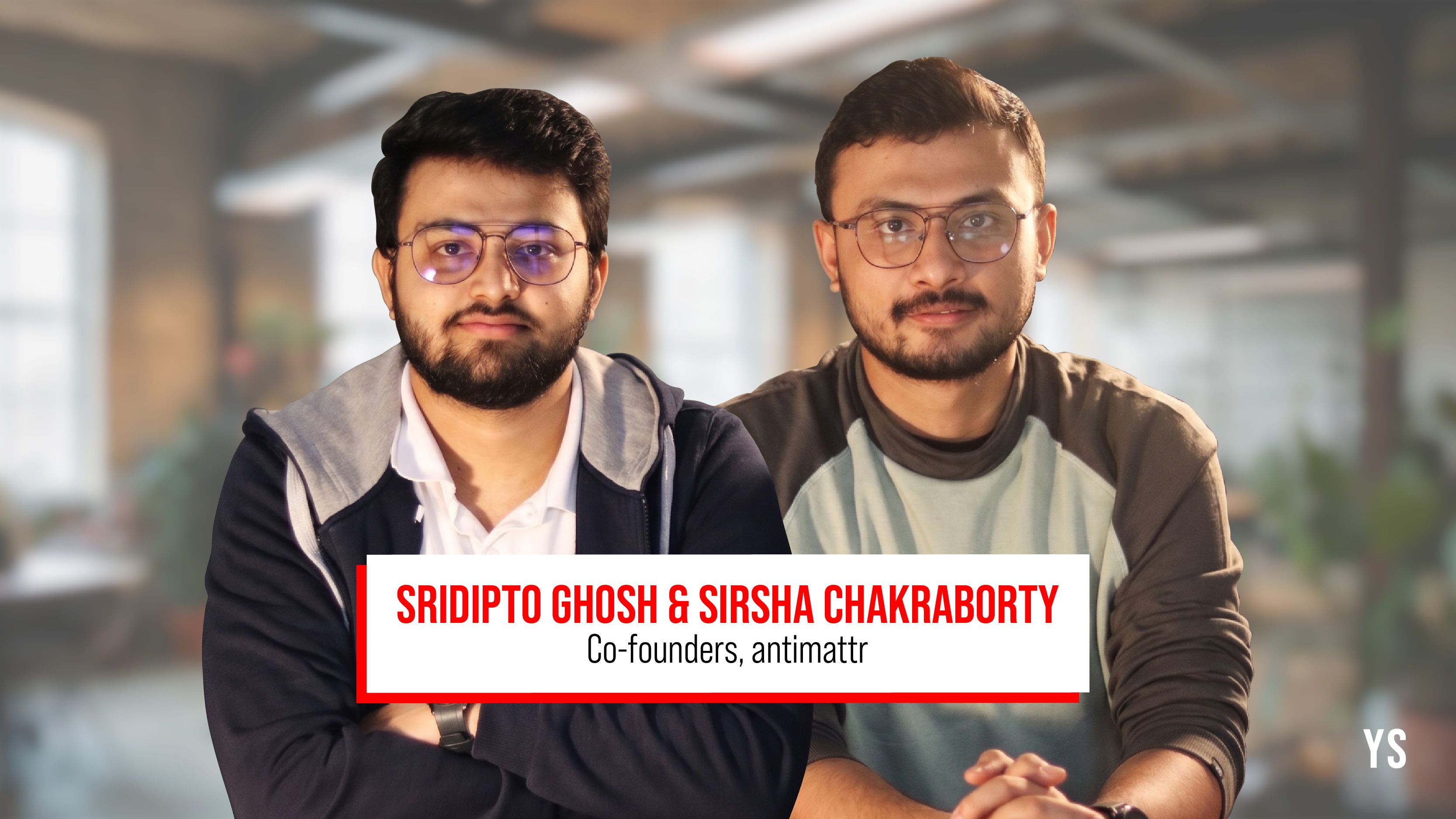
When Sridipto Ghosh and Sirsha Chakraborty were developing the thesis for their startup, many advised them against venturing into hardware. But this didn’t deter them.
“People said it was hard, that there were large companies in the hardware space, and that it was very difficult for a startup to build in this space. We continued building despite those perceptions,” says Ghosh.
Their persistence eventually led them to start antimattr in 2025. The deeptech company is building a voice-first hardware interface for human-agent interaction that summarises conversations with clarity even in noisy environments.
The conversations could be with anyone. Users can dictate to the wearable device directly or let it listen to a conversation with another person (offline or online). The technology would be able to pick up the conversation clearly despite ambient noise, says CEO Ghosh.
He says its early incubation at Scaler Innovation Lab helped the startup get off the ground. “It gave us access to prototyping equipment such as 3D printers and soldering stations, which made it easier to iterate and keep developing the idea."
The name ‘antimattr’ comes from the philosophy of challenging common notions or what people are generally taught. This year, the San Francisco-based startup was selected for Y Combinator’s current cohort, becoming the first India-origin wearable company backed by the accelerator.
“One of our biggest learnings so far has been that you don’t need to have everything figured out before you start. You just need to keep moving and evolving. YC has accelerated this process for us at a global stage and pushed us further in thinking about what’s possible in human-machine interaction,” says Ghosh.
Also Read Peak XV selects 18 startups for 12th Surge cohort, doubles down on AI and deep tech
Wearable tech that is noise-proof
One of antimattr’s projects is project mnemosyne, a voice-first hardware interface for human-to-agent (H2A) communication.
Chakraborty, the startup’s CTO, says the barrier to adopting voice AI is not technical but the reality of noisy environments, where voice is not always usable.
“For instance, dictating with clarity and accuracy while sitting in a noisy cafe is generally not possible. We are building an interface that makes voice usable everywhere, makes using it private, and solves H2A communication,” he says.
The startup’s system pairs a ring with earphones. The earphones use proprietary voice isolation technology to block out background noise, allowing users to take a call from a loud place, such as a pub, or dictate with greater accuracy. The ring runs the software by capturing thoughts, controlling agents, and summarising conversations.
Beyond this, the startup’s roadmap includes project soteria and project athena.
The team believes the future of personal AI will be private and not dependent on the cloud—a private, local computer can run all your models and have all your context.
“The next milestone towards this vision is project soteria, as true freedom begins with privacy and ownership. The final frontier for antimattr is project athena, which we envision as the machine that defines how humans function,” he says.
Chakraborty says antimattr’s long-term vision is to build an ecosystem of devices for natural human-machine interaction.
Also Read Deeptech is giving rise to new kinds of founders and bold ideas: VCs
Unlike the general assumption, antimattr’s products are not always listening to humans. They record only when users deliberately trigger them. The CTO says the team retains the raw audio but does not use it to train any model.
“We are currently pursuing SOC 2 and HIPAA compliance to bring enterprise-grade security to how data is stored and handled,” he says.
Ghosh says more than 500 customers have placed pre-orders through its website. The beta version of mnemosyne is expected to launch publicly by December this year.
The founders initially invested about Rs 25 lakh in the startup. They recently received a Rs 20 lakh equity-free grant from Nikhil Kamath’s WTFund.
antimatter competes with startups such as San Francisco-based Bee. Ghosh says antimattr’s edge lies in its focus on the real-world challenges of using voice AI in noisy environments.
“Nobody wants to shout at AI or be overheard. Even companies building hardware aren’t solving this ground-up for voice. We are building a full-stack interface that is tuned for voice and allows users to use voice anywhere,” Ghosh says.
Edited by Swetha Kannan
This content is published by YourStory and has not been created or edited by Hello Headlines. View original