From prompt engineers to tool builders: Intuit’s Vignesh Subrahmaniam on building AI that acts
For the past few years, getting better results from AI meant learning to write better prompts. That is changing fast, as AI systems begin to reason, make decisions, and act across entire workflows on their own.
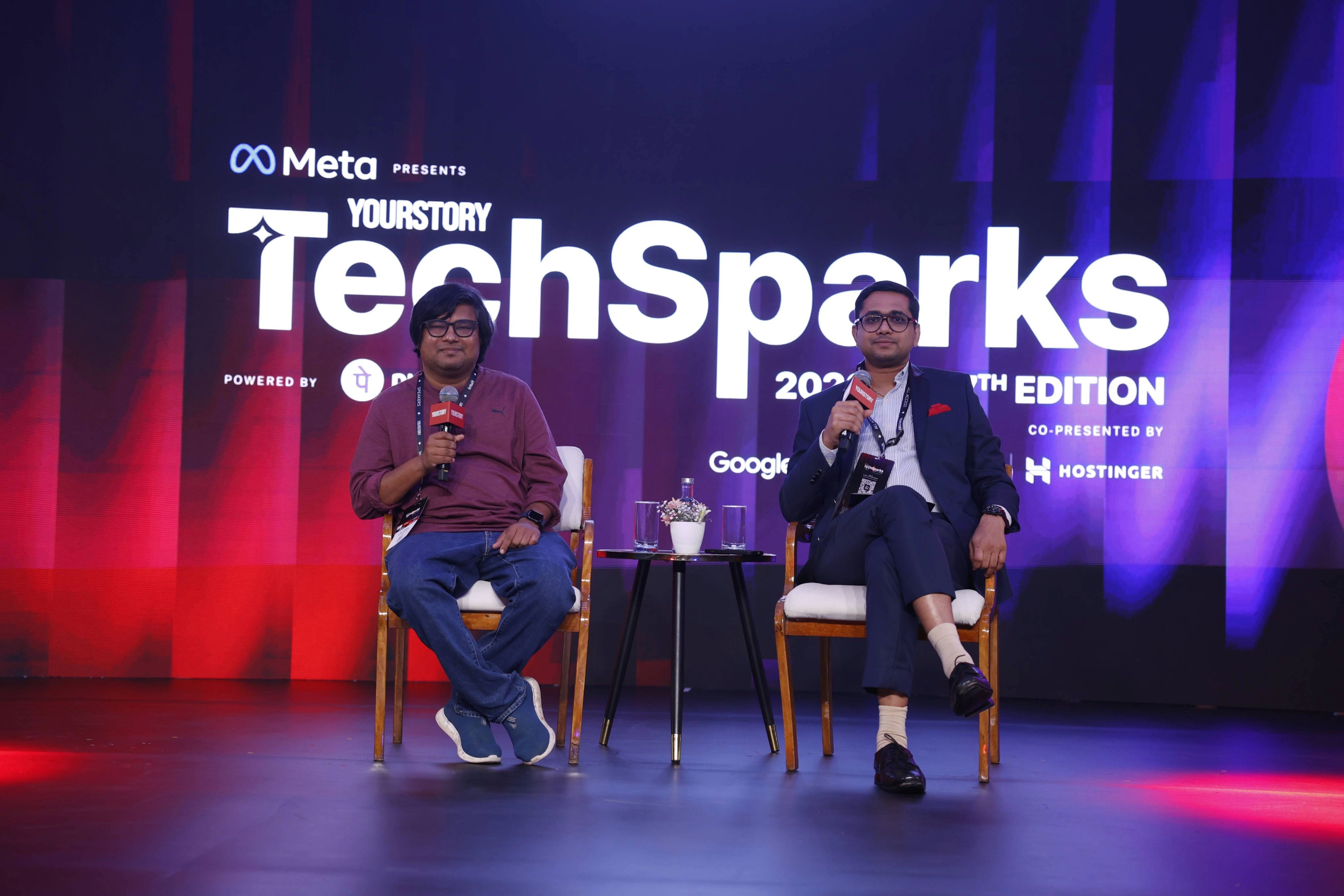
At TechSparks 2026, YourStory’s flagship event, Dr Vignesh Subrahmaniam, Principal AI Scientist at Intuit, spoke with Adith Charlie, Managing Editor of YourStory and The CapTable, in a fireside chat titled ‘Beyond the prompt: Building AI that thinks, acts, learns’. Drawing on Subrahmaniam's experience of turning AI research into scalable systems, the two explored what builders need to rethink as intelligence becomes increasingly agentic.
Teaching machines the game of business
The session opened with a question for Subrahmaniam about what a typical day looks like for him. He was also asked to simplify the concepts of fintech and AI for the audience. He responded with a chess analogy, posing a question: if an algorithm were never taught the rules of chess but was shown a million completed games and their winners, could it deduce both the rules and the strategies most likely to lead to victory? His team at Intuit applies a similar approach to supporting small businesses, as the company serves both consumers and accountants.
“How do we learn the game of business by looking at data, by looking at actual actions and outcomes that businesses are taking,” he said. The goal is to understand what helps a business win customers, grow quickly, and improve its cash flow.
From prompts to tools
The conversation then turned to the shift builders face, from years of learning to write smarter prompts to designing agents that are handed a goal and decide the steps themselves.
Subrahmaniam placed prompt engineering in the long history of programming languages, from binary and assembly to Fortran, C, and Python. Large language models let anyone program using plain English. However, this method has limits. Researchers quickly understood that intelligence should not only be in the model.
The model becomes an orchestrator, breaking a complex task into a series of actions and tool calls. The real intelligence moves into the tools it calls. Those tools must be built differently too, “not so that a human being can use them, or a software developer can use them, or anybody can use them, but in a way that an LLM orchestrator can really use them”.
That means high-fidelity tools with highly deterministic output. For builders, the craft shifts from clever wording to dependable components that a model can call on again and again without surprises.
The next frontier is beyond text
On where new data will come from, Subrahmaniam was candid that learning from text is now largely a solved problem. The harder challenge is learning from multimodal sources and real-world actions. He pointed to how a small child learns mostly from what she sees, hears and observes, not from reading, and argued that bringing such real-world signals into AI systems is what will help models go beyond generating text to suggesting actions. That, he said, is the next frontier.
Data quality still decides everything
Looking ahead at the challenges for a regulated industry, he took the audience back 18 years, to one of the first machine learning labs in Bangalore, where he worked on logistic regressions and multi-layer perceptrons. The biggest problem then was not the algorithm. “Actually, it was data quality,” he recalled.
That has not changed. Whether a team trains a simple regression or fine-tunes a transformer, “garbage in, garbage out” still applies. Enterprises that can collect, collate, and store data at the highest quality, he said, will have the edge.
Consent and privacy from the floor
In the short audience Q&A, an attendee asked how restrictions on where financial data can be stored affect Intuit’s work. Subrahmaniam called consent the heart of any learning system and cited the Framingham study, where residents of a Massachusetts town allowed doctors to follow their health over time, which shaped modern understanding of cardiovascular disease.
Companies, he added, must also explain the benefits of data use to the wider community.
What builders can take away
As the conversation drew to a close, one thread ran through every answer: as AI moves from responding to acting, the foundations matter more than the interface.
Prompts will remain a starting point, but the real work now lies in building dependable tools that agents can call on, feeding systems high-quality data, and earning the consent that lets them learn from it.
For builders looking beyond the prompt, that is where the next wave of AI will be won.
This content is published by YourStory and has not been created or edited by Hello Headlines. View original