India's next space unicorn may still be in college
India already has its first space-tech unicorn. Skyroot Aerospace crossed the $1 billion valuation mark in May 2026 and, two months later, its Vikram-1 became the first privately developed Indian rocket to reach orbit. Those milestones confirm that India's private space ecosystem has moved well beyond aspiration.
The more interesting question is what happens next and whether we are looking in the right places for it.
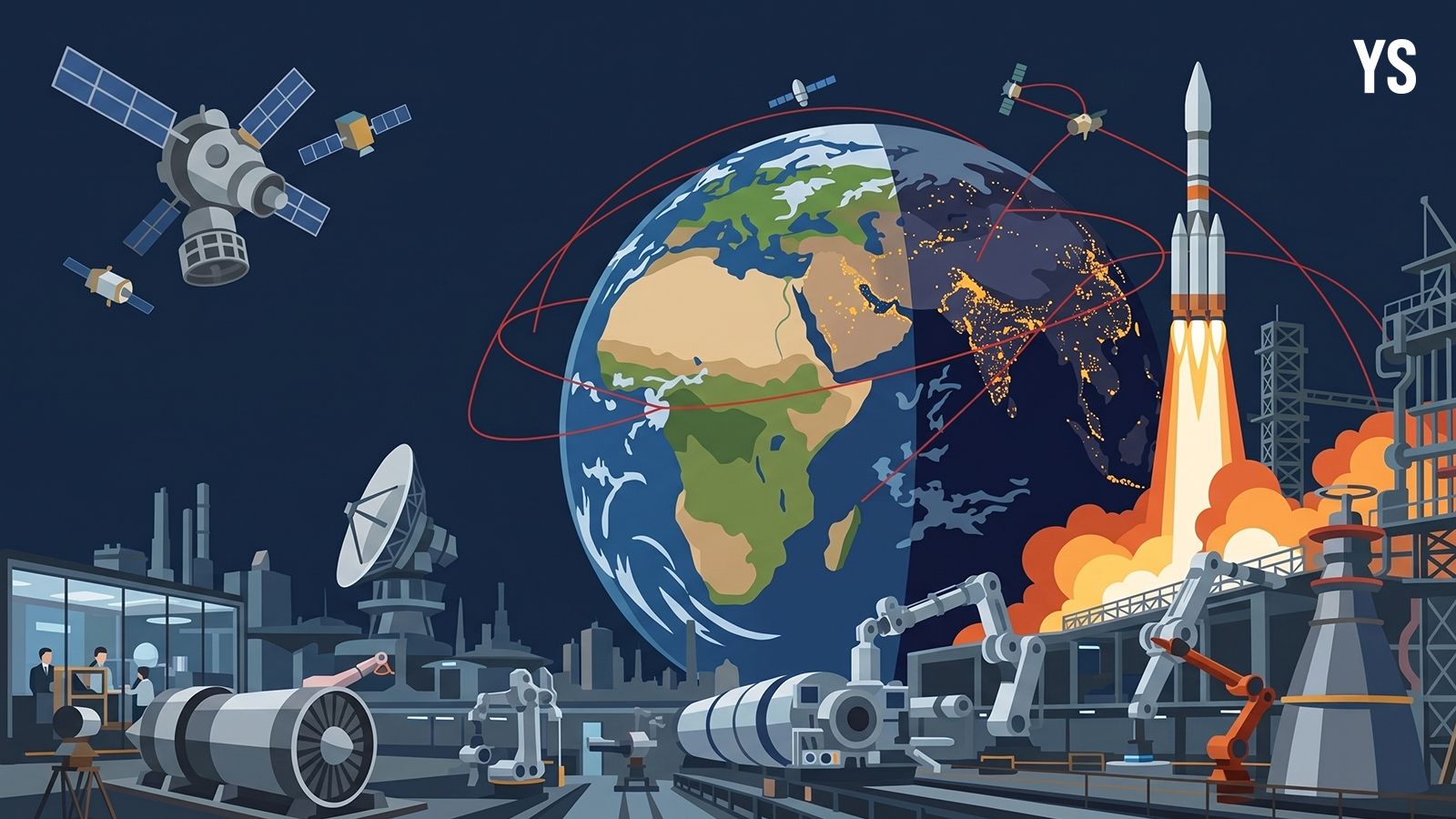
India's opportunity in space is not limited to producing another rocket company. It lies in building an entire space economy: the infrastructure, components, manufacturing systems, robotics, software and services that will make space progressively more accessible, industrial and ultimately habitable.
That economy will not appear in one leap. It will be built in layers.
The first layer is cheaper, more repeatable access to orbit. Reusable launch systems and a growing private launch market can gradually turn space travel from an exceptional event into an economic activity. Once access becomes more reliable, the next layer is orbital infrastructure consisting of more capable stations, platforms, communications networks and servicing systems.
Infrastructure then creates the conditions for industry. Manufacturing and fuelling can move into orbit. The vacuum and microgravity environment may enable forms of precision manufacturing that are difficult to reproduce on Earth, while in-space resources could eventually reduce the need to lift every material from the ground. Components, fuel and equipment will have to move through a supply chain that extends beyond Earth.
Robots will be the first workforce in that economy. They will construct, maintain and operate facilities in conditions where a permanent human presence is still impractical. Over time, closed environments may begin producing plants and food, initially managed largely by autonomous systems. Once infrastructure, industry and life-support systems have been demonstrated at increasing levels of complexity, sustained animal and eventually human habitation will become a reality. Cheap transport, then infrastructure, then industry and after that robotics and life-support. That is the long arc through which humans become a genuinely interplanetary species. Each stage creates the market and technical requirements for the next.
Seen this way, the next major Indian space company may not be building a rocket at all. It may be developing propulsion, power systems, sensors, communications, navigation, orbital robotics, satellite servicing, space situational awareness, Earth-observation tools, advanced materials, in-space manufacturing or the data applications built on top of them. Some of these businesses may not even describe themselves as space companies today.
India's own ambitions reflect the scale of this opportunity. The government estimates that the domestic space economy could grow from about $8.4 billion in 2022 to $44 billion by 2033, including $11 billion in exports. That cannot be delivered by a handful of headline companies. It will require hundreds of specialised businesses building different layers of the system.
Around 440 space-technology startups are registered on the government's Startup India portal. Separately, Tracxn covers 285 space-tech companies, which have raised roughly $871 million across 241 funding rounds. Only 72 of those companies have received institutional equity funding, and more than 60% of the capital has gone to the ten most-funded startups. The two datasets use different definitions, but they point to the same reality that entrepreneurial activity is expanding much faster than institutional capital is reaching it.
The government has begun responding to this gap with a much broader capital and infrastructure architecture. The Rs.1,000 crore IN-SPACe venture fund has been operationalised with SIDBI Venture Capital. IN-SPACe has also launched a Rs 500-crore Technology Adoption Fund, seed and pre-incubation programmes, shared technical facilities, a Satellite Bus as a Service initiative, access to ISRO infrastructure and technology-transfer pathways. By July 2026, 118 technology-transfer agreements covering 83 ISRO and Department of Space technologies had been signed with Indian industry.
The support extends beyond space. The Rs 1 lakh-crore Research, Development and Innovation Scheme is designed to provide long-term, low-cost financing for indigenous technologies at Technology Readiness Level 4 and above. Startup India Fund of Funds 2.0 adds another Rs 10,000 crore, with specific windows for deep-tech funds, micro-VCs and technology-led manufacturing.These are important signals that policy is going full throttle in recognising that frontier technologies require different timelines, instruments and a willingness to back them at scale.
The remaining challenge is not whether India is doing enough in absolute terms. It is whether the different parts of this architecture connect early enough to the founders and technologies from which the next layer of the space economy will emerge. Series A cheque is meaningful for a company ready to scale. It does not solve the problem faced by a two-person team in a university lab still trying to establish whether a thruster design works outside a simulation.
This is the structural challenge in financing deep tech. Conventional venture capital operates against a defined fund life and looks for commercial traction within a relatively compressed period. Deep-tech companies often cannot work to that clock. They may need years of research, specialised infrastructure, testing and certification before they can address a meaningful commercial market.
Patient capital is sometimes mistaken for capital without discipline. It is the opposite: capital that applies the right discipline to the right stage. The milestones simply come in a different order - proof of science, prototype, reliability, certification, first customer and then scale. The journey from technical proof to meaningful revenue is often measured in years, not months. That makes patient capital not just useful, but essential. It also means we need to rethink where the journey begins, including the role universities and campuses can play in creating the science, talent and early-stage companies that frontier industries will ultimately depend on.
This is where campuses matter.
Campus Fund has spent the past several years tracking and investing in student entrepreneurship in India, and the shift has been hard to miss. More than 7,300 startups entered the Campus Fund funnel in 2025, while DeepTech became its largest category at nearly 17% (compared to 8.4% in 2024) and the nature of the founders is changing too. The number of PhD founders in the funnel rose from just 35 in 2020-21 to 237 in 2024-25, almost a sevenfold increase. Edtech startups built around coaching and content are down 36% and traditional services startups are down 52%. Students are visibly choosing harder, more defensible problems over easier ones.
This matters because many of the technologies that will define the next decade are being worked on not in corporate strategy rooms, but in university labs by students and researchers spending years on narrow, unglamorous problems. They often have access to professors, laboratories, equipment and technically fluent peers. What they lack is institutional credibility and an early source of risk capital.
A student with a working prototype may struggle to raise a first cheque. The same founder, a few years later, with a company, customers and external validation, may find it much easier to raise several crores. The first institutional cheque should follow technical insight and evidence that something is possible.
None of this works if we pretend early-stage deep tech is a safe bet because it isn't and it was never going to be. Some of these propulsion systems won't fire. Some sensors will work beautifully in a lab and prove impossible to manufacture at cost. Some technologies will be ready only to find that the market has shifted or a competing technology has emerged. Others will simply be overtaken by better technology. That is the nature of frontier technology.
But if capital arrives only after product-market fit has been established, we risk filtering out precisely the technologies that need time and early backing to reveal their potential. A small pre-seed cheque to a student team is not only a startup investment. It helps keep research alive inside the university system and gives founders the option to build a company around work that might otherwise remain in a laboratory.
The first Indian space unicorn is no longer a prediction. The harder question is whether we can find the next one before the rest of the world knows its name. It may not be sitting in a boardroom. It may still be in a hostel room, where two founders are arguing at 2 a.m. about whether the prototype can actually work.
-- Richa Bajpai, Founder and General Partner at Campus Fund
(Disclaimer: The views and opinions expressed in this article are those of the author and do not necessarily reflect the views of YourStory.)
This content is published by YourStory and has not been created or edited by Hello Headlines. View original