The Enterprise AI Push For Decision Models
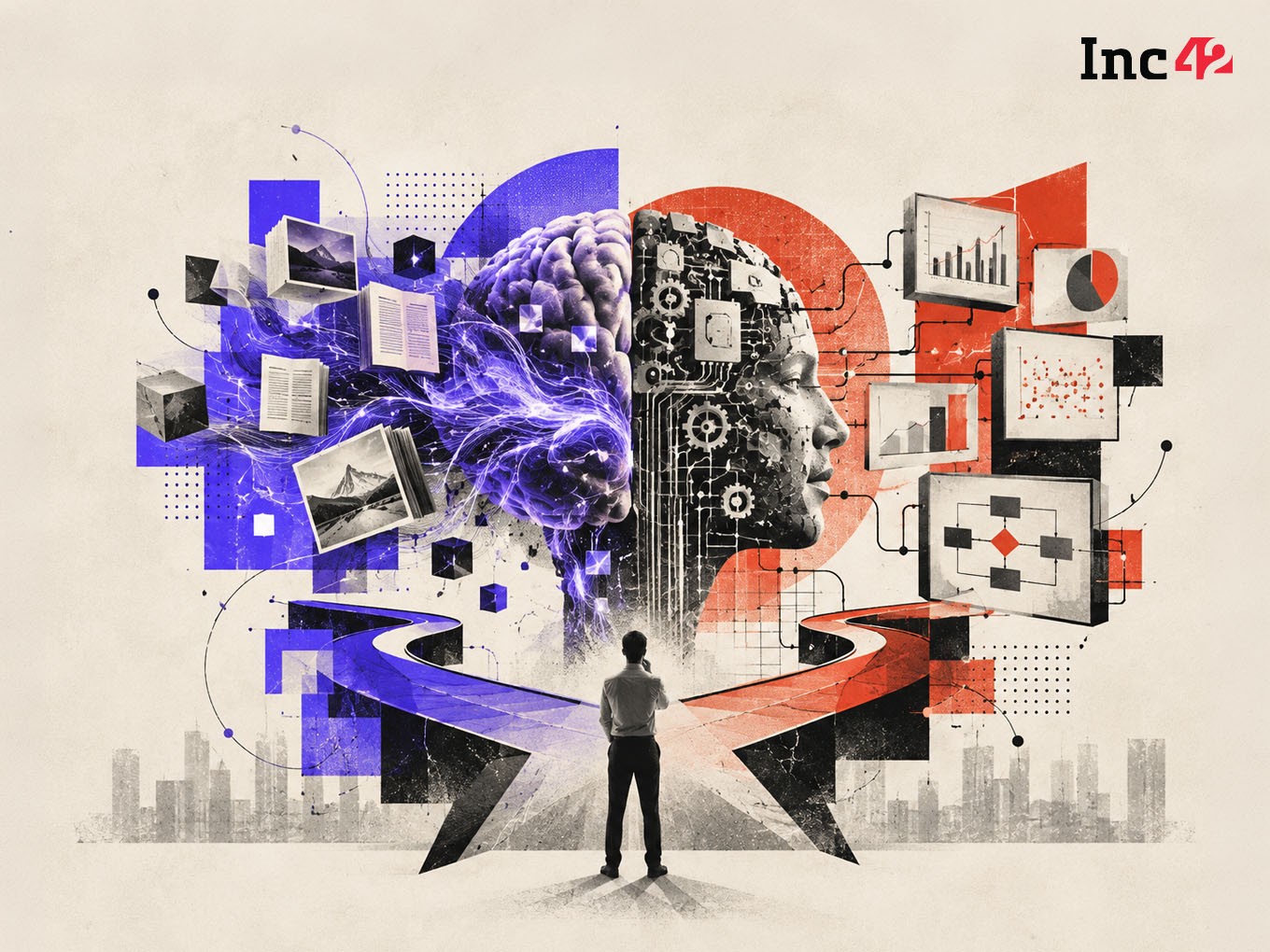
The AI race has largely revolved around frontier labs and models that can write, code, analyse documents and reason through prompts. But as companies move from chatbots to AI agents, another part of the stack is gaining attention: models that make a specific decision and return an answer that another system can act on.
Decision models gained momentum with the arrival of Jev, the first public model from TypeSafe AI, founded by Diogo Almeida, who helped develop research behind ChatGPT at OpenAI. Released in September, Jev focuses on decision-oriented outputs, including scores and yes-or-no probabilities, rather than conventional text generation.
Other companies have since explored similar capabilities, though their products differ in architecture and intended use.
Cloudflare has introduced Clef and Clef-flash, while Microsoft has released Decision-1, a model based on Alibaba’s Qwen family that has been post-trained for decision tasks. AWS has introduced Strands Decider 2B for agent workflows, and OpenAI has launched a Decisions API. Perplexity has also explored decision-oriented APIs.
Under this approach, an agent handling a customer complaint, for instance, may need to decide whether to escalate it, route it to a particular team or resolve it automatically. It does not necessarily need a long, generated response to make that decision. The same applies to systems classifying transactions, checking whether an action should proceed or routing requests across software tools.
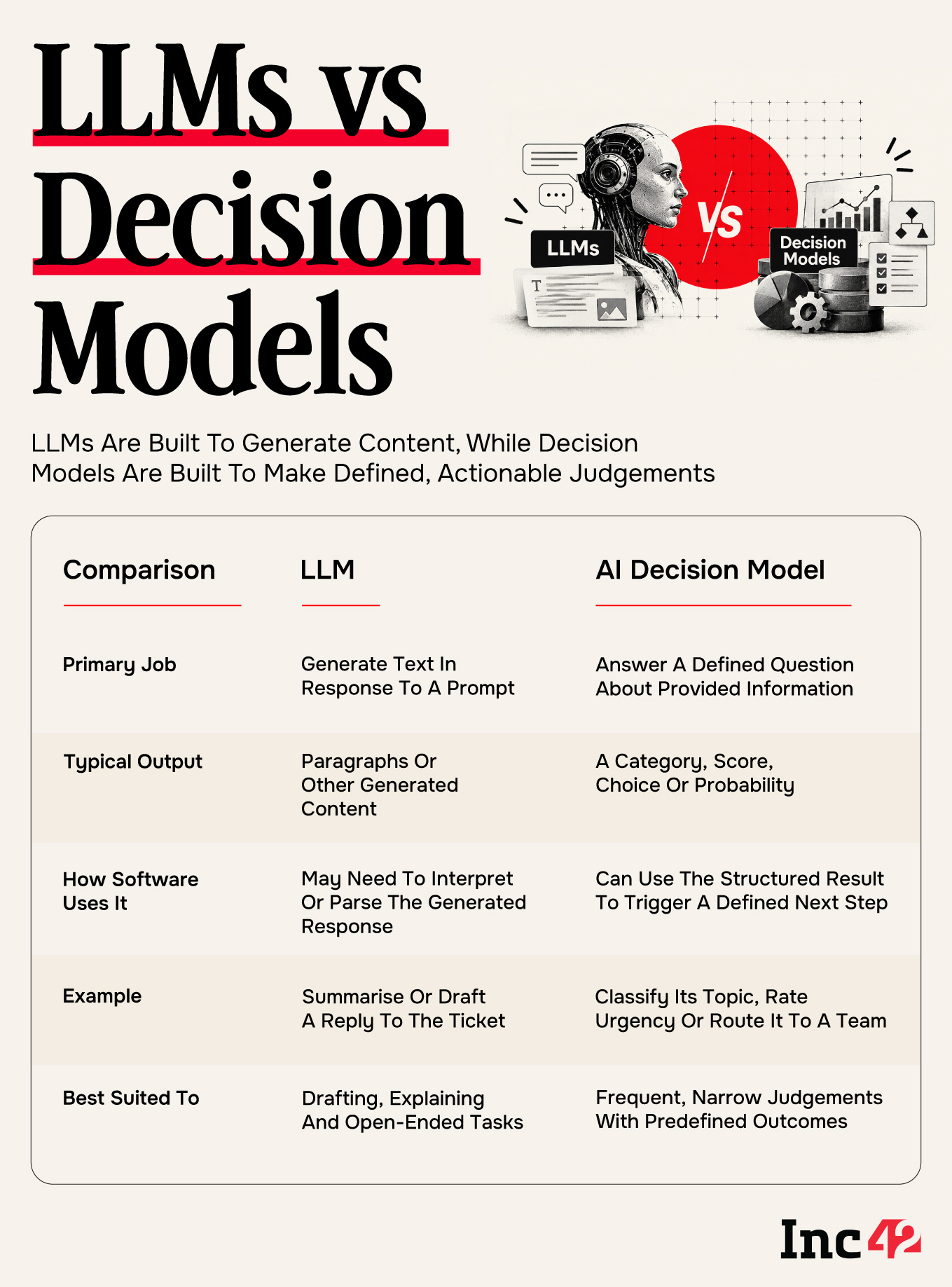
These decisions can be handled by general-purpose large language models (LLMs), but using them for every step can add latency, cost and complexity. Decision models are designed to handle narrower tasks, returning a label, score, probability or confidence level instead of a paragraph of text.
The idea is to give software a more direct way to make a bounded judgement without requiring a general-purpose model to generate a full response at every stage. In agentic systems, where multiple tools and models work together, this could make routine decisions easier to integrate into a workflow.
They are not necessarily replacements for LLMs. Rather, they can become specialised components within larger AI systems, handling defined decisions while general-purpose models take on tasks that require broader reasoning or language generation.
Enterprises Seek Reliability
For enterprises, the opportunity extends beyond reducing token consumption and cost savings. Companies need AI systems that can work with internal data, understand domain-specific context and make decisions that can be reviewed and governed.
General purpose models are probabilistic by design. Their responses can vary, even when prompts appear similar. That flexibility is useful for open-ended tasks, but enterprise workflows in sectors such as manufacturing, energy, finance and aerospace often require defined outputs, traceability and tighter controls.
Articul8 AI, an enterprise AI company spun out of Intel in 2024, is building a platform around what it calls a “correctness stack”.
According to Ananthanarayanan S, the company’s managing director for India, enterprises need more than access to a capable model. They need a system that connects their data and domain knowledge with models that can deliver outputs suited to specific workflows.
The platform is designed to work across cloud environments, on-premises deployments and air-gapped systems. Its data perception layer brings information from different enterprise sources into a unified view, helping AI systems work with the context and relationships within an organisation’s data.
Articul8 has developed around 28 domain models spanning areas such as energy, finance, aerospace and manufacturing. Its platform can select models depending on the task and combine specialised models with customers’ preferred frontier or reasoning models. The company says its approach can reduce token usage by more than 50% in relevant workflows, although the savings will depend on the application and deployment.
In October, Articul8 announced Bivia, a multimodal decision model designed to process inputs such as text, images, video frames, tables and charts, and return structured decisions. Ananthanarayanan said the differentiation lies less in any single model than in the platform’s ability to connect models and solve difficult customer problems.
He cited an engineering company with around 10,000 documents that were ingested in roughly 10 hours before an application was made available for use. Articul8 has also said the American Society of Mechanical Engineers selected it for work related to standards. These examples point to the company’s focus on applying AI within existing enterprise workflows rather than selling a standalone model alone.
PurpleTalk is approaching the opportunity through Sthānika, its applied AI research lab, and the Sieve family of decision models. Sieve-31Bv3 is designed to be called by AI agents as one component in a larger system. It returns a defined answer with a confidence score, allowing the agent to decide what to do next.
The company claimed at the time of launch that Sieve-31Bv3 ranked first on the full Jev Decision Index, a collection of 43 private and public benchmarks hosted on Hugging Face. The company reported a score of 71.1 on the full index and 71.7 on the public test, where it ranked third.
Sieve builds on earlier compact, confidence-aware decision models used within PurpleTalk products Ello and Mina. The company sees potential applications in voice, customer experience and robotics, where routine decisions need to be made quickly and predictably.
“Sieve-31B shows that a focused model fine-tuned in India can perform among the best in the world at this work. The private tests matter most to us. They come from domains outside the public suite, and Sieve generalised better than most of the field. It learned the task, not the test,” said Sridhar Muppidi, cofounder of PurpleTalk.
Bharat Lingam, CEO of PurpleTalk, believes decision models will open up a new category of agentic systems: more reliable, more controllable, and fast enough for voice, customer experience and robotics. “We are publishing everything needed to reproduce our results, and we invite the research community to test it, challenge it and build on it,” Lingam added.
The approaches illustrate two sides of the enterprise opportunity. Articul8 is building a broader platform around enterprise data, models and governance, while PurpleTalk’s Sthānika is a specialised model that agents can call for particular decisions. In both cases, the commercial test will be whether these systems improve real workflows, not simply whether their models perform well on benchmarks.
A Decision Model For Every Workflow
The decision model opportunity is not limited to enterprise platforms in India. Smaller AI startups and researchers are also exploring models that can be adapted, deployed locally and used by developers building their own applications.
Kerala-based ConvAI Innovations has developed Laya, an open-weight decision model intended to run locally on devices such as laptops and mobile phones and be adapted by developers. Founder Nandakishore Mukkunnoth said the initial focus was on building small, fast models that did not always require cloud access. Interest in a general-purpose, open-source decision model grew after Jev’s release.
The startup has discussed plans for Laya Max, with image and audio capabilities, alongside APIs, software development kits and a commercial enterprise offering. It has also suggested that Laya could deliver substantial cost savings compared with Jev. These claims will need to be tested against comparable workloads, as performance and cost depend on the task, model configuration and deployment.
Laya’s significance lies in the possibility of giving developers an adaptable model that can run closer to where decisions need to be made. Local execution could be useful where latency, connectivity, data control or inference costs matter. But open weights alone will not establish a durable advantage. The model will still need to perform reliably on real tasks and be straightforward to integrate into applications.
For investors, the opportunity may be less about backing another general-purpose model and more about identifying where decision-making can become a product in its own right. “Decision models are one of the most important shifts in AI this year. What can’t be copied is a company’s own record of decisions and outcomes. For startups, the real test is how fast the model improves on a specific, high-volume workflow,” said Shubham Gupta, founding general partner at Together Fund.
That points to a potential advantage for startups that can pair models with proprietary data, feedback from actual outcomes and a clearly defined customer problem. A model may be accessible to competitors, but the data and workflow knowledge used to improve its decisions can be harder to replicate.
In the Indian context, this creates several possible entry points: developing specialised models, building infrastructure that routes tasks to the right model, and creating applications around high-volume enterprise workflows. The challenge is to demonstrate measurable improvements in accuracy, cost or speed, rather than compete on benchmark scores alone.
As the global industry moves towards more specialised AI systems, the question is whether Indian builders can turn their models into products that enterprises repeatedly use. The next advantage may not belong to the model that can do the most things, but to the system that can make a particular decision reliably, cheaply and at scale.
[Edited by: Nikhil Subramaniam]
[Creatives by: Abhyam Gusai]
The post The Enterprise AI Push For Decision Models appeared first on Inc42 Media.
This content is published by Inc42 and has not been created or edited by Hello Headlines. View original