Kashmir's Saffron Season Begins: Why Pampore Is Known As India's Saffron Capital
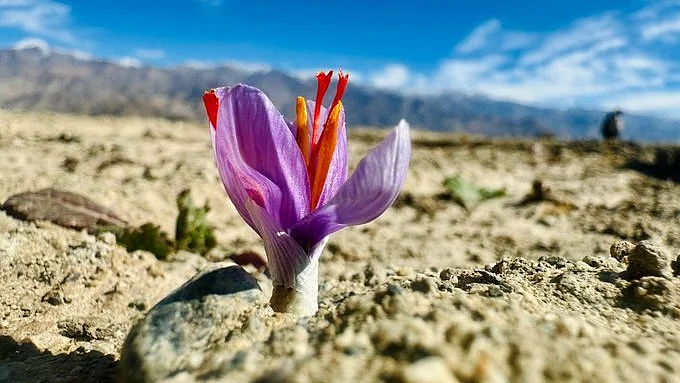
The annual saffron harvest season has begun in Pampore and its adjoining villages in south Kashmir's Pulwama district, as farmers gather in the early morning to pluck delicate saffron flowers before separating the precious red stigmas that are later dried to produce the world's most expensive spice, saffron, which is also known as red gold. Saffron is one of the most precious agricultural products, and that is why Pampore is popularly known as the 'Saffron Town' and the saffron capital of India.
LG Ladakh (@lg_ladakh) posts, "Breaking new grounds in Ladakh’s high-altitude agricultural landscape! Proud to announce that the experimental saffron cultivation, over recently restored degraded land in Leh, has begun to blossom, in a record-breaking 30 days, against the usual… pic.twitter.com/qSC0Ndc252
— Press Trust of India (@PTI_News) November 1, 2026
Every year, during autumn, the region's landscape transforms as delicate purple saffron flowers bloom across the fields. The harvest season generally begins in October and continues into November, attracting attention for its unique cultivation process and the region's centuries-old association with saffron farming.
Saffron harvest begins in Kashmir
The fields in Pampore and nearby villages in the Pulwama district of south Kashmir are experiencing the yearly blooming period, with farmers rising early to gather fragile saffron flowers, subsequently extracting the valuable red stigmas that are then dried to create the globe's priciest spice. Its cultivation has remained a traditional source of livelihood for thousands of farming families, predominantly in Pampore, which is known as the Saffron Capital of India. However, the local cultivation is facing challenges due to rampant construction and changes in climate.
A promising breakthrough for high-altitude farming in Ladakh.
— DD NEWS JAMMU | डीडी न्यूज़ जम्मू (@ddnews_jammu) November 2, 2026
Experimental saffron cultivation on restored degraded land in Leh has produced its first blooms in just 30 days, against the usual two-month timeline. Nearly 22 grams of saffron has been collected in four days.… pic.twitter.com/BXBc0M4UiG
What makes Pampore's saffron special?
Pampore is among the few places in India where saffron is cultivated on a large scale. The region is located about 15 kilometres southeast of Srinagar in the Jhelum Valley. The region's unique soil composition, climatic conditions and well-drained Karewa soil formations provide favourable conditions for growing high-quality saffron.
Saffron is harvested from the delicate red stigmas of the Crocus sativus flower, unlike several other crops. Farmers carefully handpick the flowers, separate the three red stigmas and dry them to produce the prized spice. It takes thousands of flowers to produce just a kilogram of saffron. The flower peak around in between October and November which depends upon weather and soil moisture.
The cultivation of saffron dates back to the 11th to 12th century, when Persian invaders introduced it.
Kashmiri saffron's GI tag
Kashmir saffron also received the Geographical Indication (GI) tag in 2020. This recognises its distinctive geographical origin and traditional cultivation practices. The spice is valued for its purple colour, strong aroma and distinctive flavour.
This content is published by Free Press Journal and has not been created or edited by Hello Headlines. View original