How a Surat Mom Is Making Diwali Fun With Homemade, Smoke-Free Crackers
Diwali is a little more magical when the house is lit up, the smell of festive treats fills the air, and children run around excitedly, waiting for the evening celebrations to begin. For many little ones, the excitement also comes from the familiar crackle of firecrackers lighting up the sky.
But for Surat-based mom Swati Jain, Diwali has become an opportunity to show her two young sons that the fun of crackers need not always come with smoke, noise, or fire.

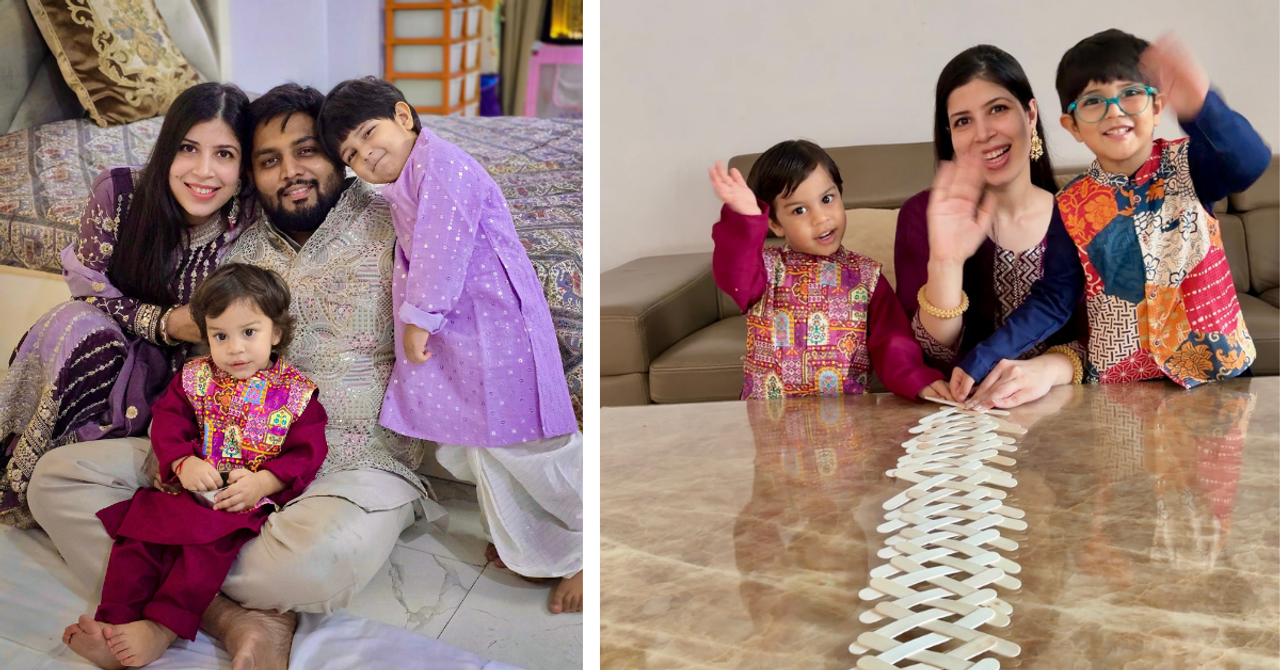
Instead of buying an entire box of firecrackers, Swati, a parenting content creator and mother to four-year-old Nirvaan and two-and-a-half-year-old Vayu, has introduced them to something rather different: homemade crackers made using ordinary wooden popsicle sticks.
When woven together in a particular pattern and released, the sticks spring apart one after another, creating a surprisingly loud crackling sound. There is no gunpowder, flame or smoke involved. Just wooden sticks, a little bit of science and plenty of excitement.
For the family, it has become more than just an alternative to conventional crackers. It is a festive activity that brings everyone together.
When a trip to Delhi changed the way they celebrated Diwali
Swati and her husband, who are both originally from Delhi, have experienced the city's pollution during the winter months for years. But a visit in December 2024, with their two young children, made them reconsider how they celebrated festivals.
"We had lived with that air for years ourselves, but seeing my kids go through it was very different," she recalls.
During the trip for a cousin's wedding, both boys began coughing, their eyes started burning, and the family had to take them to a doctor.
The experience also made Swati think about the street animals that have to endure the pollution and are often frightened by the loud sounds of firecrackers.
She is not against crackers altogether. The family still lights a few phuljhadis, anars and chakris together. However, she believes that moderation matters.

"Crackers aren't the only reason Delhi's air gets so bad, but when the whole city bursts bombs and ladis late into the night, right when the air is already at its worst, it becomes dangerous," she says.
Wanting to preserve the excitement of Diwali for her children without adding to the pollution, she began exploring alternatives. That is when she discovered the idea of popsicle-stick crackers.
Meet the crackers that go crackle without the smoke
The idea is simple: ordinary wooden ice cream sticks are woven together in a zig-zag pattern, with each stick slightly bent and locked against the next.
When the finished chain is placed on the floor and released, the sticks spring apart in quick succession, creating a crackling sound similar to a ladi.
Explaining the science behind it, Swati says that each stick stores a little energy when it is bent. Releasing the first stick sets off a chain reaction, much like dominoes falling one after another.
View this post on InstagramA post shared by Nivu and Vayu || Mom of 2 Toddler Boys (@nivuandvayu)
"The crackle is just the wood hitting the floor and each other. There's no gunpowder, no fire, no smoke, and no chemicals. Just wood, and the energy from our own hands," she explains.
For Diwali, the family uses around 80 wooden sticks to make one cracker. A pack of 200 to 300 sticks costs approximately Rs 300 at a stationery or craft store and is enough to make about three.
The process takes around 10 minutes once the sticks are ready. Swati and the boys first paint them using child-safe colours and leave them to dry for an hour. She then weaves the sticks together, keeping one hand on the chain to prevent it from releasing prematurely.
The weaving requires adult supervision because the sticks remain under tension. Once the chain is ready, the family places it on the floor, moves their faces away and lets it go.
The same sticks can be collected and reused throughout the festive season.
From painting sticks to bursting crackers, everyone has a role
What makes the activity especially enjoyable for Swati is how involved her children have become.
When they first tried it during Diwali 2025, Nirvaan was three and Vayu was around one and a half. The boys were too young to have a clear idea of conventional firecrackers, so the homemade version became their introduction to the fun of bursting crackers.
"The first time I let one go, Nirvaan burst out laughing and wanted it again and again. Vayu just sat there clapping," she says.
They repeated the activity seven or eight times that day and continued making the crackers every few days until Diwali.

This year, the excitement has returned. Nirvaan enjoys painting the sticks, while Vayu helps by handing them over and placing a few during the process.
Swati says that the best part for Nirvaan is not any particular cracker but the time spent doing activities with family and friends.
A shop-bought cracker may be over in a second, but this one gives children the chance to build, play and repeat the experience.
Making sustainability a part of the celebration
The popsicle-stick crackers are just one part of the family's efforts to make Diwali more mindful.
Swati has also switched to battery-operated diyas, which give the home a festive glow without the worry of open flames around two toddlers. For rangoli, she opts for organic colours, keeping in mind that the boys often end up touching and playing with them.
The family also makes its own paper lanterns, garlands and bandanwars instead of buying plastic decorations.
For Swati, these activities offer children a chance to participate in the preparations rather than simply watch the adults do everything.

When it comes to explaining why the family chooses alternatives to noisy crackers, she keeps the conversation age-appropriate.
"At their age you can't explain AQI or pollution. I tell them smoke hurts our eyes, and the doggies get scared of loud bangs. That's enough for them to understand," she says.
She is also careful not to make the children feel that celebrating sustainably means missing out. They still enjoy a few traditional crackers with their parents, while the homemade ones add another layer of fun.
A little change can make Diwali more meaningful
Swati's idea has also caught the attention of other parents. Several families who saw her homemade crackers have tried making them with their own children.
She believes such small changes can influence how children understand celebrations and their relationship with the environment.
"Kids learn from what we do, not from what we tell them," she says. When children make something themselves and enjoy it just as much, they begin to understand that having fun does not have to come at the cost of the air, animals or anyone's health.

Her advice to parents looking to make their festivities more sustainable is simple: start small.
"You don't have to stop crackers completely. Keep a few, skip the excess, and add one thing you make with your kids. Once they've made something with their own hands, they won't miss the rest," she says.
And perhaps that is what makes this family's Diwali special. Between colourful sticks, handmade decorations and little bursts of laughter, the boys are discovering that some of the best festive memories are not bought from a shop. They are made together at home.
All images courtesy of Swati Jain
This content is published by The Better India and has not been created or edited by Hello Headlines. View original