Sarvam’s Prism Enters India’s Growing AI Decision Model Race

AI models are increasingly being built to do more than answer questions. Some are now designed to make specific decisions, such as whether a customer query should go to a sales or support team, whether a document needs further review, or whether an AI agent has completed a task correctly.
In India, Kerala-based ConvAI Innovations was one of the first to explore this category with Laya, an open-weight decision model intended to run locally on devices such as laptops and phones. Hyderabad-based PurpleTalk’s research lab, Sthānika AI, has also developed Sieve, a family of decision models that returns probabilities for a fixed set of possible answers.
Both startups are betting that specialised models can make these decisions faster and more efficiently than general-purpose AI systems.
The space has now attracted Sarvam AI, one of India’s prominent homegrown AI model developers. The company introduced Prism, a decision model built on its 105B-parameter foundation model. Sarvam says Prism combines high accuracy with low response times, while allowing enterprises to customise and run it on their own infrastructure.
The launch raises a bigger question for India’s AI ecosystem, especially given the implications on cost, reliability and speed: Are decision models the opportunity for Indian AI startups to compete with global players, rather than trying to match them across every general-purpose AI capability?
What Are Decision Models, And Why Now?
Most large language models (LLMs) are designed to generate text. Even when asked to make a simple choice, they typically produce a response that another software system must interpret. This can add processing time, increase costs and introduce inconsistencies.
Decision models approach the problem differently. They receive information, a question and a defined set of possible answers, then return a score or probability for each option. Instead of generating a paragraph explaining which department should handle a customer complaint, for instance, the model can assign probabilities to sales, support and billing.
This makes them useful for repetitive tasks performed at scale, including customer-support routing, content moderation, fraud checks, security screening and evaluating the actions of AI agents. General-purpose models can perform these tasks too, but a specialised decision model may be faster and easier to integrate into workflows that require predictable outputs.
The category gained visibility with Jev, the first public model from TypeSafe AI. Global companies, including Microsoft and Perplexity, have since introduced their own decision-model offerings. Indian startups are also developing alternatives, with different priorities around local deployment, openness and enterprise use.
How Sarvam Is Positioning Prism
Prism is built on Sarvam 105B, the company’s large language model, but is fine-tuned specifically for making decisions. Rather than generating a sequence of words to arrive at an answer, it evaluates the available options in a single processing pass and returns a probability for each.
According to Sarvam, Prism recorded an average score of 71.8 across three evaluation indices, with a median response time of 44 milliseconds on an Nvidia B200 GPU. The company said this was the highest average score among the 25 decision models it tested that responded in under 100 milliseconds.
Sarvam also tested whether the order of available options would change the model’s decision. It reported that Prism produced consistent results across 2,000 questions after applying a fixed ordering mechanism before scoring. The company further said that Prism’s observed error rates were lower than its predicted error rates across the confidence thresholds it tested, including in Indian languages.
These are company-reported results, and independent testing across comparable workloads will be important to establish how they translate into production performance.
Sarvam is releasing Prism’s weights under the Apache 2.0 licence. This allows developers to access the model’s trained parameters, adapt them and deploy the model on their own infrastructure, subject to the licence terms. It is also available through an API.
The company is targeting applications such as customer-support routing, document intelligence, security checks, prompt-injection detection and evaluation of AI-agent activity. Its positioning is not simply about offering another language model, but about adding a specialised decision-making component to the broader AI stack.
India’s Decision Model Race Heats Up
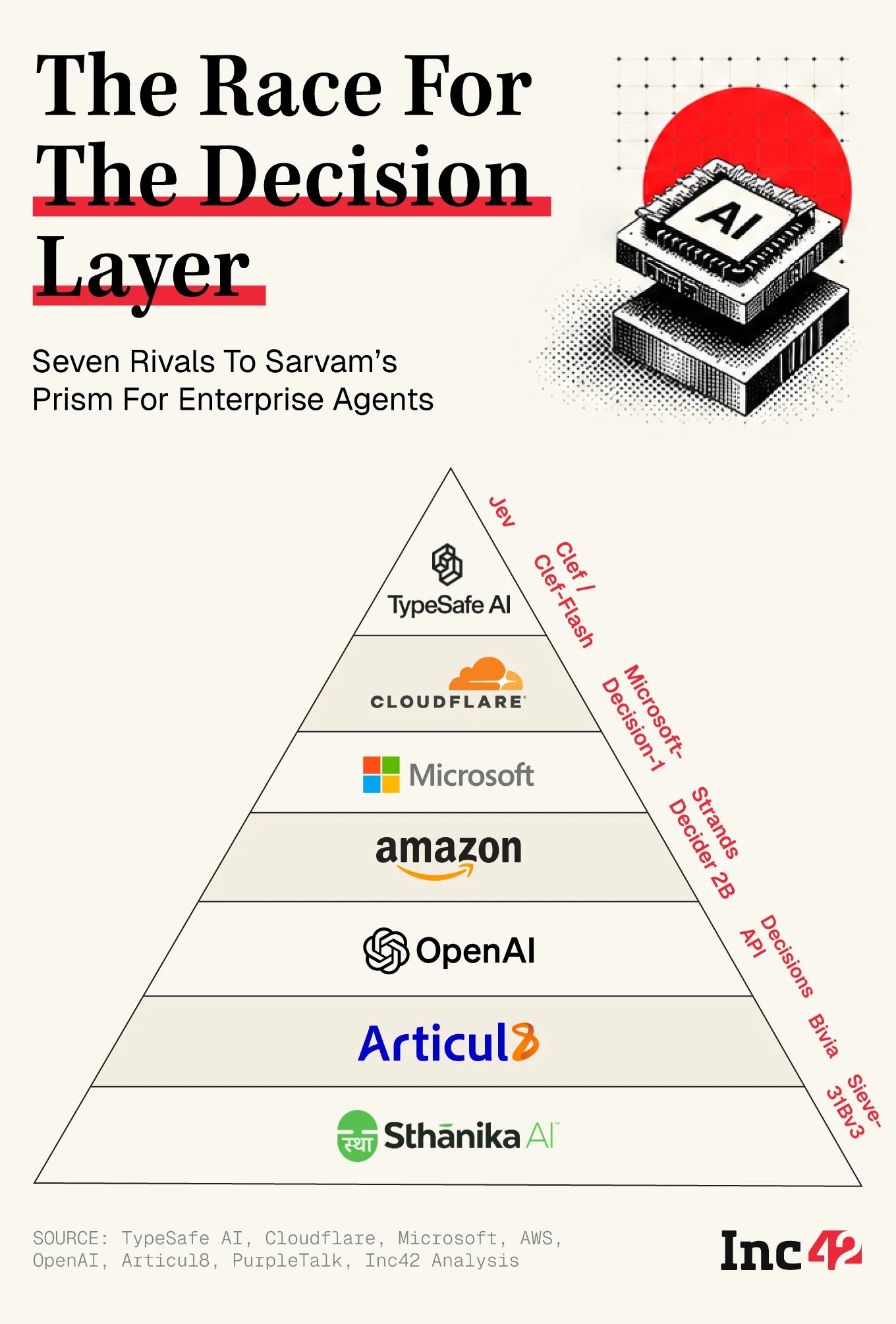
Laya, Sieve and Prism reflect different approaches to decision models in India. Laya prioritises small models that can run locally, while PurpleTalk’s research lab Sthānika AI focuses on open-weight Sieve models, with an emphasis on evaluation and tasks such as intent detection and AI-agent tool selection. Sarvam’s Prism builds on its foundation-model capabilities, with speed, confidence calibration, Indian-language performance and open-weight deployment among its key selling points.
Articul8, an enterprise AI company, is also developing the category through Bivia, its multimodal decision model designed for domain-specific, evidence-backed decisions across text, images, documents, audio and video.
Ananthanarayanan S, managing director for India at Articul8, said Sarvam’s launch adds to the growing range of general-purpose models, while positioning Bivia around a different enterprise need. He said Articul8 benchmarks Bivia against models such as Jev and evaluates it through a broader enterprise lens, including its ability to abstain when evidence is insufficient.
He believes that the competition, however, will extend beyond benchmark scores and response times. Enterprises need models that can handle unfamiliar situations reliably and integrate with existing systems through domain grounding, orchestration and execution frameworks.
Prism has also drawn scrutiny from developers and independent evaluators. Sandipan Kundu, a developer relations and AI engineer focused on fine-tuning and inference, and the builder of Tensorant, a platform for fine-tuning, evaluating and deploying open models, said on X that the model appeared capable but questioned whether its 44-millisecond median latency claim reflected real-world performance. He cited a p95 latency of 420 milliseconds in his testing. He also flagged the cost of self-hosting a model of its size.
Separately, Faizan Shaik, a software engineer at Atlan, an enterprise data and metadata management platform, shared results from the company’s Decision Bench, where Prism scored 91.5% across 1,071 decisions on 36 public datasets, placing it 12th among 22 models. His evaluation reported a median latency of 65 milliseconds on a B200 GPU. These assessments suggest that Prism is competitive, but also underline the need to examine performance across different benchmarks and deployment conditions.
For Indian builders, the opportunity lies in proving that specialised decision models can deliver measurable gains in cost, latency and reliability across real-world workflows.
[Edited by: Nikhil Subramaniam]
The post Sarvam’s Prism Enters India’s Growing AI Decision Model Race appeared first on Inc42 Media.
This content is published by Inc42 and has not been created or edited by Hello Headlines. View original