Mohammed Shami’s rise: The Kolkata coaches and clubs behind India’s pace star
New Delhi: Badruddin Siddiqui has always believed that moving to Kolkata was pre-destined for his favourite student, Mohammed Shami.
Born in the small town of Sahaspur in Uttar Pradesh’s Amroha district, Shami’s rejection during the selection of the state’s Under-19 team proved to be Uttar Pradesh cricket’s loss and Bengal’s gain, as his childhood coach decided to make a few phone calls in Kolkata.
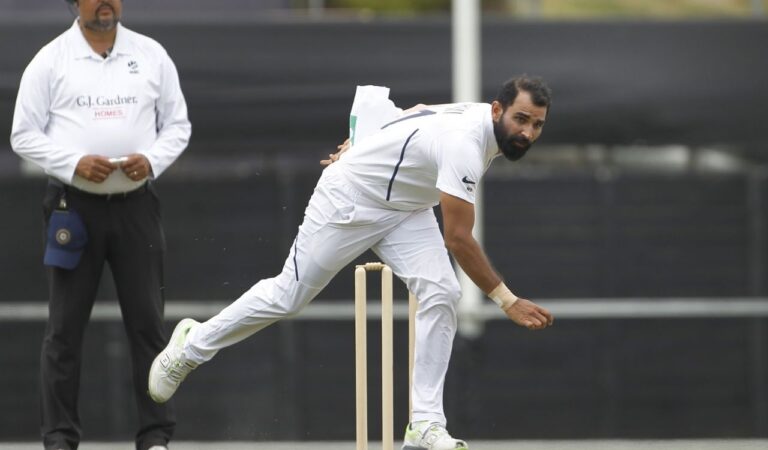
Creating artwork with his malleable wrists and making the SG, Dukes and Kookaburra red balls talk through perfect seam presentation, Shami’s pronounced backspin became his calling card.
“I thought they would pick him for Tests. He did everything that was asked of him. Yesterday, when he called, I didn’t expect him to tell me, ‘Sir, main Test chhod raha hoon (Sir, I am retiring from Tests)’,” Badruddin, or Badar bhai, as he is known in UP coaching circles, told PTI as memories came flooding back.
“I am happy that Shami is still playing white-ball cricket for Bengal and will be playing in the next IPL. Woh chhodne wala banda nahi hai. Khelega toh 200 per cent dega. That he will still play white-ball cricket for Bengal is the team’s gain. I still feel good that I called my friend and Kolkata-based coach Abdul Monayem two decades ago,” Badar bhai recalled fondly.
Town Club, ‘Debu da’ and mutton biryani
The Cricket Association of Bengal’s (CAB) first-division league is a robust one, and one of the smaller clubs that always punches above its weight is Town Club, for which Swami Vivekananda had once played in the 1880s.
The club’s owner and former CAB secretary Debabrata Das, popularly known as Debu Da, was on the lookout for a bowler when a Maidan scout named Suman Chakraborty called him one day.
“Debu da, there is a boy called Shami Ahmed (as he was known back then), who has joined Dalhousie Athletic Club. He is raw and quick. You haven’t seen anything like that in the Kolkata Maidans. Would you like to take him?” Chakraborty asked Debu Da.
Das was convinced that Shami was destined for bigger things as soon as he saw him.
“I immediately called his father and told him that I wanted to sign him up for my club. I remember the amount for the whole season — Rs 70,000. I also provided him Rs 100 every day for lunch and dinner, which he used to have at my place. He became a part of my family and a friend of my son. His brother Kaif (currently a Bengal pacer) also stayed with us,” said Das, a businessman.
His relationship with Shami was more like that of a father and son.
“He loved mutton biryani, and his innocence would floor you. There was a league match some 20 years ago. The opposition team needed less than 50 runs on a placid Kolkata Maidan club track, where the ball never got above knee height.
“I told Shami, ‘Kuch kar, match haar rahein hain’ (Do something, we are losing the match). Shami looked at me and asked, ‘Debu da, biryani khilaoge?’ I said, ‘Tu match jeeta ke toh dikha’ (First show me that you can win the match). The next thing I knew, the ball started reversing and we won the game,” Das recalled with a laugh.
He still feels hurt that some senior Bengal officials and former selectors were not convinced about picking Shami.
“He always had pain in his heel, even when he used to play for Bengal Under-22 (back then, it wasn’t Under-23). He was taking four or five wickets in every game, and yet they wouldn’t select him for the Ranji Trophy,” Das recalled.
“I literally fell at the feet of one of the senior selection committee chairmen and pleaded with him to pick Shami. He is an asset. His reply was, ‘Why are you bringing up the name of a UP boy?’ I was so angry. Arrey, will you confine Kishore Kumar, Lata Mangeshkar or MF Husain to any particular state?” he said, with the hurt and anger still evident in his voice.
Talking about Shami’s humility, Das recalled that when the pacer was first selected for the Bengal Ranji squad in 2010, he was sitting inside Town Club’s tent that very day.
“I asked him, ‘What happened? You are still here?’ He simply asked, ‘Debu da, can you lend me Rs 2,000?’ I asked why. He said, ‘Bengal team mein chance mila hai, ladkon ko biryani ki treat ka wada kiya hai’ (I have been selected for the Bengal team and have promised my teammates a biryani treat).”
Das also recalled how he helped Shami buy his first house in Kolkata.
“I helped him with the property papers and registration. When I became the manager of the Indian team a few years ago and went to England, Shami was already a superstar. But the way he met me, it felt as if I was meeting my son,” Das said.
Abdul Monayem, a former fast bowler who had persuaded Shami and his childhood coach, Badar bhai, to switch to Mohun Bagan, spoke about the pacer’s loyalty.
“He wasn’t ready to leave Town Club. At that time, former BCCI vice-president Chitrak Mitra wanted a good fast bowler for Mohun Bagan who could win them trophies. Badar bhai had told me about Shami, and I had watched him bounce batters on benign tracks.
“Shami wasn’t ready to leave Town Club, as they had taken care of him when he started out. But we had to convince him that playing for a big club would enhance his first-class prospects.”
“Shami is mostly self-coached. Obviously, he learnt a lot as he played international cricket. But playing on those lifeless Kolkata Maidan tracks — at the Town Club ground, Customs or Taltala ground, where he honed his skills for years — made him a very skilful operator,” Monayem said.
This content is published by Telangana Today and has not been created or edited by Hello Headlines. View original