Mohan Bhagwat recalls Muslim man who defended RSS against first ban attempt in 1930s
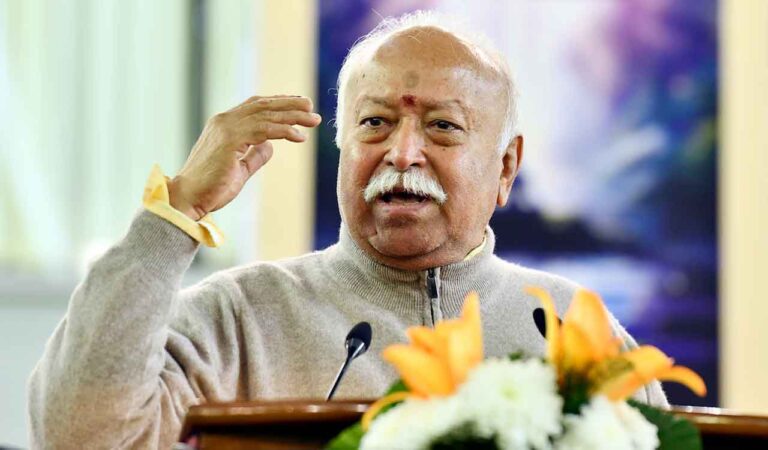
Nagpur, Nov 9: Rashtriya Swayamsevak Sangh (RSS) chief Mohan Bhagwat on Monday recounted a little-known episode from the organisation’s early history, recalling that a Muslim man named Ibrahim had spoken in defence of the RSS when an attempt was made to ban it in the Central Provinces Legislative Assembly in the 1930s.
Speaking at the inauguration of a newly constructed auditorium at the Nagpur Nagrik Sahakari Bank Limited headquarters, Bhagwat shared that during the early years of the Sangh, there were no Swayamsevaks present in the Assembly to defend it, nor was there anyone supporting the RSS ideology.
“At that time, a person named Ibrahim raised his voice in support of the RSS, stating that the organisation should not be shut down as it is not communal,” Bhagwat said. Quoting Ibrahim’s address in the Assembly, he added, “I believe that those who say Hindustan is a ‘Hindu Rashtra’ should be sent to a mental hospital. However, I know Dr Keshav Baliram Hedgewar personally. He is not insane; he is a good person. Therefore, the RSS can never be communal.”
Bhagwat noted that although the RSS was still relatively unknown in the 1930s, Hedgewar was a widely respected figure. “Since its inception, the organisation’s identity has been shaped by its swayamsevaks. Today, after 100 years, Swayamsevaks continue to be the real identity of the RSS,” he remarked.
Highlighting the selfless life of RSS full-time workers (Pracharaks), Bhagwat said that individuals come with different abilities, skills, and human qualities, but what unites them is their complete dedication. “I am a Pracharak myself. I have observed Pracharaks closely over the years, and their lifestyle has become second nature to me,” he said.
He added that people write about Pracharaks out of genuine affection and respect, not for any personal gain, as there are no material benefits associated with RSS work. Reflecting on the lifestyle of dedicated volunteers, Bhagwat said a true Swayamsevak lives a life free of ego and personal expectations, dedicated entirely to the welfare of society.
He stated that out of roughly 7 to 7.5 million volunteers who identify as Swayamsevaks today, around 4,000 full-timers completely set aside personal desires to live entirely for the nation’s future. Describing the life of a swayamsevak as “swimming against the tide,” he noted that a volunteer strives to live without ego, selfishness, or personal expectation, focusing entirely on how much positive contribution they can make to society.
Bhagwat remarked that usually, a wedding is solemnised before thread ceremony rituals, but in a Swayamsevak’s life, the sequence of sacrifice comes first. He emphasised that the global community is closely observing India’s model of selfless service and societal dedication.
He reiterated that swayamsevaks remain the true identity of the Sangh. He highlighted that 100 years into its journey, the organisation’s progress is not due to external favour or benevolence, but stems directly from the dedication, selfless service, and character of its workers. He pointed out that the world is looking toward India with high expectations amidst changing global developments, and emphasised the need for a strong, disciplined, and united society to meet those expectations responsibly
IANS
This content is published by The Shillong Times and has not been created or edited by Hello Headlines. View original