Gemini in action: How voice, agents, and coding tools are changing the way businesses use AI
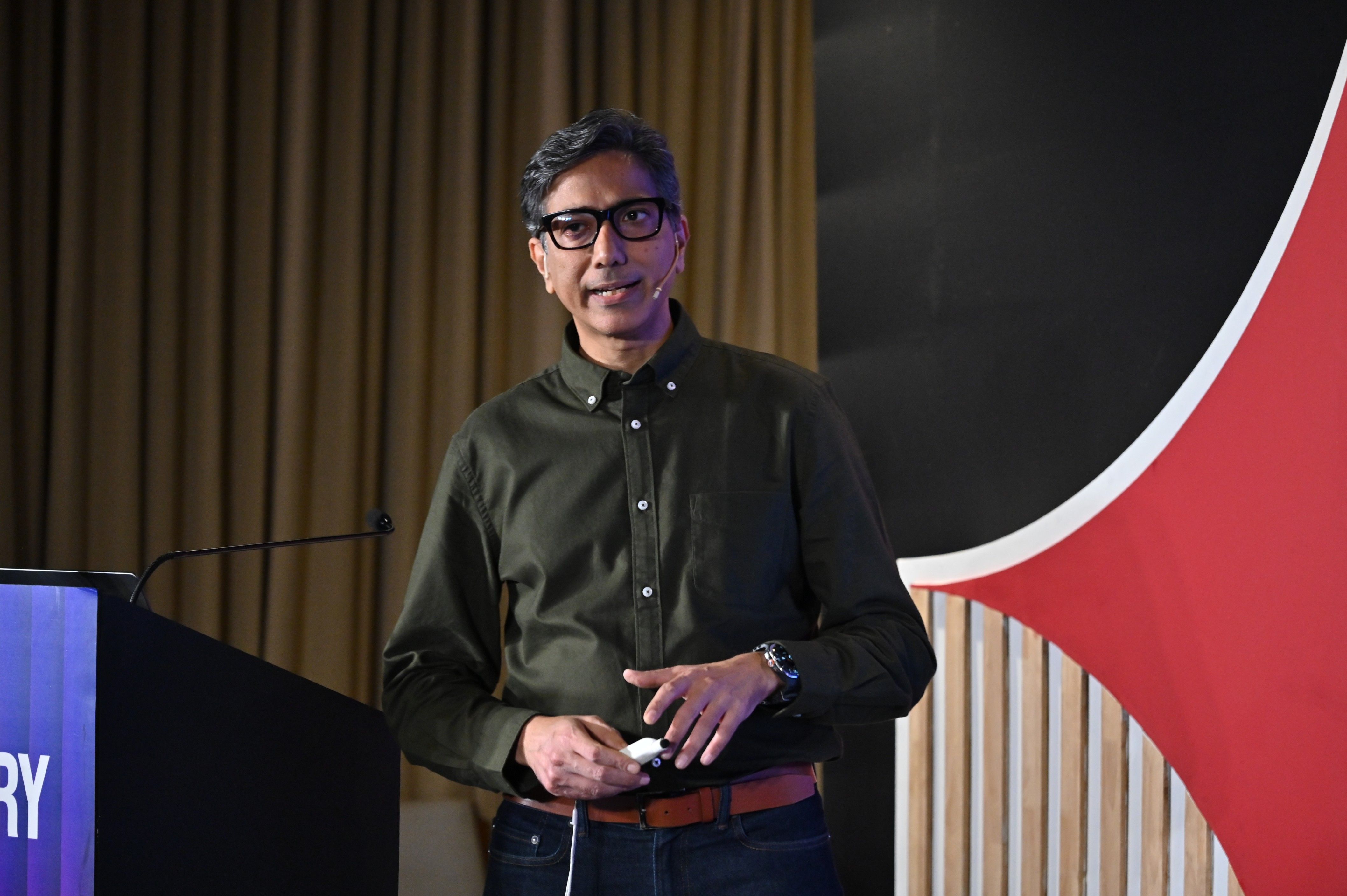
Generative AI, in the form most people know it, is only about three years old. In that short time, Rajesh Shewani believes it has already moved through three distinct eras.
First came retrieval: chatbots that answer a question and wait for the next one. Then came agents that take action on a user’s behalf. Now, he said, the industry is entering what he calls the harness era, where orchestration, memory, and guardrails around a model let it carry out work from start to finish.
“An agent is nothing now but a model plus a harness,” said Shewani, Head of AI Customer Engineering for Digital Natives, Startups and ITeS at Google Cloud, at TechSparks 2026.
In a masterclass titled ‘Gemini in action’, Shewani promised a look at what is happening rather than a sales pitch. He covered where businesses are putting AI to work, how voice is becoming an interface, the tools Google uses to build its own software, and the questions organisations need to answer as agents become everyday users of their systems.
Shewani said organizations are no longer just discussing AI but executing in five broad areas.
- Agents, which are changing how companies work and how startups build for other businesses.
- Creative work, from image and video generation to marketing and branding, was one of the earliest areas to take off.
- Multimodal AI, which lets models work with images, video, and voice, not just text.
- Physical AI, including robotics and self-driving cars, which he expects to grow fast as the “brain” of large language models gains a body.
- AI fluency, a priority for traditional organizations in banking, insurance, retail, and telecom.
For those traditional businesses, the worry is less about building models and more about whether employees can use AI in their daily jobs. They don’t need to be experts or developers, he said, but they do need to be fluent.
What every agent needs
The three eras are cumulative, Shewani explained. Agents build on retrieval, and harnesses build on agents. AI is no longer an assistant that appears and disappears, but something closer to an autonomous colleague.
“It’s no longer just about the model,” he said. “It’s the model plus everything that you build around it”, from memory and context management to sandboxing.
He described four things every agent needs:
- A goal: booking a ticket, making an entry in an SAP system, or negotiating a price by voice.
- Instructions: guidance that goes beyond a single prompt and can be stored for reuse, much as new employees learn how an organization works.
- Knowledge: a company’s own data, since models are trained on public information, not internal records.
- Tools: the means to act, such as updating a CRM or placing an outbound call.
Knowledge is where much of the effort is going. Many teams had begun building their own “LLM wikis” for agents, and Google is now trying to standardize the approach with the Open Knowledge Format (OKF). OKF v0.1 represents knowledge as a directory of markdown files with YAML frontmatter, which agents can read directly. Shewani compared its role to what Model Context Protocol (MCP) did for backend integration.
A shared knowledge layer, combining a knowledge graph with plain text, also keeps costs down, he said. Rather than querying everything for every prompt, agents are pointed to structured context, which uses fewer tokens.
Voice becomes the interface
“Voice is becoming the new user interface,” Shewani said, whether for customers, employees, or users who prefer to speak in local languages. He noted that Google DeepMind’s team in Bengaluru is doing extensive work on Indic languages. Gemini Live now supports more than 90 Indian languages and dialects, including Sanskrit, Bhojpuri, and Maithili.
He showed a live translation demo built for Grab, the Southeast Asian ride-hailing platform, in which a passenger and driver who do not share a language coordinate a pickup.
Grab says travellers and driver-partners make more than 10 million voice calls a month, and it has been testing Gemini 3.5 Live Translate, which offers two-way translation in more than 70 languages.
Shewani said Gemini 3.8 Live, launched in September, improves further on noise cancellation and conversations between multiple speakers.
Another demo, built in India, dubbed a news video into Marathi and Malayalam from a single prompt while matching lip movements and facial expressions. Dubbing once required complex pipelines with many steps, he said, but live models have cut those down significantly, making it easier to create training videos and marketing content across languages.
He also showed Citi Sky, Citi’s AI-powered wealth assistant, which uses a virtual avatar to walk clients through options for a maturing certificate of deposit and complete the renewal. For such experiences, latency is critical. “If a flow breaks even for a second or a millisecond, it doesn’t work,” he said.
The stack under the hood
Shewani then walked through the tools that sit beneath these experiences.
Gemini agent is a single agent that can carry out tasks end to end. Google Cloud introduced it on October 8, 2026, and it can keep working in the cloud for hours or days, even when a user’s device is offline.
Shewani gave the example of a procurement team asking it to research options, write a request for proposal, send it to vendors, evaluate responses, and produce a shortlist. According to Google, the agent routes each task to the most suitable model, currently choosing between Gemini and Anthropic’s Claude models.
Gemini Enterprise adds guardrails and quotas for businesses, which Shewani said helps keep costs from running away, a key concern in tokenomics. Google Cloud CEO Thomas Kurian has said nearly 90% of Fortune 100 companies use Gemini Enterprise.
Antigravity is Google’s harness for building software, available as a command-line tool and as extensions for code editors. Shewani said most of Google’s own code is now written using the same harness, known internally as Jetski. Google CEO Sundar Pichai has said 75% of new code at Google is now generated by AI and reviewed by engineers, up from 25% in October 2024.
CodeMender scans code for vulnerabilities, creates patches, tests them in a sandbox, and can integrate with a GitHub repository. When Google DeepMind first announced it in October 2025, it had already contributed 72 security fixes to open-source projects.
Google is also giving every agent its own identity, which Shewani likened to an LDAP directory for agents, so organisations can track which agent took which action.
Choosing the right model for the job
No model can be cheapest, fastest, and most capable at once, Shewani said, so businesses need a range of models and should match each task to the right one. Google’s Flash models are its workhorses for everyday tasks that do not need complex reasoning.
“If I need to get to office every day, I don’t need to have a Ferrari,” he said. For the hardest work, there is Gemini 4 Argon.
Google made Gemini 4 Argon, its latest frontier model, generally available on October 13, 2026, at an introductory price of $2 per million input tokens and $10 per million output tokens, with cached input tokens 95% cheaper. Google says it ranks first on the Vals Index, and Shewani pointed to software engineering, cybersecurity, and knowledge work in finance, legal, HR, and procurement as its main use cases.
He showed two examples. In one, Argon processed more than 80,000 raw files from NASA’s open archive, including CSVs, images, PDFs, logs, and videos, and turned the analysis into a presentation that followed a custom slide template. In another, it wrote more than 5,000 lines of Python to render a photorealistic 3D library interior from scratch, with no graphics libraries or rendering engine.
Argon can also generate up to one million output tokens, not just accept one million as input. Shewani said this helps with tasks such as mathematical proofs and multi-file code generation, where producing one large output instead of many small ones uses fewer tokens and runs faster.
Questions every organization should ask
Shewani closed with the questions businesses need to start answering now that agents are here. Will agents become the primary users of their systems? Are their databases ready for swarms of agents firing queries that no person wrote? How will they manage agents that do things they are not allowed to do?
Roles will change too. “Developers are essentially going to become managers of agents,” he said. Organizations will also need to manage budgets, route tasks across a mix of models, track telemetry and memory, and prepare for agents that generate their own user interfaces.
Asked about education, he said agents are already being used to create content in multiple languages, build AI tutors, generate quizzes, and grade students. Google offers such tools through Google for Education, he noted, and many edtech companies are building their own. In education, he added, avoiding hallucination is critical, which is why grounding agents in a trusted knowledge repository matters.
For Shewani, the shift is clear. The competition between models will continue, but the advantage increasingly lies in what businesses build around them: the knowledge they give agents, the guardrails they set, and the systems ready to work alongside them.
This content is published by YourStory and has not been created or edited by Hello Headlines. View original