11 Sessions, 2,473 Amendments: How India Created Its Constitution
Imagine a country where one region was governed by a king, another by a British-appointed administration, and another by an elected provincial government. When India became independent, these different systems could not simply be replaced overnight.
The new country needed a common set of rules, and the task fell to a Constituent Assembly that had begun meeting even before Independence.
The challenge was not merely to write a document. It was to create a framework that could govern a vast and diverse population while bringing together territories that had never functioned as one political unit.
A country with different rulers
Before Independence, British India consisted of provinces administered directly by the colonial government, while hundreds of princely states were ruled by Indian princes under British paramountcy. These states retained varying degrees of internal autonomy, but their rulers depended on the British Crown for their political status.
The departure of the British in 1947 brought this arrangement to an end. The integration of the princely states became a crucial task for Sardar Vallabhbhai Patel and his secretary V P Menon, who negotiated the states' accession to India.
But political integration and constitutional drafting were different challenges. Accession brought territories into the Indian Union; the Constitution would establish how the Union and its governments would function.

The Constituent Assembly had been formed under the Cabinet Mission Plan of 1946. Its original strength was 389 members, including 292 elected through provincial legislative assemblies, 93 representing princely states and four from Chief Commissioners' Provinces. After Partition, its membership fell to 299.
The Assembly was therefore not a directly elected parliament of all Indian adults. Its members were chosen indirectly, while princely-state representatives were selected through arrangements involving their rulers. Yet it became the body responsible for framing the Constitution of independent India.
Turning different territories into one constitutional system
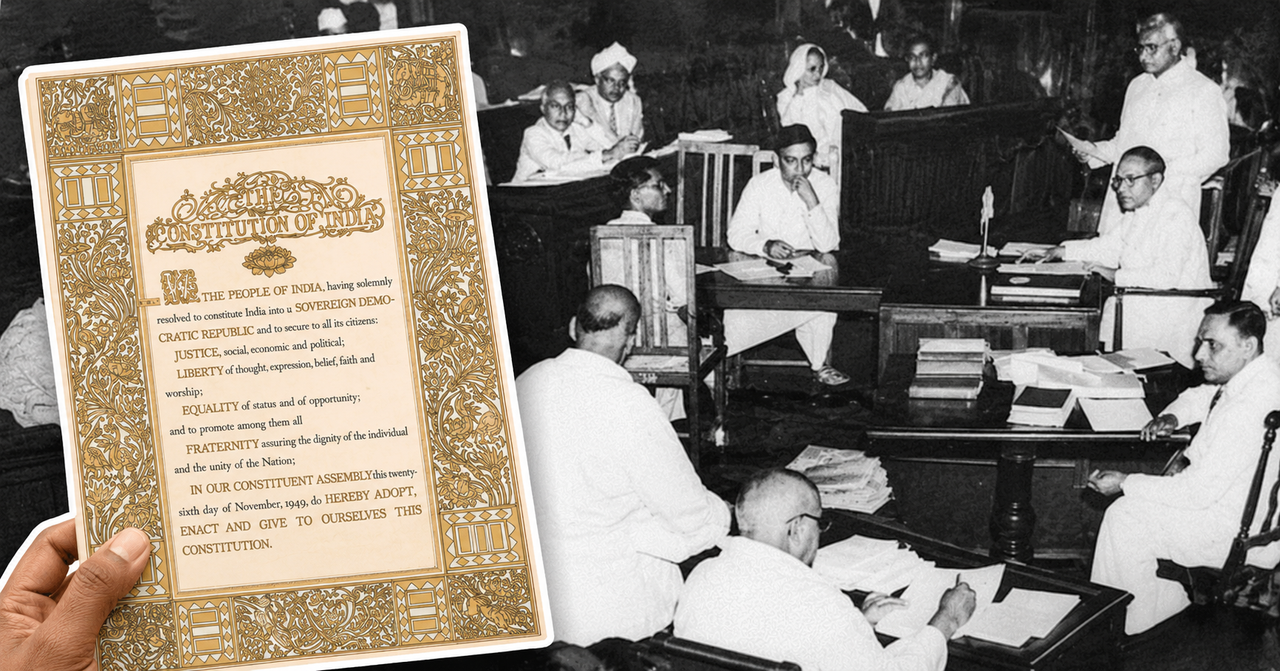
The Assembly first met on 9 December 1946 in New Delhi. Dr Rajendra Prasad became its permanent President, while Jawaharlal Nehru introduced the Objectives Resolution, which outlined the principles of the future republic.
The Resolution was adopted on 22 January 1947. It envisioned India as an independent sovereign republic, with justice, equality and freedom among its guiding principles. These ideas would later shape the Preamble.
The Assembly also created committees to examine different parts of the Constitution. Their work covered subjects such as Union powers, provincial government, fundamental rights, minorities and the relationship between the Centre and the states.

This committee-based process was important because India could not be governed through a single administrative template copied from the colonial era. The Constitution needed to define the powers of the Union while allowing states to function within a shared framework.
On 29 August 1947, the Assembly appointed a seven-member Drafting Committee under Dr B R Ambedkar. Its task was to turn the Assembly's decisions and committee reports into a coherent legal document.
Ambedkar was not working alone. The committee included legal experts such as Alladi Krishnaswami Ayyar and K M Munshi, while constitutional adviser B N Rau had helped prepare the initial draft. The contributions of Alladi Krishnaswami Ayyar illustrate how the Constitution's making drew on a wider group of legal minds.
The draft was presented in February 1948 and opened to public discussion. Members examined its provisions, proposed amendments and debated the balance between individual rights, state powers, and a strong national government.
The Constitution becomes India's common framework
The Assembly's work was extensive. It held 11 sessions over 165 days, with 114 days devoted to considering the Draft Constitution. Members tabled 7,635 amendments, of which 2,473 were moved and debated.
The debates addressed how India would function as a parliamentary democracy, how citizens would be protected through fundamental rights, and how the Union and states would share responsibilities. The Constitution also established a common framework for citizenship and governance, rather than allowing each former princely state to retain its own constitutional system.
On 26 November 1949, the Assembly adopted the Constitution. It contained 395 Articles and eight Schedules. The document came into force on 26 January 1950, when India became a republic.
The achievement was not that every territory became identical. Instead, India created a constitutional system under which diverse states and regions could operate within one Union, with common institutions and laws.
The Constitution's making was therefore a process of negotiation as much as drafting. It brought together the work of political leaders, legal experts and representatives from different parts of the country, turning a collection of provinces and princely territories into a constitutional republic.
Sources
'Constituent Assembly': Digital Sansad, Lok Sabha, Parliament of India
'The Constituent Assembly of India': Employment News, Government of India
'Constituent Assembly and Framing of the Constitution': Publications Division, Government of India, Yojana, April 2020
'Indian Constitution': Dr B R Ambedkar Foundation, Government of India
'Constituent Assembly Draft Making Debates': Parliament Digital Library, Lok Sabha Secretariat
This content is published by The Better India and has not been created or edited by Hello Headlines. View original