This 17-YO Helped Turn a Bengaluru School’s Storage Room Into a 2000-Book Library for Children
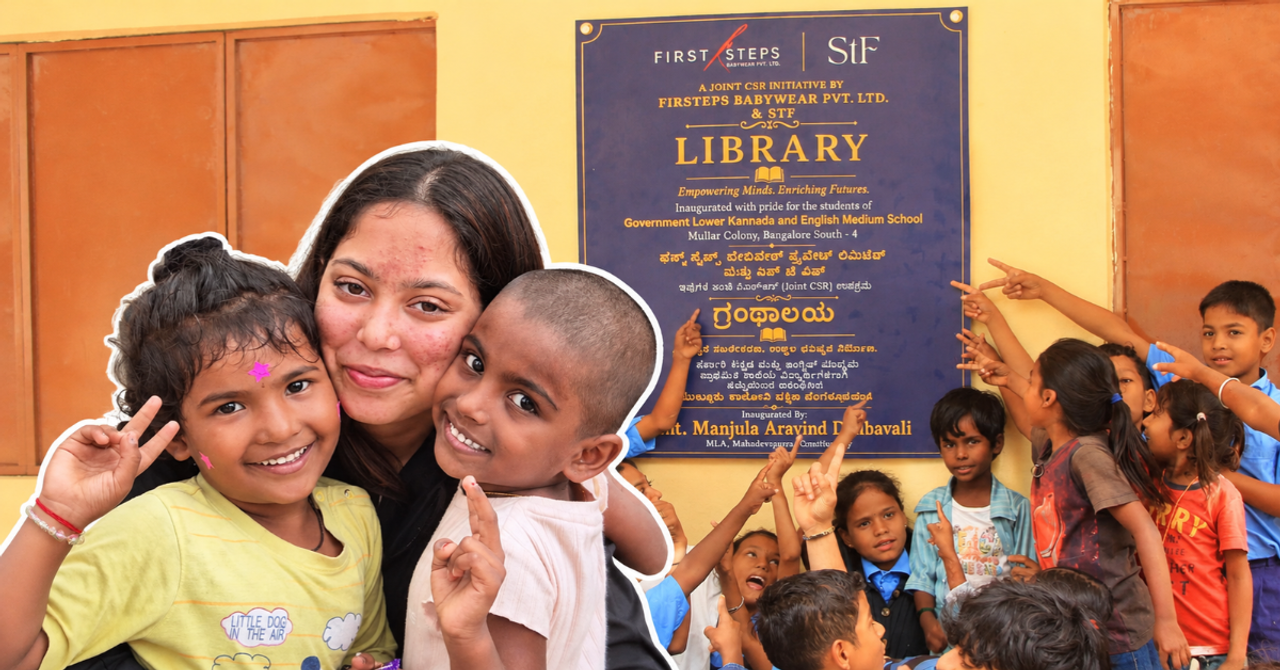
On a Saturday morning at a government school in Bengaluru’s Mullur Colony, 17-year-old Asavari Agrawal barely gets through the gate before the children surround her.
Some run up to hug her. Others tug at her hands, eager to show her something or pull her into a game. The younger ones often cling to her, refusing to let go even as she tries to begin the day’s activities.
By now, the scene is familiar. Asavari greets the teachers and children, gets everyone moving and settles into whatever the morning calls for. There may be table tennis, an art activity, a lesson, a fitness session or simply time spent talking and playing.
“When she enters the gate, they run to her,” says Victoria, headmistress of the school. “In the beginning they were shy. But because she came every week, they became comfortable very quickly.”
At 17, Asavari is balancing Class 12, college applications, national-level table tennis, Bharatanatyam and Grade 8 piano. Yet for nearly five years, she has also made space for spending her weekends with children at government schools and residential homes across Bengaluru.

That commitment began when she was a child herself and eventually grew into Shape the Future, the youth-led initiative she founded at 13.
Today, around 50 student volunteers are part of the wider network, reaching roughly 250 children. There have been sports sessions, health and eye camps, menstrual hygiene drives, book collections and learning activities.
But when Asavari talks about what matters most, she does not begin with those numbers.
“I think the idea of showing up is what matters most to my NGO,” she says. “No matter how many drives or fundraisers or events that I hold, I feel like being there for the kids, emotionally and physically, matters the most.”
It started with playdates
Asavari’s connection with children from underserved communities began long before Shape the Future.
When she was young, her mother began volunteering at Karuna Shreya hospice after experiencing several personal losses. Asavari would accompany her and, over time, also began visiting Thayi Mane, a government-recognised home for orphaned and destitute children.
Back then, she did not think of herself as a volunteer.
“I was really small when I started going there,” she recalls. “Honestly, initially it was like playdates for me. It was so fun going there and playing with the kids.”

As she grew older, those visits began to look different. She started noticing the opportunities she had access to, from learning sports and dancing to playing the piano, and how different that access could be for the children she was meeting.
In 2021, that realisation took a more concrete form. Asavari had started her own table tennis academy and decided to take the sport to the children she had been visiting. She brought tables, rackets, balls, shoes, clothes, jackets and fitness equipment and conducted a session for around 100 children.
For many, table tennis was unfamiliar.
“I think they were really excited to learn a new sport that they probably hadn’t heard of yet,” she says.
The first session was not easy. Asavari was around the same age as many of the children and had to introduce a completely new sport to a large group. But some children took to it quickly, and the experience made her think about what else she could bring to them.

A year later, in 2022, she started Shape the Future.
What began with one sport slowly expanded into a broader effort to give children access to learning, play and experiences that might otherwise remain outside their everyday lives.
What a Saturday looks like
Today, a typical weekend begins with Asavari and her volunteers packing supplies for the day’s session. Depending on the activity, that could mean sports equipment, stationery, educational material or art supplies.
Around 10 to 15 volunteers may join her, although the group changes because they are all school students managing their own academic schedules. There is usually a warm-up, the main activity and plenty of time for games before everyone heads home.
The session may last only a couple of hours, but it has become a regular part of Asavari’s week.
“I have a lot of exams and applications and personal work,” she says. “But setting aside one or two hours every weekend doesn’t do any harm. It’s not like work to me. It’s more of a hobby going there.”

At Mullur Colony, Victoria has seen that commitment first-hand.
“Most Saturdays she comes herself. On some Saturdays when she cannot come, her team comes, but someone is always here every Saturday without fail,” she says.
That consistency has changed the relationship between Asavari and the children.
“When she first came, they would just silently follow what she said,” Victoria recalls. “Now they talk back, they argue, they pull her, they sit close to her. This closeness takes time. It comes only because she has been here every week.”
Aparna, in-charge and principal at Thayi Mane and Lakshya Residential School, has witnessed the same bond.
“They know each one by name,” she says. “They wait for her on Saturday. When she comes, they run to her.”
Why a missed Saturday matters to the children
There are two kindergarten girls at Mullur Colony, Aarohi and Anjali, whom Asavari has grown particularly close to. When she arrives, they often run towards her and refuse to let go.
“They keep calling me Didi, they keep calling me Amma,” Asavari says. “We’ve built such a close connection with these kids that it just hurts me to not end up going there.”

Then there is Sumit, a boy who recently lost both his parents. One day, he told Asavari, “You’re the only family I have left now.”
For a teenager who is still learning how to understand grief, moments like this can be difficult to process.
“I think I’m still too young to understand each and every kid’s emotion,” she says. “But I try.”
At Thayi Mane, Aparna remembers another moment. When Asavari had surgery on her appendix, she could not visit for several weeks. When she finally returned, a boy named Partha told her that one night his “heart pained” because he thought she might not come back.
“She did not say anything. She just held him,” Aparna recalls.
These experiences have shaped Asavari’s understanding of volunteering. She has seen people arrive for one-off activities, donate something, take photographs and leave. For children who have experienced people coming and going, that can make it difficult to trust that someone will stay.

“The best and worst part is getting attached to these kids,” she says.
The children have even told her that when she does not come, they worry she might leave like others have.
“They don’t look for money. They don’t look for items,” Asavari says. “They look for someone who isn’t going to give up on them.”
For her, that means treating the children as equals rather than beneficiaries.
“It’s about not treating them like a project. Treating them as equals and constantly building that relationship.”
When the children asked for books
The library at Mullur Colony grew out of these everyday conversations.
Asavari would ask the children what they wanted to learn about, what they dreamed of becoming and what they wished they could read. Their answers revealed a simple gap: they wanted to explore beyond their school textbooks, but there were very few books available to them.
So Asavari and her team began collecting them.
Over nearly two years, five student volunteers took charge of the collection, reaching out to schools and communities and bringing in donated books. Slowly, the collection grew to more than 2,000.

The school also had a room that had essentially become a storage space. Turning it into a library meant redoing the flooring, repainting the walls, cleaning the room, adding shelves and furniture, and finally sorting and arranging the books.
“It went from being an absolute rag of a room,” Asavari says. “We had to uproot the entire flooring, repaint the walls, clean the entire room and then bring in the furniture and the books.”
For Victoria, who has watched the school change since Shape the Future first arrived in 2024, the library represents something the children simply did not have before.
“Before this we had nothing. Only textbooks. No library, nothing like that,” she says. “She collected more than two thousand books and arranged the room also with shelves and light. For our school this is a very big thing.”
The idea has also been about understanding what individual children want to read rather than simply filling a room with books.
At Thayi Mane, one girl wanted more advanced reading material, so Asavari sourced a set of 25 encyclopaedias specifically for her.
“That kind of attention is rare,” Aparna says. “The children feel seen when someone notices what they individually need.”
Preparing for the Saturdays she may miss
Shape the Future has remained entirely bootstrapped. Asavari has funded its work through earnings from her Bharatanatyam Arangetram, table tennis prize money and even by selling her own piano and table tennis table.
But she does not see those decisions as sacrifices.
“I wouldn’t call myself selfless,” she says. “I think the kids needed it more than I did.”
If anything, the harder thing to give has been time. And now, time is precisely what Asavari is preparing to have less of.
She is in Class 12 and hopes to study at university in the US or UK. For the first time since she began visiting these children regularly, she may soon be unable to walk through the school gates every Saturday.
“I’m absolutely terrified as to how these kids are going to feel once I leave,” she says. “When I’m in college, I’m not going to be able to come for months.”
So she is preparing Shape the Future to continue without her.
Responsibilities have been divided among heads of fundraising, volunteering, social media and operations, while younger students are being given more responsibility. Asavari is deliberately preparing a team that can continue the work even when she is away.
Her mother, who first introduced her to volunteering, remains part of that support system too.
“This is not just Asavari’s work,” Aparna says. “Her mother has always been part of this. This is their family’s commitment.”
Asavari describes what she hopes to build in a different way.
“I think of it like generational wealth,” she says. “You build it, you pass it on, you make sure it outlasts you.”

What began as playdates now includes dozens of young volunteers, hundreds of children and a library built from thousands of donated books.
Yet what Asavari values most cannot be measured in numbers. It is the familiarity of a Saturday morning, the children knowing she will walk through the gate, and the trust that has grown because she has kept returning.
“I’ve just done it consistently,” she says. “And I’ve grown it into something big. These little changes, being consistent with these little changes, is what matters most.”
Her advice to other young people is just as simple.
“You don’t need to build the world’s biggest NGO. Start with 10 children, but stay.”
All images courtesy of Asavari Agrawal
This content is published by The Better India and has not been created or edited by Hello Headlines. View original