Collective Artists Network’s Vijay Subramaniam on AI and the changing media landscape
For years, the media industry has operated in silos. Talent agencies managed stars, studios made films, platforms distributed content, and brands paid to reach audiences.
Today, those boundaries are blurring. Creators are building their own businesses, AI is changing how content is made, and a single story or character can become the starting point for films, series, brand partnerships, and more.
The Collective Artists Network, founded by Vijay Subramaniam, is building across many of these areas.
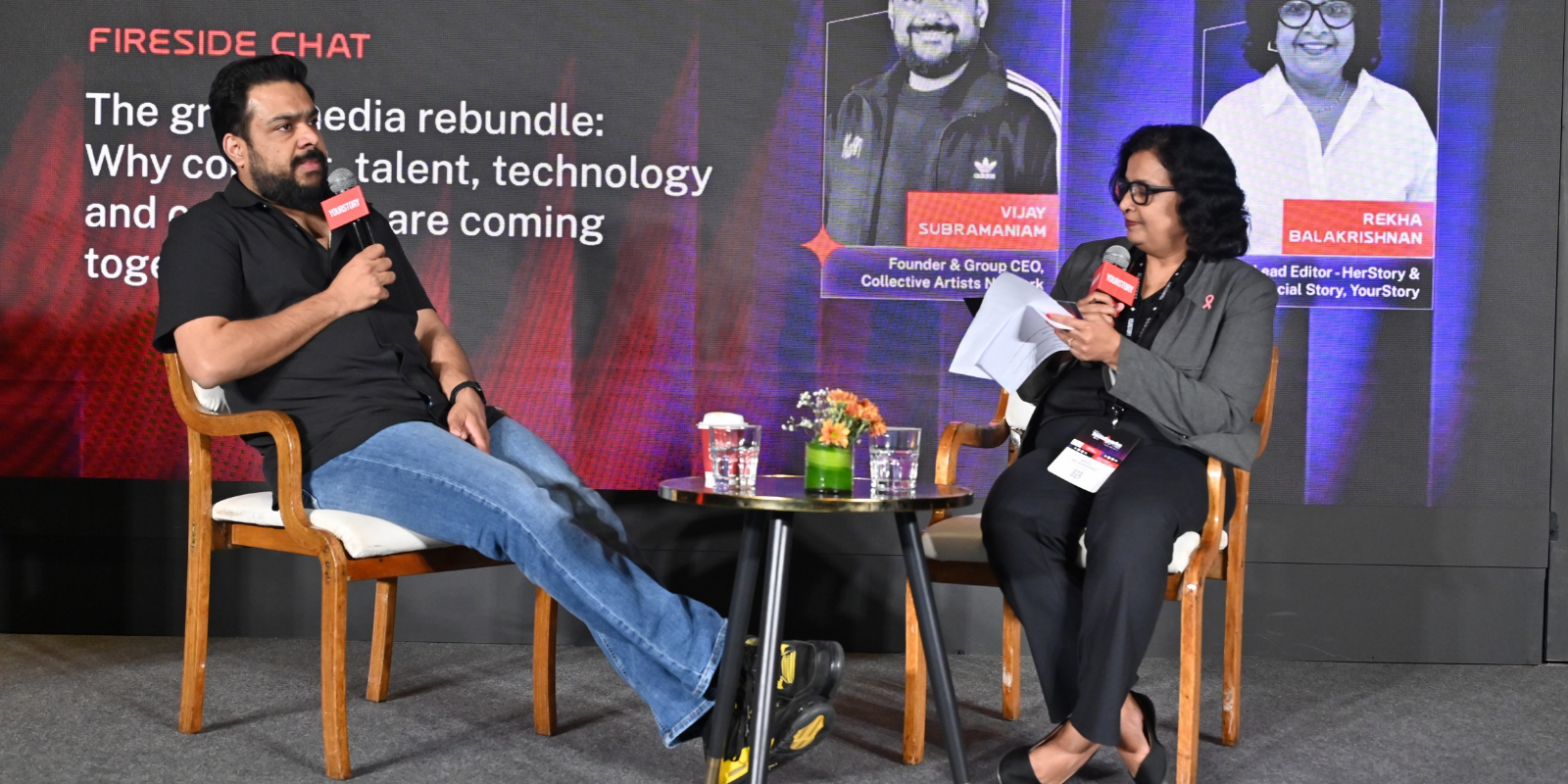
In a fireside chat titled The great media rebundle: Why content, talent, technology and commerce are coming together at TechSparks 2026, Subramaniam discussed how his venture is building layers across talent communities, marketing communities, and technology, and how AI fits into the larger scheme.
Dubbed the “AI man of the media industry”, Subramaniam said that, though it’s scary, he wears the badge with confidence because technology is here to stay.
“My fundamental belief is that content creation should be a level playing field. Historically, a few elites have always had the opportunity to tell a story. But anyone with a story should be able to tell and consume it. My company is pursuing that aggressively. We have the largest slate of AI-enabled content in the world today, and we’re very excited about it,” he explained.
As the media business changes, what does it stand to gain and what does it stand to lose?
Subramaniam believes the media business is recession-proof.
“When COVID happened, we were all confined to our houses to consume content. I don’t think the media stands to lose anything. The operators of media stand to lose if they don’t move with the times.”
He pointed out that for the first time, the Indian media ecosystem is seeing the death of oligarchs.
“Look at everything that has done well, from the pandemic years onward: KGF, Mahavatar Narsimha, the shows on Netflix. We just produced a beautiful little show called Musafir Cafe, which blew up on Netflix. Look at Aditya Dhar and Ranveer [Singh] and what they did with Dhurandhar. These are not people who have been around for 40 to 50 years gatekeeping the industry. These are new names, fresh faces, fresh talent that has broken through. I think that’s what will succeed,” he said.
But is AI making content cheaper? Will it make businesses more profitable and allow them to make content at a fraction of the earlier cost?
“Will businesses be more profitable because of it? Two hundred per cent, yes. Will storytelling now be democratic, so that you can sit in Jabalpur or Coimbatore and tell a story? Yes. What we’re bringing to the table is this: if you have a vision, you can realise it,” he said.
Subramaniam also emphasised that it’s not typing a prompt and getting a script, or “AI slop”.
"The same principles that apply in animation apply here. You need a production designer, a costume designer, a DOP. There will never be a point where AI cracks the script and the dialogue."
“You’ll need a human behind it. Nobody can capture a director’s vision. We’ve built our [G5] tool entirely on the back of working with four National Award-winning directors: Rajesh [Mapuskar], who won for Ventilator; Hansal Mehta; Sanjay Puran Singh [Chauhan]; and Manu Anand. They told us what they needed built into the product, and that’s what you see us building today,” he added.
Speaking about Mahabharat, a fully AI-generated animated and visual series released late 2025, Subramaniam admitted to learnings from the first release.
“Did we learn a lot from that first release? Yes. Are we proud of it? Yes, because we’re the first in the world to do it. More importantly, we’ve built the tech so well that in our subsequent releases, starting next month, you’ll see the enhancement. Today we actually have emotion. We have comic timing. We have genuine stress, grief and other expressions coming alive through the tools,” he said.
The creator economy is evolving rapidly, with artificial intelligence, new business models and direct-to-consumer brands opening up opportunities for creators to build businesses. But as the industry looks to the next five years, the bigger question is what will drive success: talent, stories or access to audiences?
For Vijay Subramaniam, the answer begins with recognising that audiences are becoming increasingly difficult to predict.
“The audience is tougher than it has ever been. Every time you say, ‘This is a formula’, it breaks,” he said, pointing to how audience preferences can defy even the most established industry assumptions.
A title like Musafir Cafe challenges the belief that big-budget streaming shows need the scale and spectacle of Game of Thrones or House of the Dragon. Similarly, the belief that audiences won't commit time to theatrical releases can be upended by the success of films like Dhurandhar.
In an environment where established formulas offer little certainty, Subramaniam believes the fundamentals of building a successful creative business remain unchanged: find the right storytellers, equip them with the resources they need, and ensure the economics make sense.
“What you need to keep in view is: one, catch the best storyteller with the most passion. Two, give them everything they need from a tools standpoint. Three, don’t be stupid about economics,” he said.
This content is published by YourStory and has not been created or edited by Hello Headlines. View original