Same AI, different outcomes: what 25 lean AI startups got right
Every AI startup today starts from the same place. The same frontier models, the same open-source alternatives, the same rented GPUs. A two-person team in Bengaluru and a thousand-person incumbent buy them on nearly the same terms.
So why do a handful of small teams scale beyond $5 million in annual recurring revenue while most stall after their first round?
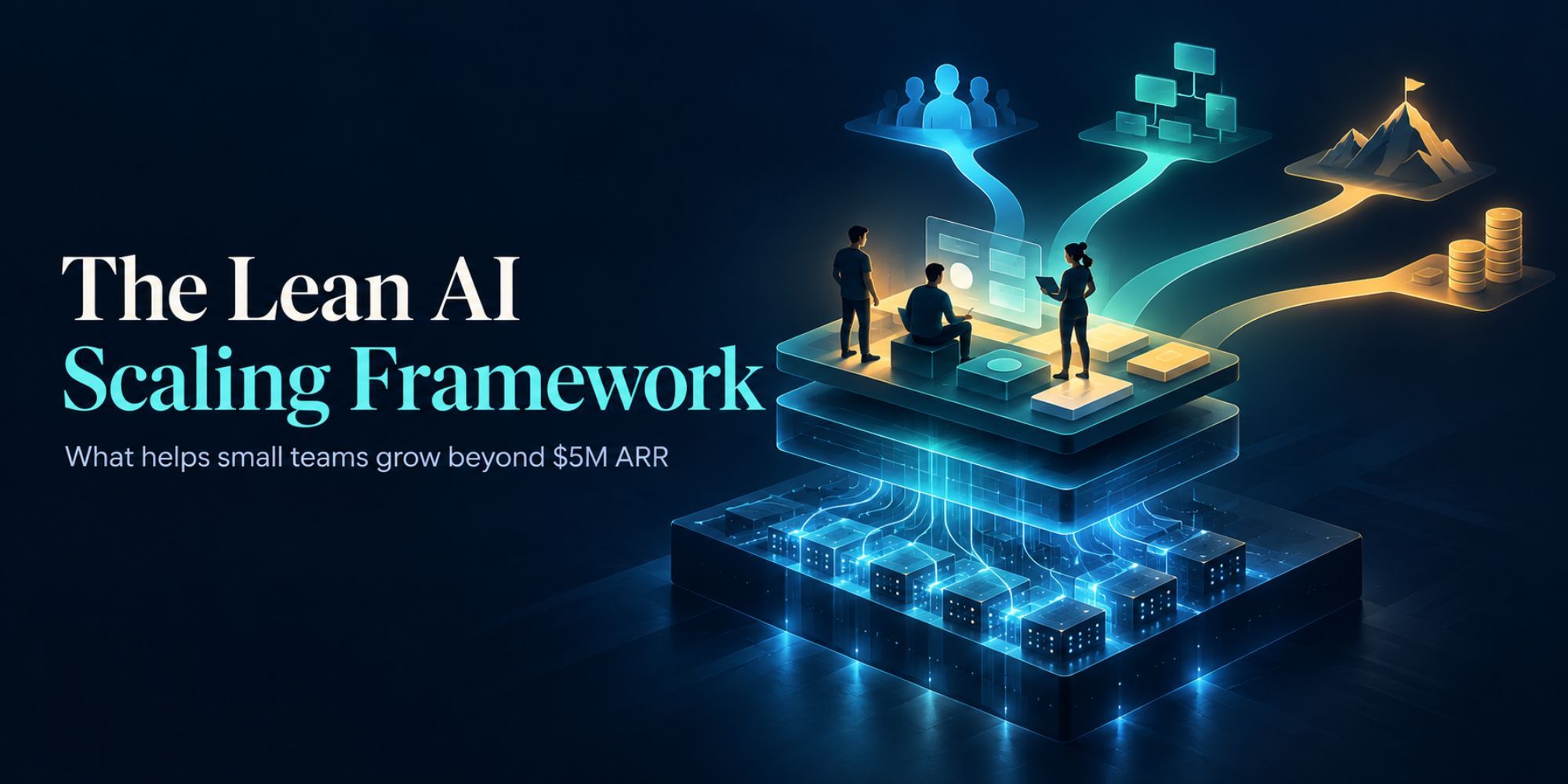
That is the question behind The Lean AI Scaling Framework, a September 2026 report by Suvan Ventures Managing Partners Radhesh Kanumury and Piyush Gupta, with research intern Rahul Maran. The team studied 25 AI-native B2B companies, from Cursor and Lovable to ElevenLabs, Vapi and Legora, and catalogued 124 publicly cited reasons for their growth. Those reasons collapsed into 73 tags and, eventually, seven recurring "scaling drivers."
What is a “Lean AI Company”
For the purposes of this framework, a "Lean AI company" is defined as a company that has scaled to more than $5M in annual recurring revenue (ARR) with a core team of 10 people or more. Most companies in the 25-company sample meet this bar.
Access to AI is the baseline, not the moat
The report's starting premise is simple and direct. Since any company could ride the same AI wave, something other than AI access separates those that scale from those that don't.
What the wave did do was create opportunities. Problems that once needed a large specialist team and years of R&D became solvable by a small team on top of a purchasable or open-source building block. Natural-language coding became possible using frontier LLMs and AI coding agents, without building code-generation systems from scratch. Voice agents no longer needed proprietary speech stacks. Photorealistic video no longer needed an in-house research lab.
20 of the 25 companies (80%), formed around a specific capability wave such as RAG, agentic coding, better voice models or generative video. But the authors are careful here: timing explains why a category of startups appeared. It does not explain why one company in that category pulled ahead of rivals chasing the same opening with the same tools.
That answer sits in what founders built on top of the shared base.
The seven drivers that separated winners
Driver Seen in(of 25) What it means Examples from the sample D1 Market timing 20 Building on a capability that only just became possible Cursor, ElevenLabs, Kling AI D2 Distribution and GTM 19 Acquiring customers without a matching sales hiring curve Lovable, Langfuse, Zapmail D7 Problem selection 15 An acute pain tied to an existing budget and clear ROI Xbow AI, Chatbase, Legora D4 Workflow ownership 13 Sitting inside a process the customer would have to rebuild to remove Portkey, Langfuse, Vapi D3 Product and technical moat 10 Something a model provider cannot replicate by shipping a feature Cursor, RunwayML, Polsia AI D6 Economics 7 Revenue that grows with usage, not headcount Bland AI, Neysa AI, Surge AI D5 Founder-market fit 6 Founders who lived the problem at scale before building Xbow AI, Portkey, Athina AI
Three drivers do most of the explaining.
Distribution explains the "lean" part. Bottom-up developer adoption, open-source cores, freemium funnels, SEO and founder-led content let small teams grow without proportional sales hiring. Lovable is the sharpest example: the report cites roughly 8% freemium-to-paid conversion against a typical 2 to 5% SaaS benchmark, and says the company held off on a dedicated sales team until around $100M ARR. Zapmail gets about 35% of customers through affiliates.
Workflow ownership explains durability. The question the authors suggest: what would a customer have to rebuild if they stopped using you tomorrow? Gateways, observability layers and orchestration tools score highest because ripping them out means re-engineering systems and retraining teams.
Problem selection is the most controllable. It is the one driver a founder decides before writing any code. Xbow AI went after security testing, an expensive and talent-constrained bottleneck, with an ROI story framed around risk rather than productivity. Chatbase went after customer support, an existing budget line with measurable returns.
Different businesses win on different drivers
No company in the sample scored well on all seven, and the authors say none should be expected to. What matters is which drivers carry the weight for a given business model.
Archetype Sample companies Drivers that dominate AI infrastructure and platforms Vapi, ElevenLabs, RunwayML, Neysa AI, Langfuse, Helicone, Portkey Workflow ownership (D4), technical moat (D3) AI-native creation and development Cursor, Lovable, Emergent, Gamma, Kling AI, Legora Distribution (D2), problem selection (D7) AI-native execution and automation Retell AI, Bland AI, Chatbase, Xbow AI, Polsia AI Problem selection (D7), economics (D6), founder-market fit (D5) Data, training and model-ops Surge AI, Athina AI, Parea AI Workflow ownership (D4), economics via high-ACV contracts (D6)One data point stands out in the infrastructure group. The report records three of its sample companies being acquired by larger platforms in 2026: Langfuse by ClickHouse, Helicone by Mintlify and Portkey by Palo Alto Networks. Workflow ownership, it seems, is as attractive to acquirers as it is to customers.
A scorecard founders can run on themselves
The framework ends in a practical tool. Each driver gets one diagnostic question, scored 0 (no evidence), 1 (claimed but not shown) or 2 (shown with a specific, verifiable example).
- Timing: What capability shift makes this possible now that wasn't possible 18 months ago?
- Distribution: What does it cost, in money and headcount, to win the next 50 customers?
- Moat: What breaks for the customer if a frontier lab ships this natively?
- Workflow: What would a customer have to rebuild to switch away tomorrow?
- Founder fit: Did you live this exact problem, at what scale, for how long?
- Economics: Does revenue scale with usage, or with services and support headcount?
- Problem: How deep it is, who pays for this today, and from which budget line
The patterns matter more than the total. A 2 on timing and little else is a company riding a wave, and its growth rate should be read as a market signal, not proof of an advantage. Strong distribution plus strong workflow ownership is the most attractive combination for capital-efficient growth. And a 0 on problem selection, a founder who cannot name the pain, the payer and the time to value, is the earliest red flag.
For Indian founders, the lesson is encouraging. Capital and compute have historically been the gap between Indian and Silicon Valley startups. If model access is now a commodity, the remaining differentiators are distribution, workflow depth and problem choice, all of which a lean Indian team can compete on. Several companies in the sample, including Portkey, Emergent and Neysa AI, were started by Indian founders.
What the framework does not claim
The authors are upfront about its limits. Every company studied had already scaled, so there is no comparison group of startups that used the same playbook and failed. The data comes from founder interviews and press coverage, where success stories tend to get simplified after the fact. One analyst did all the tagging, and 25 companies is a small, deliberately chosen sample.
So this is not a pass-or-fail scoring model, and it does not predict outcomes. It is a shared vocabulary and a set of sharper questions for the founder-investor conversation.
In a market where everyone can call the same API, "we use AI" says nothing. The questions that remain are older and harder: what pain points, who pays, how you reach them cheaply, and why they can't leave.
You can access the full report here.
This content is published by YourStory and has not been created or edited by Hello Headlines. View original