Told to give up science in school, Mallikarjuna Iytha now backs 2,000 entrepreneurs with disabilities
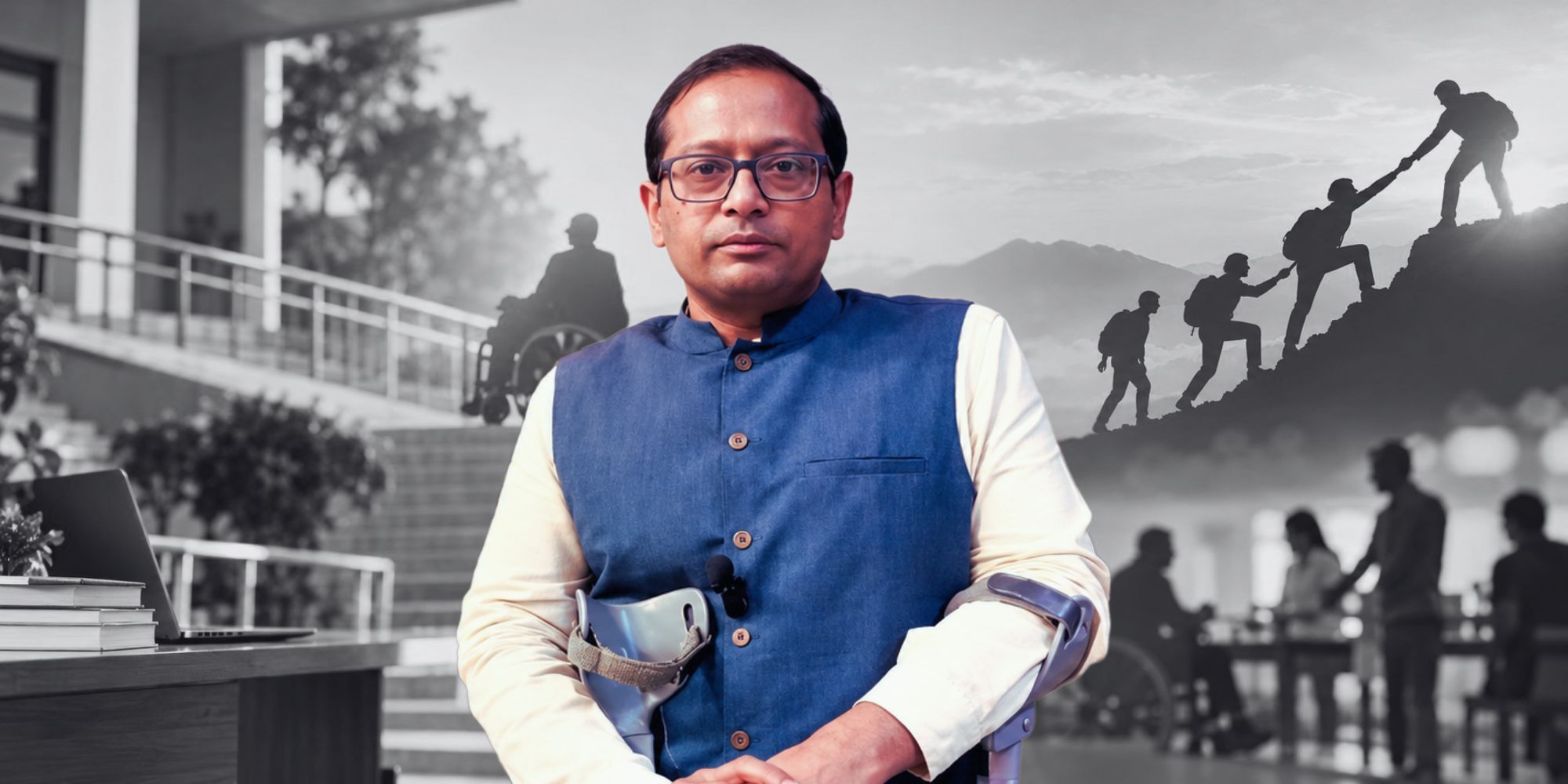
Living with 88% locomotor disability, the National Award-winning founder of IDEA has spent seven years making one argument: persons with disabilities should be treated as entrepreneurs and job creators, not welfare recipients.
Mallikarjuna Iytha was in Class XI when he was told to drop science.
The reason was not his marks. It was his disability. Science, he was advised, would be too hard for someone with 88% locomotor disability. The arts would be more practical.
That advice would follow him in different forms for years. Today, it is the reason he runs the Inclusive Divyangjan Entrepreneur Association (IDEA), an organisation that says it has supported more than 2,000 entrepreneurs with disabilities across India.
His work since has been built on refusing to let anyone else decide how far a person with a disability can go.
Three closed doors
The first door was science in school. The second came years later, when Iytha set out to pursue doctoral research in environmental science and met the same doubts about whether someone with his disability could do the work.
The third was quieter. In the corporate sector, he found that getting hired was not the same as being considered for leadership. Persons with disabilities could be employed. They were rarely expected to lead.
Together, those experiences pushed him towards one question: what would change if persons with disabilities were seen not as beneficiaries, but as entrepreneurs, leaders and creators of economic value?
An alumnus of Jawaharlal Nehru University, Iytha built a long career in India's development sector. He went on to serve as president of Fair Trade Forum-India, the national network that represents the World Fair Trade Organization in India and works with grassroots artisans and farmers.
In 2017, when Delhi hosted World Fair Trade Week and the 14th WFTO Biennial Conference, the forum was among the organisers and Iytha was its president. Linking marginalised producers to markets, rather than to aid alone, would become central to what he built next.
From question to IDEA
Iytha spent years studying the aspirations, barriers and economic realities of persons with disabilities before founding IDEA in 2019.
The organisation was built to work across the full journey, from an entrepreneur's first idea to running and growing a business. Its support combines entrepreneurship training, mentoring, employment, financial help, accessibility and market access.
The premise is a deliberate break from welfare. Instead of asking what persons with disabilities need to receive, IDEA asks what they need in order to build.
The numbers have grown steadily. When Iytha received his national award in December 2024, IDEA was recognised for supporting more than 1,060 entrepreneurs with disabilities. By March 2025, the New Delhi-based not-for-profit said it had backed over 1,500 entrepreneurs across 11 states, whose businesses had together generated about Rs 100 crore in turnover. IDEA now puts the count at more than 2,000.
The organisation has also helped persons with disabilities into jobs. In May 2025, it said more than 5,000 people had found employment through its work.
One of those entrepreneurs is Sonia. She was diagnosed with muscular dystrophy while studying for her BCom, which left her with 75% disability. Struggling with depression and isolation, she had nearly given up on her plans until she connected with IDEA. She now leads her own self-help group and runs an enterprise that employs other women.
Money that keeps moving
One of Iytha's signature ideas is the Divyangjan Hunar Atmanirbhar Network, or DHAN.
It works like a revolving fund. Entrepreneurs receive seed support to get started. Once their businesses succeed, they contribute back to a common pool, which then funds the next person. Support does not end with one beneficiary; it keeps circulating.
For Iytha, the design is the philosophy. Empowerment lasts when people can create value, make their own choices and give back to the system that helped them.
DHAN has become IDEA's flagship programme. By March 2025, it had supported more than 1,200 entrepreneurs with disabilities across 10 states through training, mentoring, financial aid and market access.
That month, many of them showed their products at the Ability Expo organised by IDEA at Purple Fest 2025 in New Delhi, which President Droupadi Murmu opened.
The model is also spreading through partnerships. With the Andhra Pradesh MedTech Zone (AMTZ) in Visakhapatnam, IDEA runs a programme that offers entrepreneurship training, seed funding, market linkages and two years of handholding. AMTZ also buys products made by the entrepreneurs it supports. The aim, Iytha said, is to help Divyangjan become "active contributors to society and the economy."
Beyond business
Iytha argues that a loan and a business plan are not enough. An entrepreneur with a disability also needs accessible transport, workplaces, buildings, digital systems and markets.
That thinking produced Sugamya Delhi Abhiyaan. It grew out of a campaign in Dwarka, launched on 1 May 2025, in which more than 500 experts and volunteers audited over 70 buildings and public spaces for accessibility in just 15 days. They covered government offices, schools, colleges, banks, bus stops, parks and footpaths.
The citywide campaign was launched on 17 May 2025, Global Accessibility Awareness Day, at the office of the Chief Commissioner for Persons with Disabilities. More than 100 stakeholders pledged support. "Accessibility must now become a people's movement, not just a government initiative," Iytha said at the launch.
Two tools came out of the event: a Purple Building Certification Scheme for accessible buildings, developed jointly by IDEA, AMTZ and ICMR, and IDEA's own accessibility guidelines for events.
He has also brought a researcher's lens to the problem, co-authoring academic work on entrepreneurship among persons with disabilities, including how uncertainty and technology shape their journeys.
Recognition, and what it stands for
On 3 December 2024, International Day of Persons with Disabilities, President Droupadi Murmu presented Iytha with the National Award for Individual Excellence in the Sarvshresth Divyangjan category. The citation recognised his work on empowering persons with disabilities, inclusive growth, disability rights and social entrepreneurship.
The honour matters beyond him. It acknowledges the argument he has been making for years: that disability inclusion has to mean opportunity, enterprise and economic participation, not just access to schemes.
Believing is seeing
Iytha sums up his approach in three words: "Believing is Seeing." Opportunity, he says, begins when society believes in what a person can do.
His larger goal is an India where persons with disabilities do not just fit into existing systems, but build businesses, create jobs, lead institutions and shape policy themselves.
The targets ahead are bigger still. By 2027, IDEA aims to train 5,000 entrepreneurs with disabilities, create 10,000 jobs and help their businesses reach a combined Rs 1,500 crore in turnover.
He started out being told to settle for a smaller dream. He has spent his career making room for bigger ones.
This content is published by YourStory and has not been created or edited by Hello Headlines. View original