US on the Sidelines? Four Regional Powers Meet in Tehran
Kashmir, Observer, Jammu, Srinagar, Latest Kashmir News, Kashmir News, Kashmir Latest News
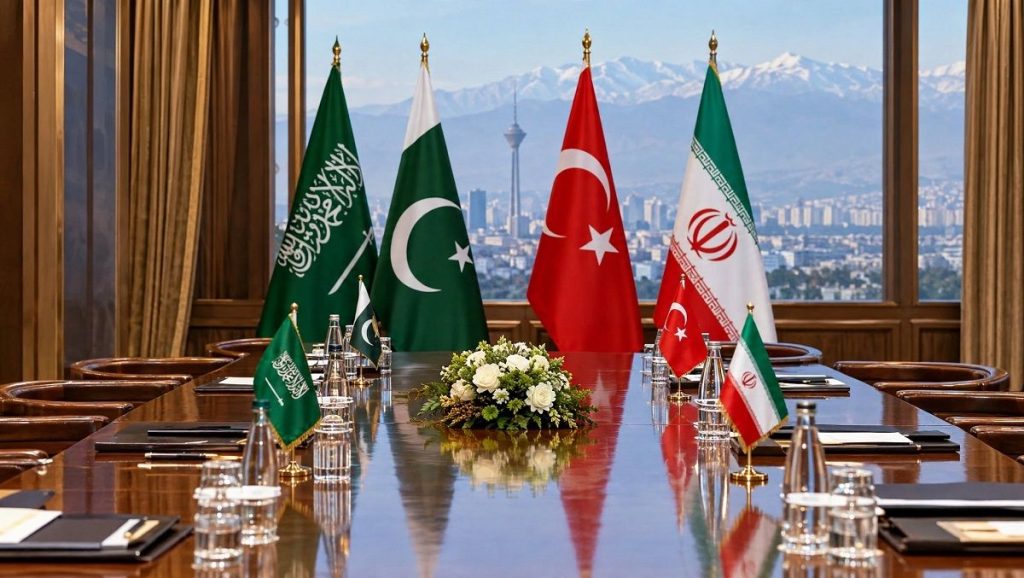
Tehran- In a potentially significant geopolitical development following the 40-day US-Israeli war on Iran, top security officials from Saudi Arabia, Pakistan and Turkey are due to meet Iranian leadership in Tehran on Monday to discuss a regional security framework that could reshape strategic calculations across West Asia.
The proposed gathering brings together four influential regional powers with overlapping, and at times competing, security interests at a moment when the fallout from the Iran war, tensions surrounding the Strait of Hormuz and uncertainty over US-Iran diplomacy continue to threaten regional stability.
Saudi Defence Minister Prince Khalid bin Salman, Pakistan’s Army Chief Field Marshal Asim Munir and Turkey’s National Intelligence Organization chief Ibrahim Kalin are expected to participate in the meeting with Iranian officials, including Supreme National Security Council Secretary Major General Mohsen Rezaei, according to statements by Iranian officials.
The meeting’s significance extends beyond the immediate question of military security. It reflects an emerging effort by major regional players to explore whether West Asia can develop its own security arrangements rather than remain dependent on external powers, particularly the United States.
Iranian officials have presented the initiative as an opportunity to draw lessons from the recent conflict and build a framework based on regional countries’ own interests, capabilities and decisions.
If translated into sustained cooperation, the Tehran meeting could open a new diplomatic channel among countries that have traditionally approached regional security from markedly different strategic positions.
‘Regional Security Must Be Decided Here’
Iranian Foreign Ministry spokesperson Esmaeil Baqaei said the initiative could serve as a starting point for establishing a regional security mechanism rooted in the interests and concerns of countries in West Asia.
Speaking at his weekly press conference on Monday, Baqaei said the proposal emerged during Pakistani Army Chief Asim Munir’s recent visit to Tehran and was welcomed by the Iranian leadership.
“From our perspective, the fact that regional countries are seeking to establish, or at least consider, regional security mechanisms based on their own interests and concerns is a welcome development,” he said.
Baqaei described the meeting as a possible prelude to further steps towards what Tehran calls endogenous security—a model in which regional countries assume primary responsibility for protecting their territories and maintaining stability.
Iranian Deputy Secretary of the Supreme National Security Council Ali Baqeri Kani said the gathering would also draw on Iran’s experience during the 40-day conflict with the United States and Israel.
Tehran maintains that its reliance on indigenous defence capabilities helped it withstand the military campaign, and Iranian officials are now presenting that experience as a potential model for regional security cooperation.
However, whether Saudi Arabia, Turkey and Pakistan will endorse Iran’s broader strategic vision remains an open question. Participation in the meeting does not, by itself, signify agreement with Tehran’s military doctrine or its positions on the United States and Israel.
WHY THIS MEETING MATTERS
The proposed meeting is particularly significant because it brings together four countries whose relationships with Washington, regional rivals and one another differ considerably.
Saudi Arabia remains a major US security partner, while Turkey is a NATO member with its own regional ambitions. Pakistan maintains longstanding military ties with Saudi Arabia and has important security and diplomatic interests in the wider Muslim world. Iran, meanwhile, has consistently advocated a regional order less dependent on Western military power.
Bringing representatives of these four countries into the same security discussion could therefore create an unusual diplomatic opening.
For Tehran, the meeting offers an opportunity to turn its wartime experience into diplomatic leverage and demonstrate that the conflict has not isolated Iran from its regional neighbours.
For Riyadh, engagement could provide an additional channel for managing regional tensions and protecting critical infrastructure, energy supplies and maritime trade.
For Ankara, participation offers a platform to influence discussions over the future security architecture of West Asia while maintaining its independent diplomatic position.
Pakistan, meanwhile, could emerge as an important intermediary, given its military relationship with Saudi Arabia, its engagement with Iran and its capacity to communicate with competing regional actors.
The crucial question is whether the four countries can move beyond broad declarations of regional ownership and agree on practical measures to prevent another major conflict.
A NEW SECURITY CALCULUS
The proposed initiative comes in the aftermath of the US-Israeli military campaign against Iran, which began on February 28 and continued for 40 days before a ceasefire brought the war to a halt.
Tehran has portrayed its response as evidence that indigenous military capabilities can deter or withstand attacks by technologically superior adversaries.
The war, according to Iranian officials, imposed significant costs on the United States and Israel without achieving their stated objectives of subduing Iran or dismantling its defensive capabilities.
Those assertions form an important part of Tehran’s argument for a regional security arrangement that reduces dependence on outside military intervention.
Yet the war has also highlighted the risks of escalation in a region central to global energy supplies, maritime commerce and international security.
The Strait of Hormuz, through which a substantial share of the world’s seaborne oil trade normally passes, has remained a major source of concern amid the war and its aftermath.
Any prolonged disruption to shipping through the strategic waterway can affect oil prices, insurance costs, energy-importing economies and the broader outlook for international trade.
For Gulf countries, therefore, the search for security arrangements is not simply a question of military alliances. It is also about protecting economic infrastructure, maintaining uninterrupted energy exports and preventing regional confrontation from becoming a recurring threat to development.
The Tehran meeting could provide an opportunity to discuss these shared vulnerabilities, although no specific joint defence commitments or maritime security arrangements have been announced in the statements provided.
THE SAUDI FACTOR
Saudi Arabia’s participation is likely to attract particular attention.
Relations between Riyadh and Tehran have historically been shaped by strategic rivalry, competing regional interests and differences over several conflicts across the Middle East.
Their diplomatic rapprochement in 2023, facilitated by China, nevertheless demonstrated that both countries could pursue dialogue despite longstanding disagreements.
The proposed meeting would offer another opportunity to test whether that diplomatic engagement can be extended into discussions on regional security.
For Saudi Arabia, the central challenge is balancing its interest in reducing regional tensions with its established security relationship with Washington.
Riyadh has substantial interests in preventing attacks on energy facilities, safeguarding maritime routes and avoiding a wider confrontation that could threaten its economic transformation plans.
Engaging Tehran could help create channels for communication during a crisis. But any lasting security framework would have to address the competing interests of participating states and establish credible mechanisms for managing disputes.
Saudi participation should therefore be viewed as a significant diplomatic signal rather than proof of a strategic realignment away from the United States.
NATO MEMBER AT THE REGIONAL TABLE
Turkey’s involvement adds another dimension to the proposed initiative.
As a NATO member with substantial military capabilities and an independent regional agenda, Ankara occupies a position different from those of Iran and Saudi Arabia.
Its participation could help broaden the discussion beyond a bilateral understanding between Tehran and Riyadh or a security arrangement limited to the Gulf.
Turkey has its own interests in preventing regional instability, protecting trade and energy corridors, and maintaining influence over developments across West Asia.
The presence of intelligence chief Ibrahim Kalin, rather than a defence minister, also places an experienced security and diplomatic official at the centre of the proposed discussions.
Whether Ankara would support a framework that explicitly seeks to reduce Western influence is less certain. A more plausible starting point could be practical cooperation on crisis communication, counterterrorism, border security and the prevention of regional escalation.
The distinction will matter: a mechanism designed to manage shared risks may attract broader support than one framed primarily as a challenge to Washington.
A POTENTIAL BRIDGE
Pakistan’s role could prove particularly important in translating the proposed initiative into sustained diplomatic engagement.
Army Chief Asim Munir’s visit to Tehran preceded the announcement of the planned gathering. According to Baghaei, Munir informed Iranian officials of the decision by senior Saudi, Turkish and Pakistani representatives to travel to Iran for a joint meeting.
That sequence suggests Pakistan has played a role in facilitating the initiative, although the precise extent of its mediation has not been independently established in the statements provided.
Islamabad has important reasons to encourage regional stability. Its relationships with Saudi Arabia and Iran, alongside its wider economic and security interests, give it an incentive to prevent tensions from spreading across the region.
A successful initiative could also strengthen Pakistan’s diplomatic standing by positioning it as a channel for dialogue among countries with different strategic alignments.
However, sustaining such a role would require careful diplomacy, particularly if regional security discussions become entangled with wider US-Iran tensions or disagreements over the role of external military powers.
WASHINGTON IN THE BACKGROUND
The most consequential question surrounding the Tehran initiative may be its relationship with the existing US-led regional security order.
Iranian leadership has repeatedly argued that foreign interference, particularly by the United States and Israel, undermines regional stability.
Baqeri Kani has presented the proposed framework as an alternative based on the principle that countries in the region should guarantee their own security.
That position challenges a longstanding feature of West Asian geopolitics, where US military deployments, defence partnerships and security guarantees have played a central role.
Yet the participating countries do not share a uniform approach to Washington.
Saudi Arabia continues to rely on its defence partnership with the United States. Turkey remains a NATO member, despite periodic disagreements with Washington. Pakistan also maintains a complex relationship with the US, shaped by security cooperation, economic interests and diplomatic differences.
The four countries could therefore agree on the value of regional dialogue without embracing Iran’s broader opposition to American influence.
For Washington, the emergence of a regional mechanism that reduces the need for external intervention could complicate established strategic calculations. Conversely, a credible regional dialogue process that prevents renewed hostilities could also serve wider international interests.
Much will depend on whether the initiative is designed as an inclusive mechanism for managing regional disputes or as a platform for challenging the existing security order.
DIPLOMACY REMAINS UNCERTAIN
The planned meeting is taking place as Tehran maintains that it remains prepared for different scenarios while keeping diplomacy open.
Foreign Ministry spokesperson Baqaei said on Sunday that Iran remained ready for “any scenario” despite what Tehran describes as unilateral US demands in negotiations.
The statement underscores the difficult environment in which the proposed regional initiative is unfolding.
Even if the four countries agree on the need for greater regional ownership of security, their discussions will have to contend with the immediate consequences of the war, unresolved disagreements and the risk of renewed confrontation.
A durable framework would require more than political declarations. It would need regular consultations, agreed procedures for crisis communication, mechanisms for preventing incidents from escalating and sufficient confidence among participating countries to sustain cooperation during periods of tension.
It would also have to reconcile differing views on military deployments, maritime security, sovereignty and the role of outside powers.
No such detailed framework has yet been established in the announcements cited by Iranian officials.
A TURNING POINT?
For now, the Tehran gathering represents an important diplomatic opening, but its ultimate significance will depend on what follows.
If the meeting leads to regular consultations, practical confidence-building measures and an agreed mechanism for managing regional crises, it could mark the beginning of a more autonomous regional security process.
If it remains confined to broad statements about regional ownership and opposition to foreign interference, its immediate impact may be largely symbolic.
The presence of Saudi Arabia, Pakistan and Turkey alongside Iran nevertheless gives the initiative considerable political weight. These are countries with the diplomatic reach, military capabilities and economic interests to influence the future of West Asia.
Their willingness to explore a common security agenda after a major regional war suggests that the costs of instability are creating incentives for dialogue, even among states that do not share the same strategic outlook.
The post US on the Sidelines? Four Regional Powers Meet in Tehran appeared first on Kashmir Observer.
This content is published by Kashmir Observer and has not been created or edited by Hello Headlines. View original