Trees Alone Cannot Protect Wildlife: Chandigarh Survey Shows Why Grasslands & Wetlands Matter Too
Take a walk through a city park. There are trees lining the paths, lawns stretching between them and plenty of shade. It looks green, perhaps even thriving.
But where are the wild grasses that feed grazing animals? The flowering shrubs that attract butterflies? The ponds and stream banks where birds and other creatures find food and shelter?
A place can look green while losing what wildlife needs to survive.
That is the message emerging from Chandigarh’s 2026 wildlife survey. Researchers recorded an impressive range of species, from a leopard and sambar deer to birds and butterflies. Yet they also found that several native trees were struggling to regenerate naturally and recommended greater protection for grasslands, wetlands and other habitats.
For Indian cities, where planting drives often signal environmental progress, the findings suggest a better starting point: the habitat and the life it supports.
What the survey found in Chandigarh’s forests
Conducted between 20 and 27 November 2025 by the Chandigarh Department of Forest and Wildlife and the Wildlife Institute of India (WII), the assessment covered Sukhna Wildlife Sanctuary and forest patches beyond its boundaries.
Researchers documented 16 mammal species, 132 bird species, 73 butterfly species and 13 species of reptiles and amphibians. They also recorded 43 tree species, 14 shrub species and 22 herb species.
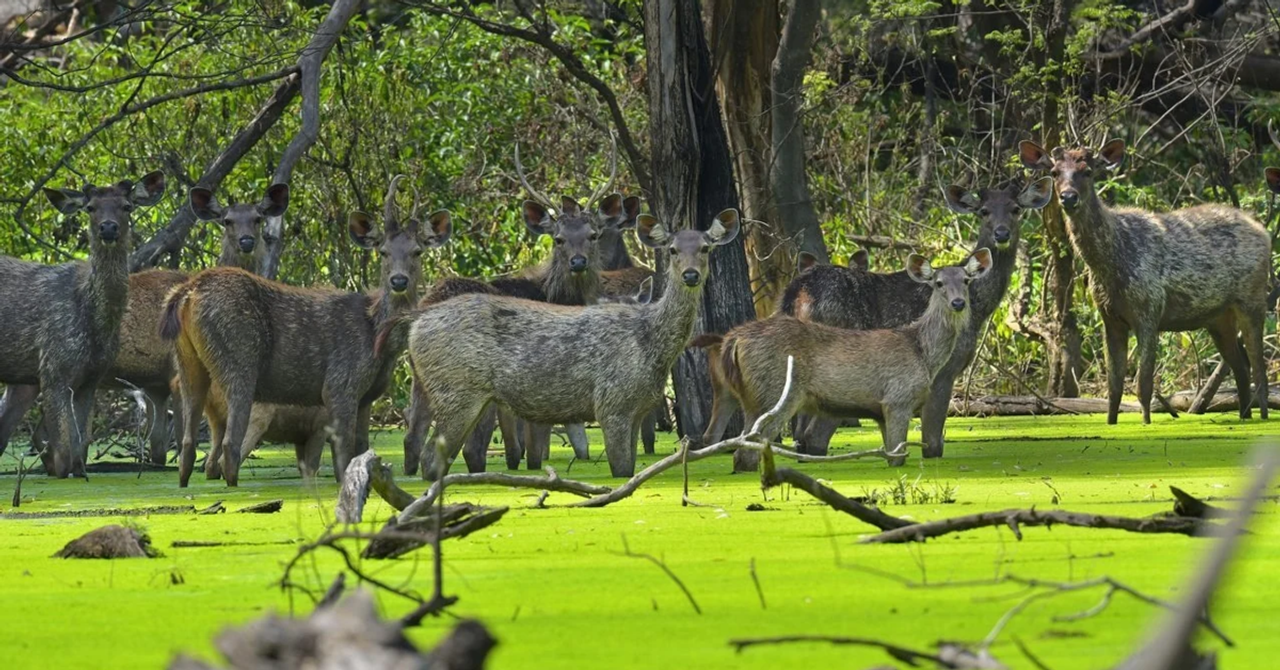
The survey detected a leopard and estimated around 603 sambar, a deer species found in the region’s forests. The figures show the variety of life these natural areas continue to shelter.
But counting species was only one part of the exercise. The report also looked at the condition of their habitats and recommended restoring native vegetation, protecting grasslands, reviving wetlands and streamside habitats, and controlling invasive species.

Knowing which animals live in a forest matters. Knowing whether their habitat can continue to support them tells us what needs attention.
A forest can have trees and still need help
Imagine a woodland full of mature trees. From a distance, it might seem healthy. Look beneath the canopy, though, and there may be very few young trees coming up to replace the older ones.
This is the problem of poor natural regeneration, which the Chandigarh survey flagged in native species including khair (Senegalia catechu), siris (Albizia lebbeck), Lannea coromandelica and Terminalia anogeissiana.
Natural regeneration is simply the process of seeds becoming new plants without people planting them. It allows a forest to renew itself across generations. If young trees are missing, some native species could become less common as older trees die.
That is why an increase in tree cover cannot, by itself, tell us whether a forest is doing well.
The survey also cautioned against large plantations dominated by one species, known as monocultures. A row of identical trees may offer shade, but a healthy habitat needs different kinds of vegetation, from tall trees to shrubs, grasses and ground cover.
Each layer has a purpose. Birds need places to nest, butterflies seek nectar, insects live among leaves and grasses, and herbivores depend on suitable plants for food.
The report recommends replacing invasive vegetation with native species. Why does that matter?
Why native plants can make a difference
Native plants occur naturally in a region. Over time, they develop relationships with the insects, birds and animals around them. Some insects feed on particular plants; birds visit their flowers; other animals carry their seeds to new places.
Introduced, or exotic, plants come from elsewhere. Many grow successfully in cities, and some offer flowers, fruit or shelter. But they do not always support the same relationships. Certain species can also spread so aggressively that they push out local vegetation.
A 2023 Bengaluru study published in Science of the Total Environment helps explain why the distinction matters.
Researchers compared how birds and mammals interacted with native and alien trees. They found that taller native trees with larger floral displays supported more bird species than alien trees with comparable displays.
There was another interesting difference. Nectar-feeding birds were more likely to visit native flowers in ways that helped pollination. On alien trees, their visits more often involved ‘nectar theft’, where a bird takes nectar without transferring pollen in the way the flower needs to reproduce.
This does not mean every introduced tree is harmful. The study recognised that alien trees can provide resources for wildlife in cities where natural vegetation has already been lost.
The lesson is to understand what different plants actually offer local wildlife, rather than choosing them only because they grow quickly or look attractive.
For Chandigarh, that supports the survey’s recommendation to prioritise native vegetation that belongs to the landscape.
Why an open grassland deserves protection
A patch of tall, wild grass might look like an empty plot beside a landscaped park. It is easy to imagine someone deciding to plant trees there to ‘improve’ it.
But a grassland is already a habitat.
Its native grasses feed grazing animals, shelter insects and support species that depend on open spaces. Their roots also help hold soil together and influence how rainwater moves through the ground.
Planting trees across an existing grassland can change the conditions that make it useful to those species. The result may look greener to us while offering less to the wildlife that lived there.

This is why the Chandigarh survey specifically recommended protecting grasslands and restoring native grasses, including Eulaliopsis binata, Arundinella nepalensis and Heteropogon contortus.
Across India, open spaces are often treated as land waiting to be developed, tidied up or planted over. Planners first need to ask what habitat is already there.
Sometimes, caring for a green space means leaving room for its grasses to grow.
Wetlands and riverbanks support different kinds of life
The same principle applies to waterbodies and the land around them.
In Chandigarh, the survey recorded 49 butterfly species in riparian habitats, the areas alongside streams, rivers and other waterbodies. Woodland habitats, meanwhile, recorded the highest bird diversity.
These differences matter. A forest, an open grassland and a stream bank may all be part of the same landscape, yet each offers food and shelter to different species.
The report therefore called for wetland restoration and better care of streamside habitats, alongside other measures such as controlling invasive species.
Research from the East Kolkata Wetlands shows why protecting such spaces requires attention to more than their size or appearance.
A 2024 study in Environmental Research examined changes between 1991 and 2023. It found that the number of wetland patches had risen from 2,689 to 4,532, a sign that the landscape had become more fragmented. Over the same period, the study’s ecosystem health index fell from 0.67 to 0.55.
In simple terms, a wetland can still appear on a city map while its connected habitats are broken into smaller pieces and its ecological condition deteriorates. The Kolkata findings do not describe Chandigarh’s wetlands, but they show what cities risk overlooking if they focus only on how much green or blue space remains.
The two-day Capacity Building Workshop on Wildlife Survey & Techniques concluded today in Chandigarh! Diverse participants— representatives of civil society organisations, college students, wildlife enthusiasts, media personnel and journalists were sensitized and trained on various wildlife survey and monitoring methods. Thank all the multiple stakeholders for making it impactful. #WildlifeConservation #CitizenScience #WildlifeSurvey #Chandigarh #Sukhna #Chandigarhbirdclub @moefcc @wii_india @GobindsagarBha1 @RuchiBadola2 @gopigv @UDHAYAR230 @Ashik40405287 @Alexjacob11 @NonitaRana04 @RayR5847
— Wildlife Institute of India (@wii_india) November 19, 2025
Chandigarh’s survey also recorded the red-eared slider turtle, an exotic aquatic species, and recommended its removal and management in controlled settings. Such species are sometimes released into waterbodies after being kept as pets and can place additional pressure on native wildlife.
Wetlands need care as living habitats, not simply as water-filled spaces.
What should other Indian cities measure?
There is evidence from Delhi, too, that a park’s value to wildlife depends on more than its tree count.
A 2024 study in Ecological Frontiers examined birds across 64 city parks, recording 90 species and 19,131 individual birds. It found that vegetation characteristics and disturbance affected which birds used the parks. Native trees and lower surrounding urbanisation were also linked with greater bird diversity.
For cities designing parks, the type of vegetation and its surroundings can matter as much as tree numbers.
Chandigarh’s plantation figures offer another lesson. During 2025–26, the administration planted 6,64,133 saplings against a target of 5,76,221. But third-party monitoring in November 2025 and March 2026 found an overall survival rate of around 79%.
For 2026–27, the administration lowered its target to 4,19,854 saplings, including those distributed and sold, and said it would pay greater attention to site selection, quality and care after planting.
Survival is important. So is asking whether the right species have been planted in the right place, and whether existing habitats are being protected rather than replaced.
The Chandigarh survey was conducted over a short period, so its findings are a snapshot rather than proof that the city’s wildlife populations are rising or falling. Longer-term, seasonal monitoring would help show how these habitats and their inhabitants change.
But its message is already useful. Before the next plantation drive, city planners can ask a few practical questions: Is this land a forest, grassland or wetland? Which species rely on it? Are young native plants growing back? And what does this place need most?
For some spaces, the answer will be trees. For others, it may be restoring a stream bank, protecting a grassland or allowing native shrubs to return.
A city’s natural wealth lives in more than its canopy. It is in the butterflies visiting riverbanks, the birds sheltering in woodland, the deer grazing on native grasses and the many smaller creatures that depend on them.
Making room for all these habitats is how a city makes room for wildlife.
Sources:
‘Restore native species, wetlands; curb invasives: UT wildlife survey’: By Munieshwer A, Published on 2 October 2026
‘Chandigarh’s Wildlife Survey Exposes the Cost of Neglecting Native Habitats’: By Urban Acres, Published on 2 October 2026
‘Urban park characteristics defining avian community structure in Delhi, India’: By Deepti Kumari, Ashutosh Srivastava, Upamanyu Hore, Published in December 2024
‘Native fauna interact differently with native and alien trees in a tropical megacit’: By Purabi Deshpande, Rohan Sharma, Aleksi Lehikoinen, Rose Thorogood, Published on 10 April 2023
‘Wildlife Week 2026 inaugurated in Chandigarh with Walkathon; focus on habitat connectivity and wildlife conservation’: By India News Calling, Published on 2 October 2026
This content is published by The Better India and has not been created or edited by Hello Headlines. View original