POT POURRI
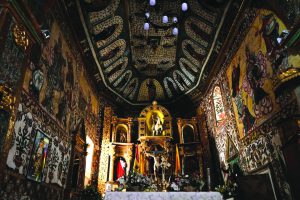
Bolivia’s ‘Andean Sistine Chapel’ gets new life as centuries-old church undergoes restoration
the western province of Oruro, Bolivia, on Sunday. (AP)
CURAHUARA DE CARANGAS, Nov 18: A 418-year-old church built and painted by Indigenous hands is getting a new lease of life in Bolivia’s high-altitude desert, where its colorful murals tell the story of an encounter between Spanish Catholicism and ancient Andean beliefs.
Known as the “Andean Sistine Chapel,” the modest adobe church in the western province of Oruro is celebrated for its elaborate murals depicting biblical scenes alongside Indige nous religious symbols.
“It is a jewel of mestizo Baroque art,” said the Rev. Jacek Dziadosz, a Polish priest known locally as Father Jacinto. He said the church reflects how Spanish colonizers and Indigenous communities sometimes collaborated, creating a religious blend that endures today.
About a dozen Aymara workers, including several women, are putting the finishing touches on a new thatched roof and whitewashing the church’s walls ahead of the restoration’s scheduled completion in mid-December.
The project received about $66,000 from the U.S. Ambassadors Fund for Cultural Preservation, with technical support from heritage conservation specialists and the Catholic University of Bolivia. Finding workers skilled in traditional thatching techniques was a challenge, said Josefina Matas, a conservation specialist and university professor.
The new roof is expected to last another 25 years, withstanding freezing winds, intense sunshine, rain and hail at an altitude of nearly 4,000 meters (13,100 feet), said technical supervisor Elizabeth Aguilar.
Construction of the church began around 1608, according to an inscription on its walls.
Indigenous artists used natural pigments to depict biblical stories, including Genesis, the Great Flood and the Apocalypse. Missionaries used the paintings to teach Christianity to people who could not read.
“I still use these paintings to teach catechism to children and young people from rural communities, even in the age of TikTok,” Dziadosz said.
The murals also reveal how Indigenous artists incorporated their own beliefs into Christian imagery. (AP)
This content is published by The Shillong Times and has not been created or edited by Hello Headlines. View original