
From pattern matching to governing intent: How Semantic DLP is securing enterprise Gen AI
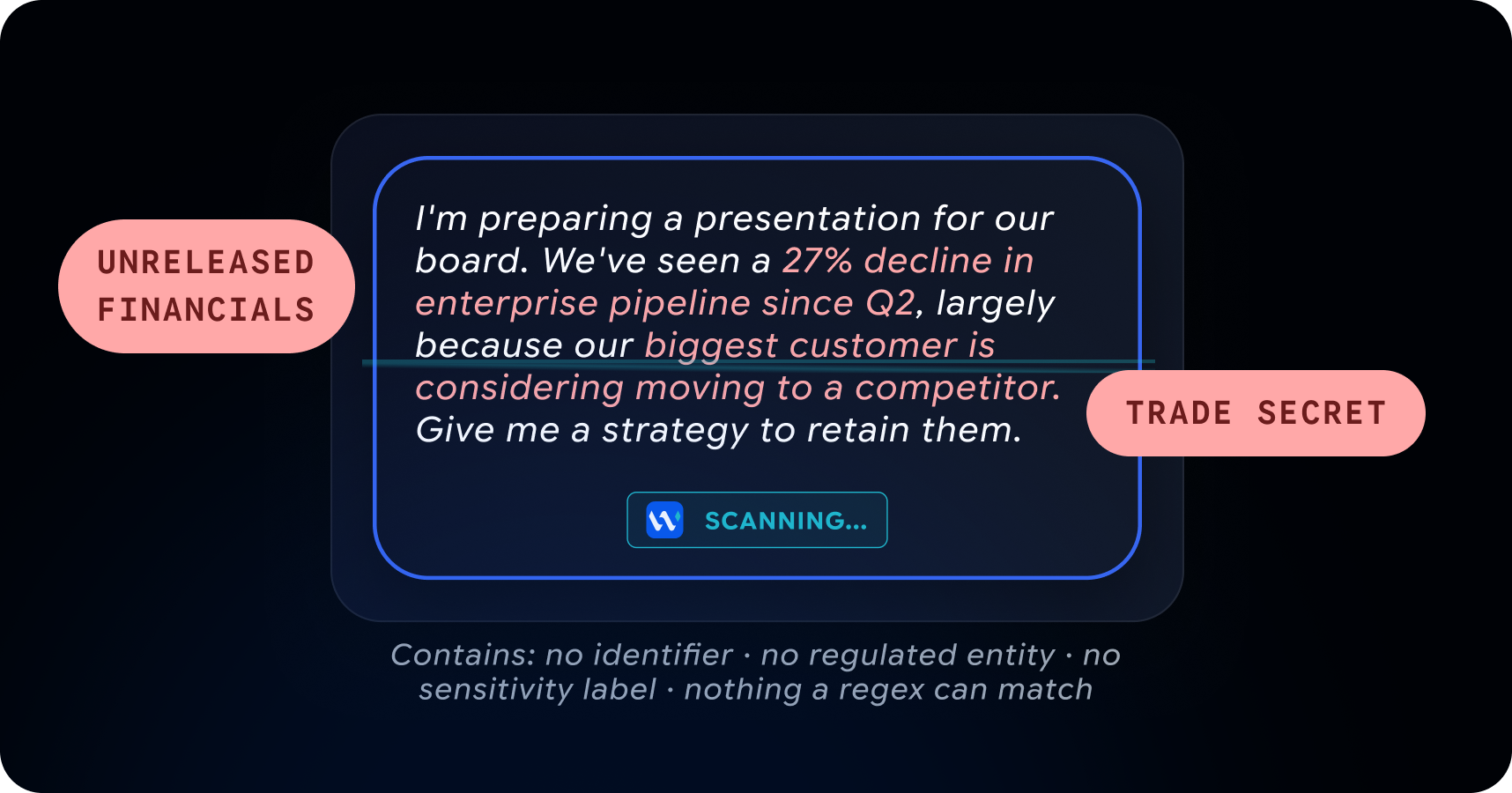
A quiet tug-of-war is playing out in nearly every enterprise today. On one hand, engineers, financial analysts, legal teams, and operations staff are turning to generative and agentic AI to debug code, summarize contracts, and automate tasks and decision-making. On the other side, security and compliance leaders are racing to prevent proprietary source code, financial projections, and regulated customer records from leaking into unauthorized models.
For most Chief Information Security Officers (CISOs), the question is no longer whether employees are using AI; it is what they are pasting into it. Yet the security tools most organizations rely on to police this boundary were built for a completely different era.
Why legacy DLP fails in the GenAI era
Traditional Data Loss Prevention (DLP) systems were designed for structured data moving across predictable channels such as emails, file transfers, and cloud storage. They rely heavily on regular expressions (regex), keyword lists, and static rules. If a document contains a 16-digit credit card number or a government ID, legacy DLP flags it.
Generative AI breaks this model entirely. AI interactions happen in unstructured natural language, where data sensitivity is defined by context and intent rather than fixed formatting. Consider two scenarios:
- A software engineer pastes a snippet of proprietary authentication logic into an LLM and asks it to optimize the code.
- A strategy analyst uploads a paragraph describing an upcoming, unannounced product roadmap or M&A target to draft an executive summary.
Neither prompt contains a credit card number, a Social Security number, or a flagged keyword. To a regex-based DLP system, both interactions look completely benign. Conversely, when security teams tighten keyword rules to catch more nuances, false positives skyrocket, triggering alert fatigue for security teams and frustrating employees who are simply trying to do their jobs.
Faced with this visibility gap, many organizations initially defaulted to blunt-force bans on public AI tools. However, blocking AI only drives usage underground onto personal devices and unsanctioned accounts, multiplying “Shadow AI” risk while starving the enterprise of productivity gains.
The shift to semantic, context-aware security
As generative AI evolves from simple chat interfaces to complex, autonomous workflows including Model Context Protocol (MCP) tool calls and agent-to-agent communications, the enterprise attack surface is expanding across every endpoint and application. Securing this environment requires moving from pattern matching to semantic understanding.
At Wald.ai, we built our platform around a simple premise: to secure AI, your security layer must understand language as well as the AI itself.
Instead of scanning for static patterns, Semantic DLP evaluates the meaning, context, and intent behind every prompt and file upload. By deploying a specialized Small Language Model (SLM) directly on the employee’s endpoint, Wald.ai inspects and classifies AI interactions locally in milliseconds before sensitive data ever traverses the network or reaches an external AI server or provider.
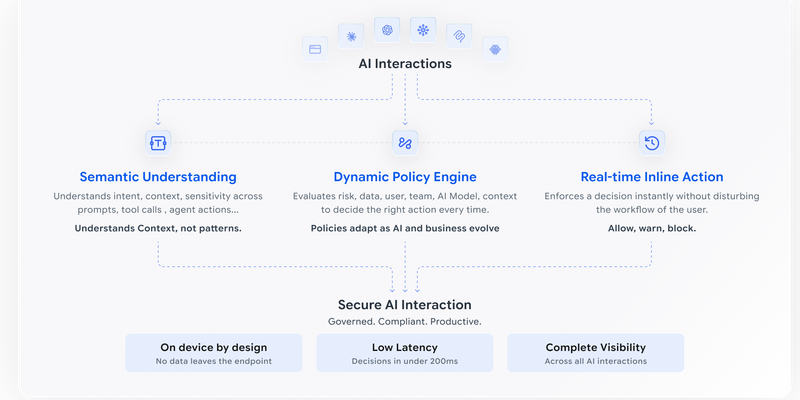
This on-device, context-aware approach solves three critical enterprise challenges simultaneously:
1. Catching what Regex misses: Semantic models distinguish between an engineer pasting harmless open-source boilerplate and one exposing proprietary algorithms, or between general market research and confidential corporate strategy.
2. Eliminating alert fatigue: By disambiguating context in real time, organizations drastically reduce false positives, allowing security teams to focus on genuine exposure risks.
3. Enabling safe productivity at the endpoint: Rather than a binary “allow or block” posture, enterprises can enforce granular, real-time guardrails, automatically redacting, masking, or sanitizing sensitive entities within a prompt while preserving the context needed for the LLM to return a useful answer.
Real-world impact across regulated sectors
We are already seeing this playbook transform how regulated industries such as financial services, healthcare, and legal practices adopt AI. For instance, financial institutions and credit unions using Wald.ai have transitioned from restrictive AI policies to sanctioned, company-wide adoption.
Scaling enterprise AI governance with NetApp Excellerator
As enterprises mature in their AI journey, the boundary between data infrastructure and AI security is disappearing. Participating in Cohort 15 of the NetApp Excellerator program has been a pivotal milestone for Wald.ai as it scales contextual intelligence architecture for large enterprise environments.
Working alongside NetApp’s technology leaders and deep-tech ecosystem provided insights into how global enterprises architect, govern, and manage massive data estates across hybrid and cloud environments. Combining robust data infrastructure practices with real-time, endpoint semantic guardrails ensures that data remains protected from the storage layer all the way to the AI prompt.
The road ahead
The next wave of enterprise competitiveness will not be won by the companies that restrict AI, nor by those that deploy it recklessly. It will be won by organizations that build trust into their AI stack, replacing outdated, reactive compliance checks with intelligent guardrails that operate at the speed of conversation. When security understands context, enterprises no longer have to choose between innovation and data privacy.
This content is published by YourStory and has not been created or edited by Hello Headlines. View original