AI can write code, but knowing what to build still matters
AI is making it easier to build software. Product managers, designers, and domain experts can now turn ideas into prototypes without necessarily knowing how to code. But turning those prototypes into reliable products that solve real problems remains a challenge.
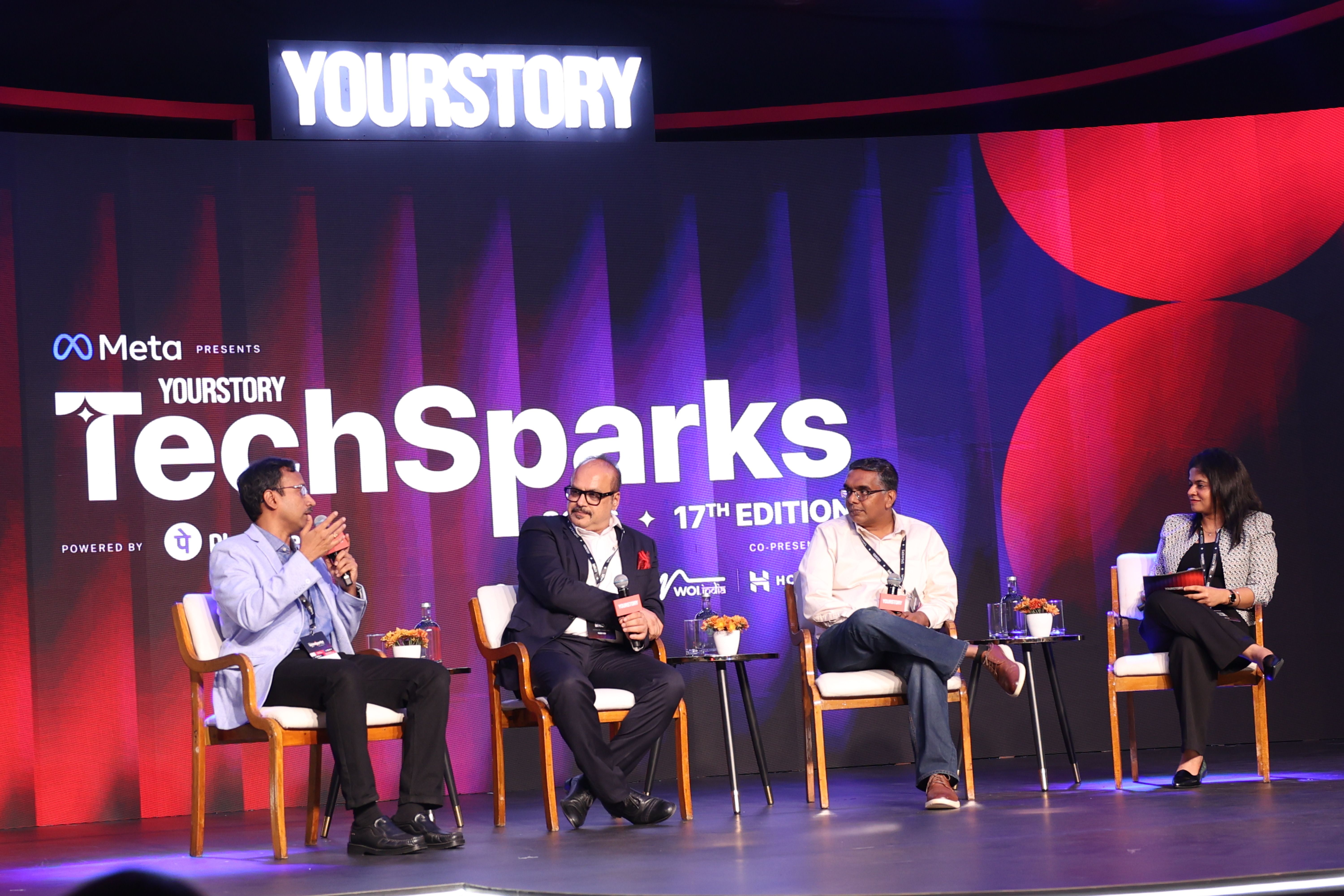
At TechSparks 2026, Srinivas Chamarthy, Senior Vice President of Engineering, Site Lead and Country Head at Diligent India; Madhusudan N. Murthy, Digital Engineering and Tech Strategy Leader at EY GDS; and Arun Kalyanaraman, VP of Engineering at Target in India, discussed these changes during a panel titled ‘From Who Can Code to Who Can Build’.
The discussion was moderated by Chhavi Mahajan, Chief Content Officer at YourStory.
From prototypes to production
AI-assisted development allows business teams to test ideas, demonstrate concepts, and gather feedback much earlier. However, a prototype that shows an idea can work is not necessarily ready for production. Applications still need to meet security, scalability, and reliability requirements.
Murthy said that AI is making experimentation easier, but companies must distinguish between a proof of concept and a production-ready application. Engineering teams still need to identify vulnerabilities, put safeguards in place, and ensure systems can handle real-world use.
“It's good, it's a very positive development, but it also has to have its guardrails,” he stated.
Kalyanaraman said AI can do more than help developers write code faster. It can also speed up the entire development process, from defining a problem and testing a solution to getting stakeholder approval. However, strong engineering fundamentals, architectural thinking, and technical depth will remain essential, even as AI changes how solutions are built.
He gave the example of a product owner, an engineer, and a UX professional who used AI tools and large language models to prototype a complex concept and present it to leadership within a week. Without these tools, the process could have taken six weeks to two months.
The benefit was not just faster coding, but the ability to test an idea and make a decision sooner.
Chamarthy said coding is becoming a commodity in the generative AI era, shortening the path from prototype to customer feedback to production, with a nine-month cycle potentially coming down to a month or two. As speed increases, he said, knowing what not to build becomes more valuable, so ideas should be tested in a sandbox while experienced engineers harden them for security, scalability, and privacy.
Deciding where human oversight is needed
As companies move from using AI to assist developers to deploying agents that can complete tasks with limited supervision, they must decide how much autonomy to allow.
Chamarthy said this should depend on the risks involved, the potential impact of a decision, and whether its outcome can be reversed.
He suggested organizations consider whether a decision is a two-way-door or a one-way-door call, with significant financial or strategic decisions needing human oversight and contextual judgment.
Chamarthy cautioned that access to AI coding tools cannot replace engineering experience. Experienced engineers understand the architectural decisions that affect security, scalability, and long-term maintenance, including risks that may not be apparent in a prototype.
His advice was to encourage experimentation, but within controlled environments.
“Don't stop the code. Sandbox it.”
This allows more employees to test ideas while giving engineering teams the opportunity to review the applications, address weaknesses, and prepare them for production.
Why domain expertise matters
As AI makes it easier to generate code and find answers, knowing which problems to solve becomes more important.
Kalyanaraman compared using AI to consulting a genie that grants only three wishes. Getting a useful result depends on asking the right questions and understanding the constraints.
“In a world where maybe getting answers are easy, asking the right questions is going to be a really, really critical skill,” he said.
People who understand customers, business processes, and operational requirements are better placed to identify solutions that create value.
Engineering teams will also need systems thinking and platform expertise to help non-engineers develop applications without putting production systems at risk.
The shift also has implications for workforce development.
Murthy said EY GDS is preparing employees for an AI-driven workplace by bringing experienced professionals and younger talent together. Existing employees bring knowledge of customers and systems, while newer team members contribute fresh approaches and develop emerging technical skills.
Chamarthy said teams need a mix of strengths: organizations should upskill existing employees, who understand their products and customers, while bringing in fresh graduates who can work with AI tools.
He also added that engineering performance should be measured by the problems teams solve for customers, rather than only by metrics such as lines of code written or tickets closed.
As AI takes over more routine work, the outcomes delivered by engineering teams become a more useful measure of their contribution.
A workforce of people and AI agents
The panellists expect employees and AI agents to work increasingly closely together.
As agents take on more complex tasks, companies will need to rethink workflows, accountability and performance expectations. They will also need to ensure safeguards keep pace with what the technology can do.
Murthy described a future in which managers will oversee AI agents alongside human employees.
“The future I see is getting used to agents reporting to you and not just humans,” he said.
Kalyanaraman added that The New Tech Order is not just about what AI can do for us. It is about how we evolve our thinking, engineering practices, and decision-making to make the most of it.
While AI is making software easier to build, companies will still need engineering expertise, domain knowledge, and human judgement to decide which ideas are worth pursuing and which prototypes are ready for production.
This content is published by YourStory and has not been created or edited by Hello Headlines. View original