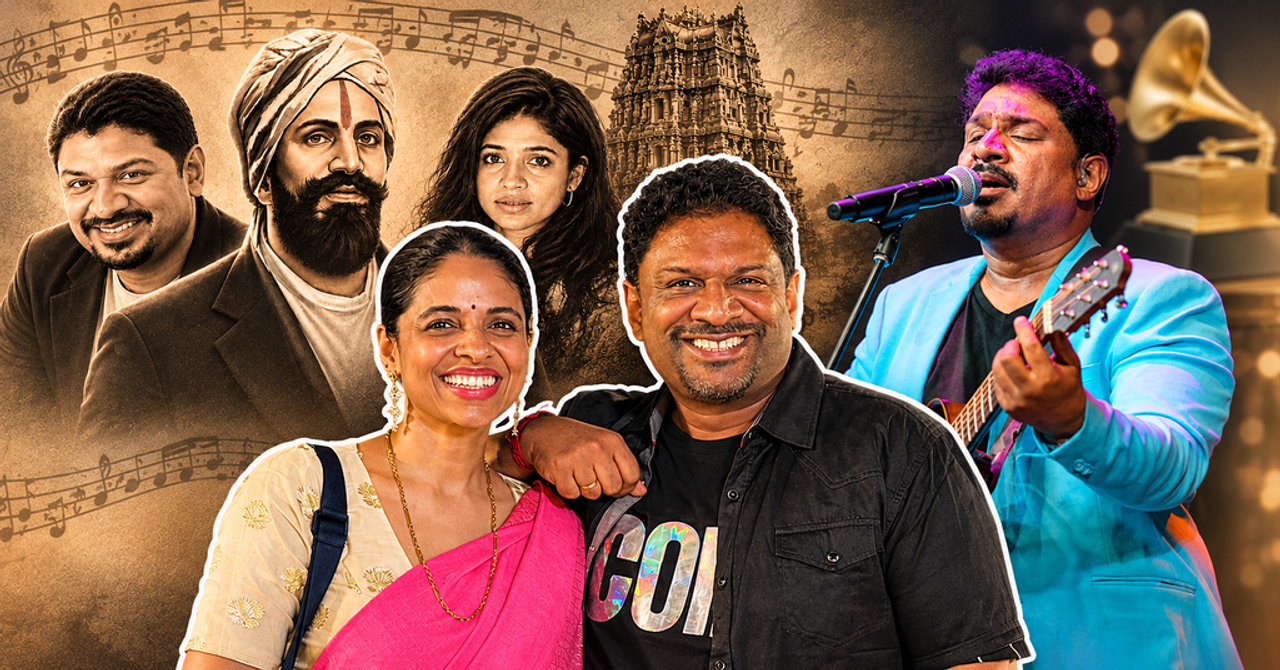
Exclusive: From Leaving Engineering for Music to Earning a Grammy Nod, Devan Ekambaram’s ‘Varuvaaiy’ Makes History For Tamil
“Uruvaai arivil olirvaai Kanna!
Uyirin amudhaai pozhivaai Kanna!”
Shine within my consciousness, O Kanna; pour forth as the nectar of my life.
In Subramania Bharati's poetry, the imagery of devotion and love often reaches beyond the immediate moment. More than a century after his words were written, one of his compositions has found a new musical life — this time, on a global stage.
But when the Grammy nominations were being announced on 16 November, the man behind that contemporary interpretation was nowhere near a television screen.
Back from a project in Sri Lanka, Devan Ekambaram could not bring himself to watch the nominations unfold. He went instead to a temple.
“I was too nervous to watch,” he recalls.
At 6.47 pm IST, his phone lit up. A friend in Los Angeles sent him a message: “Congratulations!” His phone soon filled with 80 or 90 similar messages.
“I realised what had happened and immediately broke down crying,” he says.

The song that had brought him to this moment was Varuvaaiy, an independent Tamil recording he composed and produced with vocalist Subhiksha Rangarajan, known as Susha. It had been nominated for Best Global Music Performance at the 69th Grammy Awards, becoming the first Tamil song to receive a Grammy nomination.
For Ekambaram, the moment carried a childhood dream: watching Michael Jackson win a Grammy for Thriller and hearing presenter Whoopi Goldberg urge young viewers to hold on to their dreams. It was also a milestone reached without a family music legacy.
“I come from a family of doctors and engineers. Nobody is in the art field, and I had to embark on this journey all alone,” he says.
A childhood tuned to music
Growing up in New Jersey, often one of the few Indian children in his neighbourhood, Ekambaram found it difficult to fit in. Music became a source of confidence. His mother introduced him to different genres, while programmes such as American Bandstand and Solid Gold showed him performers building careers around music.
He began playing guitar between the seventh and tenth grades, then joined the school choir and marching band. He learnt to listen for harmonies and how musical parts fitted together, and began recording at home.
“I knew my weakness, but I found my strength,” he says. He developed his musical identity through choir, harmony and arranging.

The Grammys entered his imagination around this time. “I remember watching Michael Jackson win for Thriller, and hearing presenter Whoopi Goldberg urge young viewers to hold on to their dreams, come what may. And that became my dream,” he says.
At 19 or 20, while studying electrical engineering at the University of Illinois, he explored music opportunities during a college break in India. He eventually left engineering and moved to Chennai at 21.
“I just quit my engineering degree in the US and came here with no support and no direction. It was the scariest thing because I never saw anyone do this growing up,” he says.
Building a life in music — and finding the right voice
Ekambaram’s move to Chennai gradually opened doors. His 1998 album Kamban Oru Kannile, made with S P Charan, caught A R Rahman’s attention and led to work on Kadhalar Dhinam. He made his playback debut with “Oh Maria” in 1999 and went on to sing on more than 500 film soundtracks, while also working as a composer, voice artist, and vocal arranger.
He had contributed to Grammy-winning projects such as Winds of Samsara (2015) and Divine Tides (2022). But this time, he wanted to create something that was unmistakably his own: an independent album reimagining the poetry of Subramania Bharati through contemporary arrangements.
For the first single, he had a particular voice in mind.
Ekambaram had met Subhiksha Rangarajan, known as Susha, back in 2007, when they appeared on the television programme Coffee with Anu. He had wanted to collaborate with her ever since, but the opportunity never quite came together. When he began working on the Bharati project, he reached out to her again.

In June 2026, Susha arrived at his home studio with her mother, Lakshmi Rangarajan. The composition they were about to record was one Lakshmi had taught her, set to a tune by L Krishnan that was already around 40 to 50 years old.
What followed was an unusually quick coming together of ideas. Ekambaram asked Susha to sing, and the recording took shape over the next two to three hours.
For him, her voice brought together the musical sensibilities the song needed. Trained in Carnatic music and having studied jazz at the University of Toronto, Susha could move between the classical foundation of the composition and the contemporary sound he wanted to create. She had also been building her own independent music career, including through NEXA Music, an initiative by A R Rahman and Clinton Cerejo that selected her among 24 artistes in 2019.
“Without her singing, nobody would have listened to the song,” Ekambaram says.
Giving an old poem a new sound
He wanted to rebuild the traditional arrangement while retaining the melody’s character.
“I just gave it a makeover,” he says. “I looked at it thinking, how I would want to hear this?” He wanted to make the form inviting to a new generation of listeners unfamiliar with Carnatic music without flattening its identity.
Set in raga Desh, the arrangement brings Carnatic phrasing together with piano, slide guitar, acoustic guitar, bass and tabla. Ekambaram played keyboards and produced the track. It features pianist Anil Srinivasan, slide guitarist Prakash Sontakke, guitarist Naveen Samson, bassist Joseph John and tabla player Sarvajit Krishna Mohan. Roshan Sebastian mixed and mastered it.
The collaboration was largely remote: Susha recorded at Ekambaram’s home studio, while the instrumentalists sent their parts from elsewhere. “I coordinated the musicians and worked with Sebastian on the final mix. The result was a three-minute-and-26-second recording released independently on 12 August 2026,” he says.

Susha’s contribution was central to the sound he had imagined. “Without her singing, nobody would have listened to the song,” Ekambaram says. Her Carnatic training, jazz studies at the University of Toronto and contemporary sensibility shaped the recording. In 2019, she was among 24 artistes selected for NEXA Music, an initiative by A R Rahman and Clinton Cerejo. Her debut album, Love Language, arrived in August 2026.
Written more than a century ago, the poem’s exact date is unknown, though it is believed to date from Bharati’s years in Pondicherry. Its imagery calls for a force to enter human thought and dispel darkness, and has been read as a metaphor for resisting oppression and colonial rule.
That purpose appealed to Ekambaram. Rather than create a new song with contemporary lyrics, he wanted to bring a poet whose words shaped Tamil public life to younger listeners.
“I thought this had a purpose,” he says. He hoped a fresh musical arrangement would allow his children’s generation to encounter Bharati’s language without feeling distanced by it.
A release against the clock
Getting the single out in time required a difficult decision. Ekambaram says labels he approached were hesitant because the underlying work was in the public domain, and the permissions process threatened to delay the release. “With the Grammy submission deadline approaching, I chose to release the track independently and complete the distribution myself. But I never imagined how well it would work,” he recalls.

He had submitted work before and contributed to Grammy-winning projects, but this time concentrated on Varuvaaiy, preparing its streaming links for the Best Global Music Performance category. The category had 526 submissions, he says, and seeing the names on the ballot made a nomination feel far from certain.
On nomination morning, the song had around 300 YouTube views, according to Ekambaram. As the news spread, the count rose to about 35,000. Messages of appreciation came from musicians including Scott Hoying of Pentatonix and Chandrika Tandon.
What comes after the nomination
The recognition arrived as Ekambaram questioned what came next. He had considered continuing in Chennai or returning to the United States if work did not move forward. He wanted to build a body of work listeners could associate with him, not a film or star. He worried that short-lived online trends left less room for songs that stay with people.

“The nomination has renewed my resolve to make independent music, compose and experiment rather than rely only on past successes. To think that I almost gave up and left for L. A., but we never know when opportunities will come. Today, I’m glad I continued on the path,” he says.
Ekambaram credits mentors including Madhav Das at Magnus Sound, choir director Ruth Lane McIntyre and the high-school teacher who encouraged him to sing. He wishes they could have witnessed the announcement.
The larger Bharati album is now the next step. Ekambaram says it will contain 10 to 12 contemporary interpretations, with the tracks already taking shape and around two months of work remaining at the time of the interview. He is also waiting for a bilingual Tamil-Telugu film for which he composed the music to reach audiences.
The ceremony is scheduled for February 2027 in Los Angeles, where Varuvaaiy will compete alongside recordings by Angélique Kidjo, Rosalía, Shakira and Burna Boy. Winning would be wonderful, he says, but the nomination has already given him something deeply valuable.

“I don’t care whether I win the category or not,” he says. “I’ve been a catalyst in placing Tamil music on the global map. That is my win.”
More than a century after Bharati wrote the poem, its words have travelled into a new musical language: first through a melody passed down across generations, then through a contemporary arrangement shaped by musicians working across genres and distances. Now, listeners far beyond Tamil-speaking communities are being invited to hear it, too, today.
That, perhaps, is the lasting possibility of Varuvaaiy. A poem written in another time has not been left behind in it. It has been given another voice, another audience and another chance to be understood. And somewhere, a listener encountering Bharati for the first time may follow the song back to the words that began it all.
This content is published by The Better India and has not been created or edited by Hello Headlines. View original