Former IGNOU Chief Flags Financial Crisis in Panchayats
Kashmir, Observer, Jammu, Srinagar, Latest Kashmir News, Kashmir News, Kashmir Latest News
ByShadab Khan
Srinagar- More than three decades after India amended its Constitution to strengthen village and municipal governments, a fundamental question remains: How much power do elected local representatives actually have?
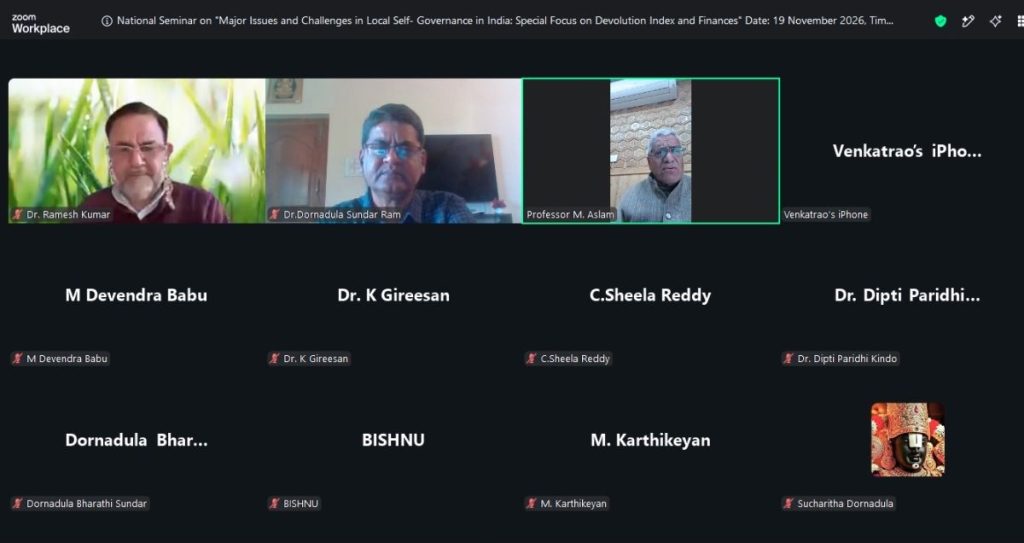
Prof. M. Aslam, former vice-chancellor of Indira Gandhi National Open University, raised that question during a national seminar in Tirupati on Wednesday, pointing to the financial and administrative constraints that continue to limit grassroots democracy.
The seminar, organised by the Academy of Grassroots Studies and Research of India, examined the challenges facing local self-governance, with particular attention to the Devolution Index and finances. Prof. Aslam’s central argument was clear: India’s Panchayati Raj institutions need money, trained personnel and greater authority to fulfill the responsibilities voters expect them to perform.
The Ministry of Panchayati Raj’s Devolution Index, he said, provides an honest measure of how much power states have transferred to local governments. It examines six areas: institutional framework, functions, finances, functionaries, capacity building and accountability.
Finance, however, remains the weakest link in the decentralisation process.
Gram Panchayats have several potential sources of revenue, including property taxes, user charges, fees and income from common property resources. Many underuse these sources because elected representatives fear that collecting taxes could cost them votes.
That reluctance has consequences for accountability. Panchayats that depend heavily on government grants have limited financial freedom to decide their priorities, Aslam argued.
“A Panchayat that does not collect its own revenue will never be truly accountable to its own people,” he said, urging elected representatives to change their approach to taxation.
Government grants create another challenge. Finance Commission transfers remain essential to village development, but delays, restrictive conditions and utilisation certificate requirements make planning difficult.
A Sarpanch, the professor said, cannot plan a five-year term when funds arrive during the final three months of a financial year.
Even when money reaches Panchayats, shortages of trained accountants, engineers and technical staff often prevent them from spending it effectively. Inadequate digital infrastructure compounds the problem, leaving funds unused or causing them to lapse.
Prof. Aslam called for a dedicated cadre of Panchayat finance professionals, arguing that local governments need trained personnel rather than temporary administrative arrangements.
His proposed reforms extend to the structure of local governance itself. He urged governments to clearly map responsibilities, specifying who performs a function, who pays for it and who answers for its execution. He also called for trained secretaries, accountants and technical staff under the control of local bodies.
State Finance Commissions, he said, should be constituted on time, their reports tabled and their recommendations implemented. Digital Panchayats could improve budgeting, accounting, asset mapping and social audits, strengthening transparency in public spending.
He also called for stronger Gram Sabhas, describing them as the Parliament of the village. Participatory planning, social audits and citizen charters, he said, should give residents a greater role in decisions affecting their communities.
The seminar brought together former government officials, academics and public policy experts. S.M. Vijayanand, former chief secretary of Kerala and former Union secretary for Panchayati Raj and rural development, inaugurated the event. Former chief election commissioner T.S. Krishna Murthy and former Andhra Pradesh High Court judge G. Yethirajulu attended the inaugural session.
AGRASRI founder director D. Sundar Ram moderated the proceedings, highlighting the organisation’s 25 years of work in rural governance through research, training, education and advocacy.
Prof. Aslam framed local self-governance as a democratic commitment to giving people in India’s remotest villages the authority to decide their futures.
The challenge, he said, is to make Panchayats and municipalities genuine institutions of self-governance in the Gandhian sense.
The post Former IGNOU Chief Flags Financial Crisis in Panchayats appeared first on Kashmir Observer.
This content is published by Kashmir Observer and has not been created or edited by Hello Headlines. View original