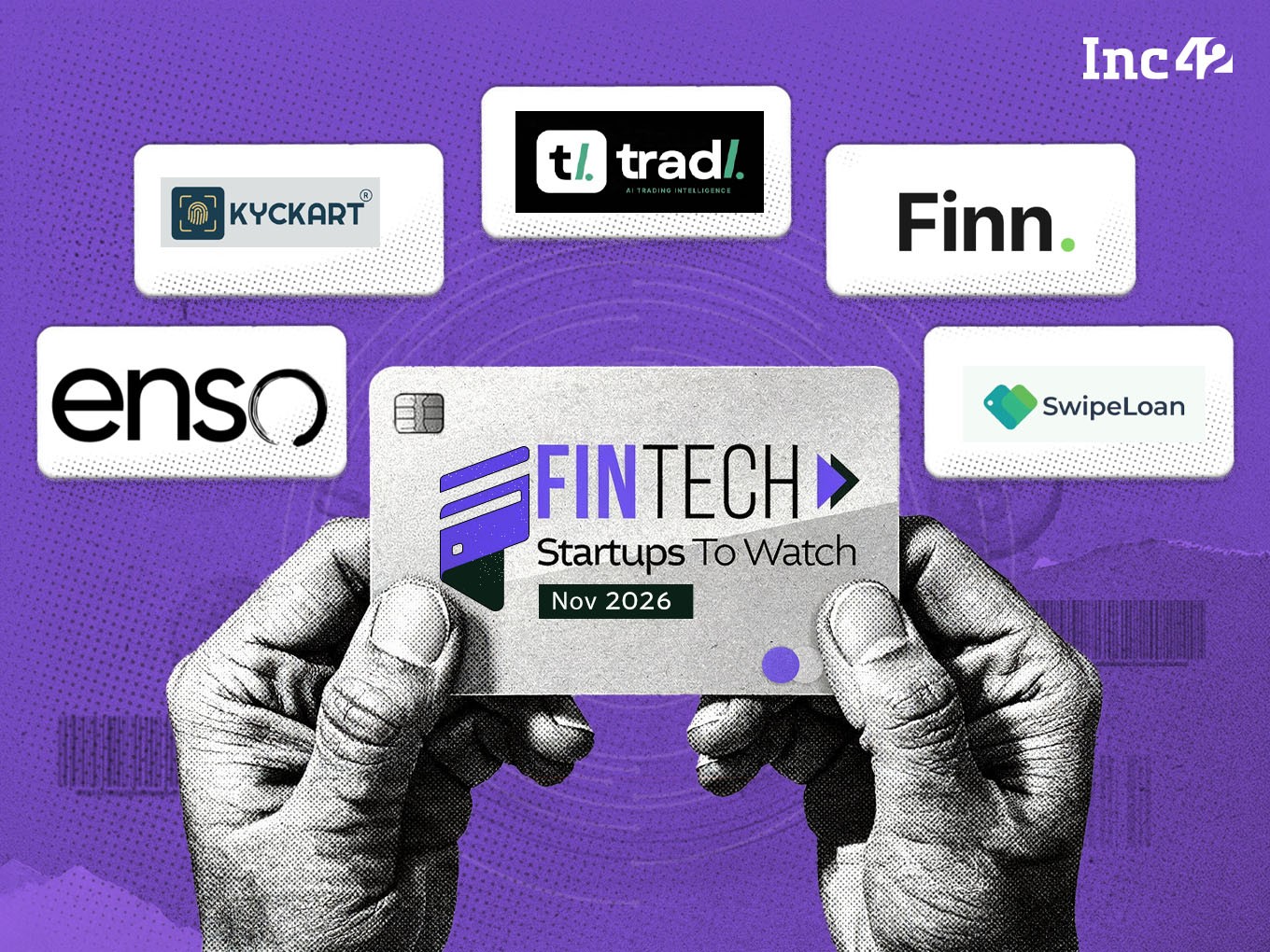
Fintech Startups To Watch: Startups That Caught Our Eye In November
It was a stormy November for the Indian fintech sector. Even as the Diwali season brought a surge in digital payment volumes, festive cheer felt muted on the ground for the broader fintech ecosystem.
Subdued discretionary spending weighed on sales, dragging average online card payments down 13% during this year’s festive season. Another telling sign was the credit bottleneck. According to retailer body AIMRA, only 60-70% of logged loan applications were approved as creditors tightened underwriting and CIBIL stepped up rejections.
This softer consumer pulse collided directly with prolonged uncertainty around merchant discount rates (MDR) on UPI. Originally slated for mid-October and later pushed to post-Diwali after trader pushback, the proposed MDR framework has now been deferred to mid-2027.
This took a direct toll on the shares of listed fintech players like Paytm, Pine Labs and MobiKwik, which had to survive a sharp correction.
But the issues weren’t limited to digital payment startups. At IRDAI, the insurance regulator formed an expert panel to review feedback on its proposed distribution reforms that could reshape digital insurtech economics, triggering industry pushback and share-price swings for listed players like PB Fintech and Turtlemint.
But there were silver linings too.
Walmart-backed fintech giant PhonePe has revived its IPO plans and is now targeting a listing on the D-Street in early 2027 at a valuation of $12-15 Bn. It is eyeing an IPO size of around $1.3 Bn.
Meanwhile, Razorpay secured SEBI’s approval for its planned $600 Mn IPO, signalling that institutional appetite remains alive for late stage fintech platforms even as regulatory overhangs persist.
Amid this environment of excitement and uncertainty, we are back with the November edition of Five Fintech Startups To Watch. This monthly series spotlights emerging fintech startups pushing the envelope and carving out a niche in India’s evolving fintech landscape.
That said, here are five new-age fintech ventures that caught our attention this month.
Editor’s Note: The list below is not a ranking of any kind. Startups have been listed alphabetically.
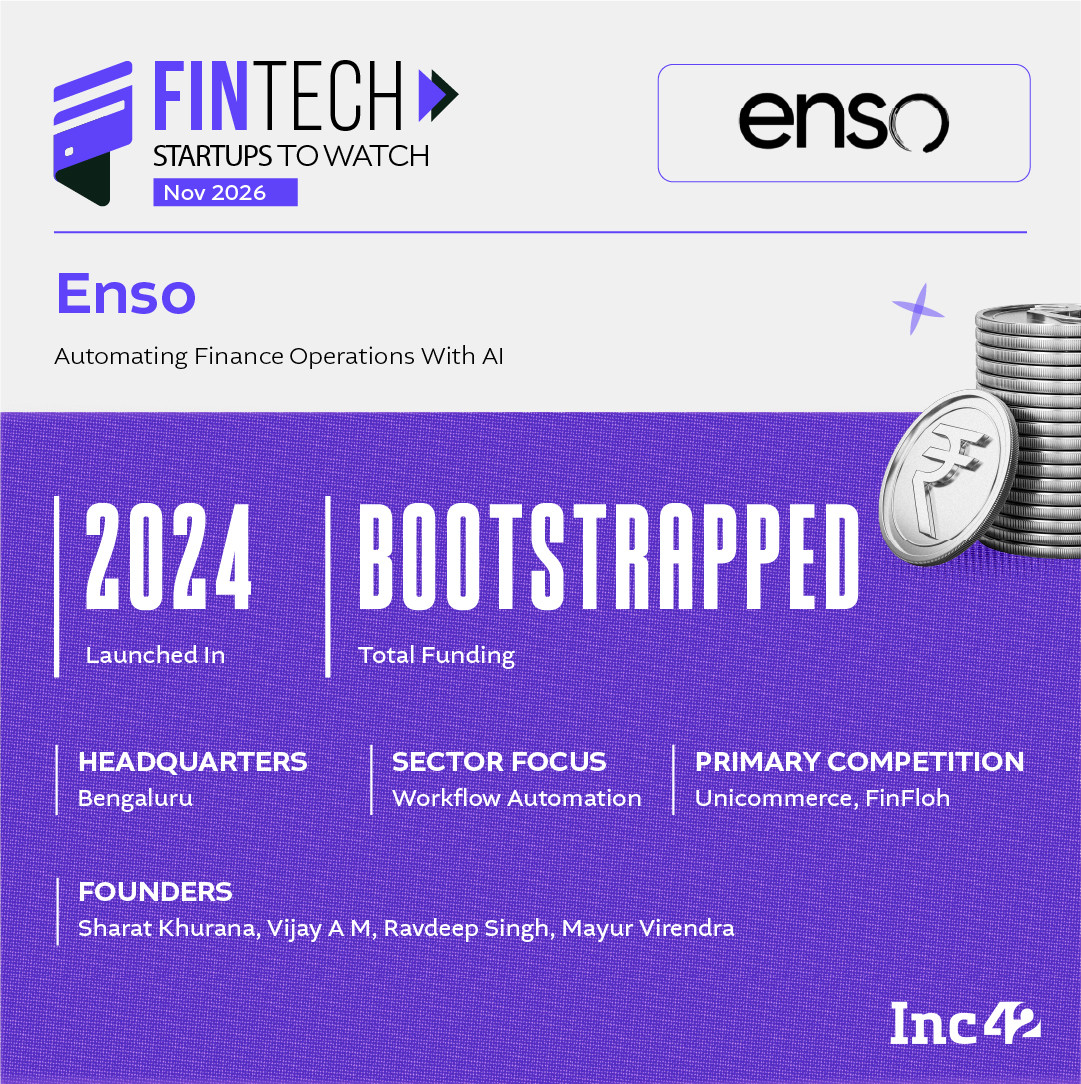
Enso | Automating Finance Operations With AI
For finance teams, revenue rarely lives in one place. Contracts sit in PDFs, usage data sits in product systems, invoices sit in billing tools and payments sit in bank statements. This can make month-end closing slow, manual and error-prone.
Enso wants to turn this fragmented workflow into one automated revenue engine. Founded in 2024 by former InMobi and Freecharge CFO Sharat Khurana, former MPL CFO Vijay A M, ex-Myntra product leader Ravdeep Singh and former Beckn Protocol engineering leader Mayur Virendra, Enso’s AI-powered platform can read complex customer contracts, track pricing, generate invoices and manage collections.
The bootstrapped startup is eyeing a piece of the broader Indian enterprise AI market, which is projected to become a $70 Bn opportunity by 2030.
Enso uses AI agents to extract pricing terms, billing schedules and revenue recognition rules from contracts, including unstructured PDFs. The platform can then also ingest consumption data from multiple product systems to generate automated invoices and track payments.
Beyond billing, Enso also claims to automate payment reminders, chase overdue invoices and match incoming payments against open receivables. It also supports reconciliation, automated revenue recognition and scenario modelling for pricing and commission changes.
Enso is designed to be integrated with existing systems like Salesforce, HubSpot, Zoho Books, Tally and Razorpay. The Bengaluru-based startup counts the likes of Capillary Technologies and Neuberg Diagnostics as its customers.
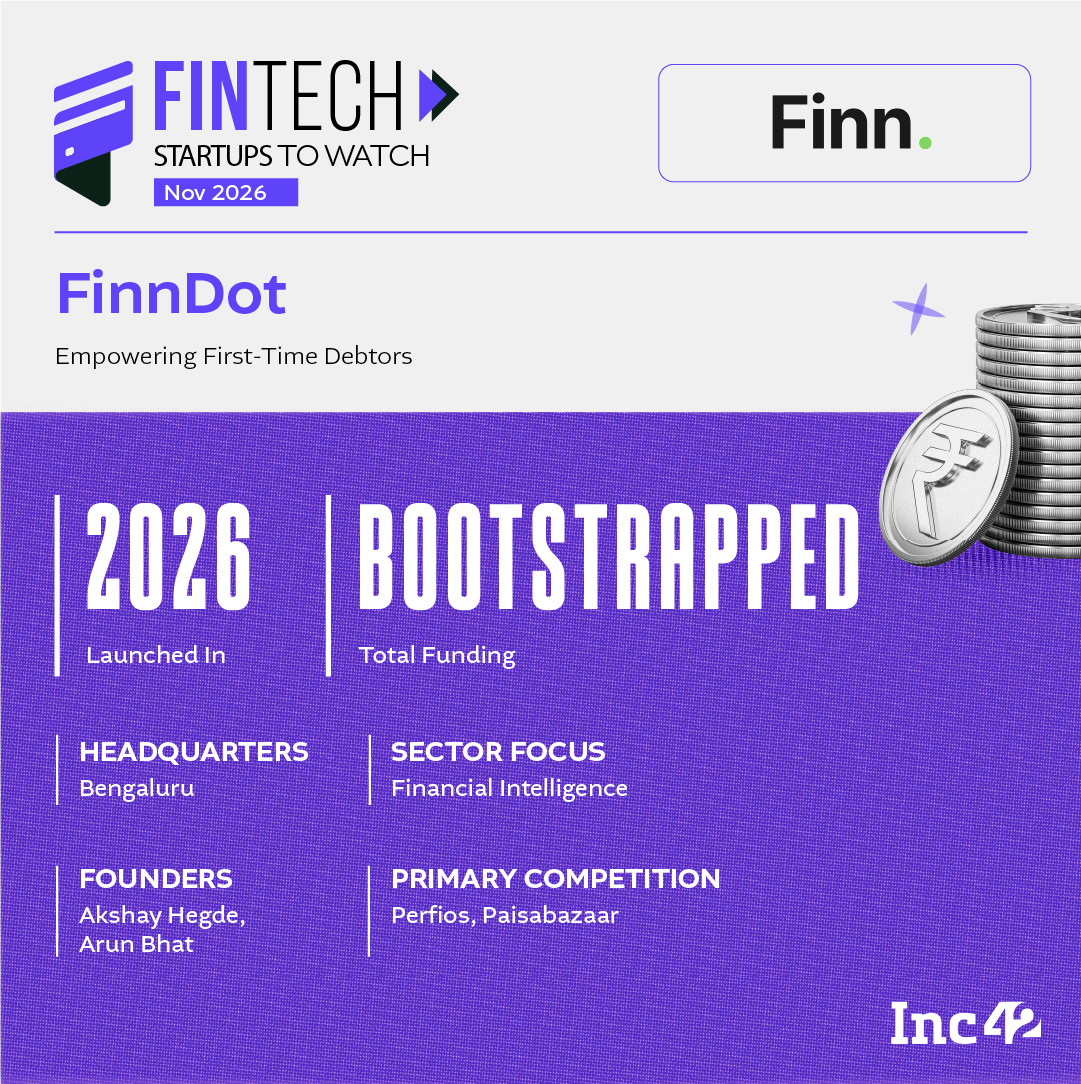
FinnDot | Empowering First-Time Debtors
After completing his engineering degree, Akshay Hegde applied for his first credit card, thinking it would be easy with his salary. But he was rejected due to a low credit score.
Coming from a farming family in rural Karnataka, the incident hit home. He had grown up seeing how formal financial services remained out of reach for first-time borrowers and self-employed persons in his part of the world.
To solve this, Hegde banded up with Arun Bhat to incorporate FinnDot in 2026. The startup is building an AI-powered financial intelligence layer to bridge the gap between borrowers and lenders. It operates on a B2B2C model.
On the consumer side, FinnDot’s app analyses financial data such as bank statements and income patterns to recommend loans, credit cards and investment products to end users.
On the B2B side, the startup’s FinnDot Credit Intelligence platform evaluates income consistency, spending behaviour, existing obligations, cash flows and repayment capacity to help banks and NBFCs assess the risk of creditors.
It generates revenue through referral and distribution commissions from partners whose products it recommends. It also earns a fee by providing credit intelligence solutions to financial institutions.
The startup claims to be currently clocking a revenue run rate of ₹10 Lakh, with its top line growing 40% month-on-month. Going forward, FinnDot plans to create alternate streams of revenue, including API usage fees, enterprise subscriptions and premium consumer services to further boost its top line.
KYCKART | Seamless Automated KYC Verification
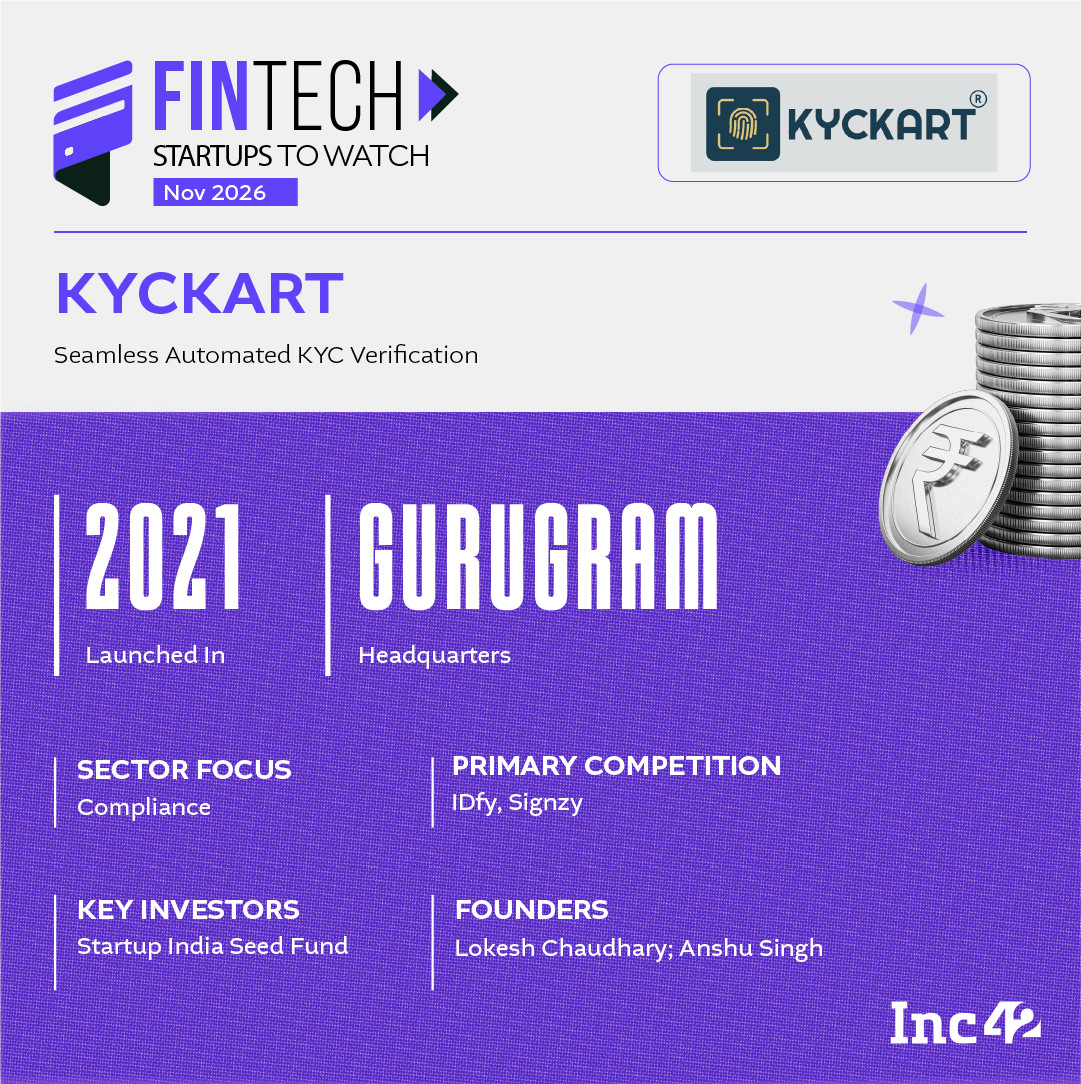
Know your customer (KYC) is a core pillar of compliance in India. But stitching together multiple verification vendors often leaves businesses with a slow, fragmented onboarding process and other operational bottlenecks.
Gurugram-based KYCKART wants to solve that fragmentation through a unified verification layer.
Founded in 2021 by Lokesh Chaudhary and Anshu Singh, KYCKART offers digital KYC, know your business (KYB) and fraud-prevention tools for banks, NBFCs, insurers and fintechs.
Its platform bundles identity checks, business verification, financial document validation and risk intelligence into a single API. Enterprises can access these workflows through a no-code dashboard or developer APIs that plug directly into existing stacks.
KYCKART offers more than 150 verification checks across PAN, Aadhaar, GSTIN, CIN, Udyam and employment records. It also offers fraud-detection capabilities like document forgery detection, liveness checks and AI-powered risk scoring. It provides solutions to support risk assessment after a customer has been onboarded.
The startup claims to process over 1.5 Cr verifications every month for more than 250 enterprise clients, including ICICI Bank, Bajaj Finserv, Kotak Mahindra Bank and Cars24.
SwipeLoan | Data-Driven Financial Services Marketplace
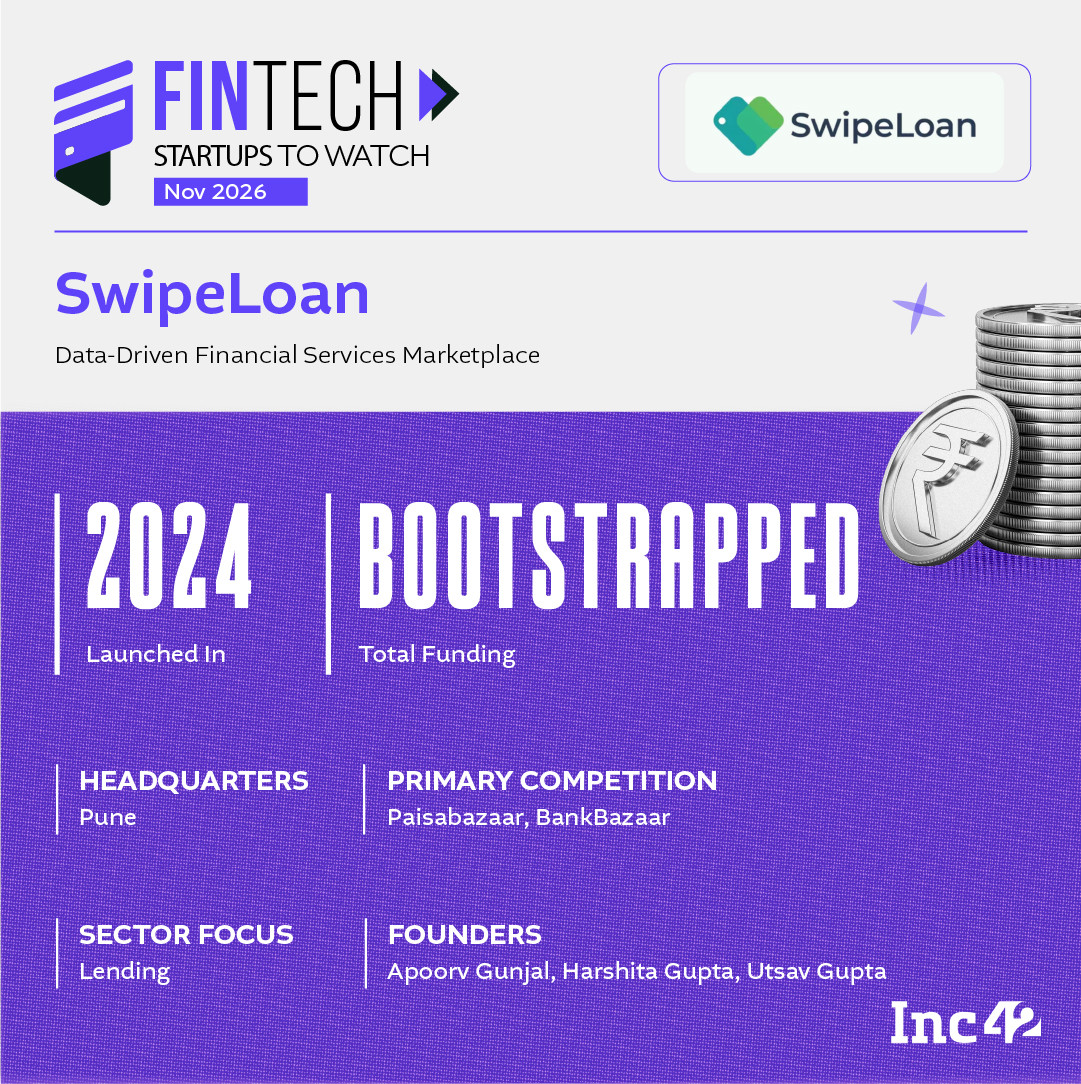
Accessing credit in India can be cumbersome. Borrowers often apply blindly across multiple lenders without knowing whether they meet eligibility criteria. This creates friction for applicants and drives up user acquisition costs for lenders chasing unqualified leads.
Pune-based SwipeLoan is tackling this mismatch with its eligibility-first credit-matching platform. Founded in 2024 by Apoorv Gunjal, Harshita Gupta and Utsav Gupta, the startup operates a digital financial services marketplace. Its catalogue spans personal, business, education, medical, and used-car loans, alongside loans against property, loans against mutual funds, credit cards, and insurance.
Rather than spraying consumer leads across lenders like conventional aggregators, SwipeLoan screens profiles upfront before routing them to partner banks and NBFCs. The startup does this by running identity verification, credit bureau checks, financial behaviour analysis, income and employment assessments and fraud-risk screens on users with their consent.
It then maps these signals against lender credit policies to identify relevant lending offers, leaving final underwriting, approval and disbursement to the lending partner.
The fintech platform is still bootstrapped and is yet to raise external funding. Despite this, SwipeLoan claims to have so far onboarded over 50 Lakh users and built a network of more than 140 lending partners.
The startup claims its current monthly revenue run rate exceeds ₹2.5 Cr and is growing about 25-30% each month. It is targeting ₹30 Cr in revenue in FY27.
Tradl | Simplifying Stock Analysis With AI
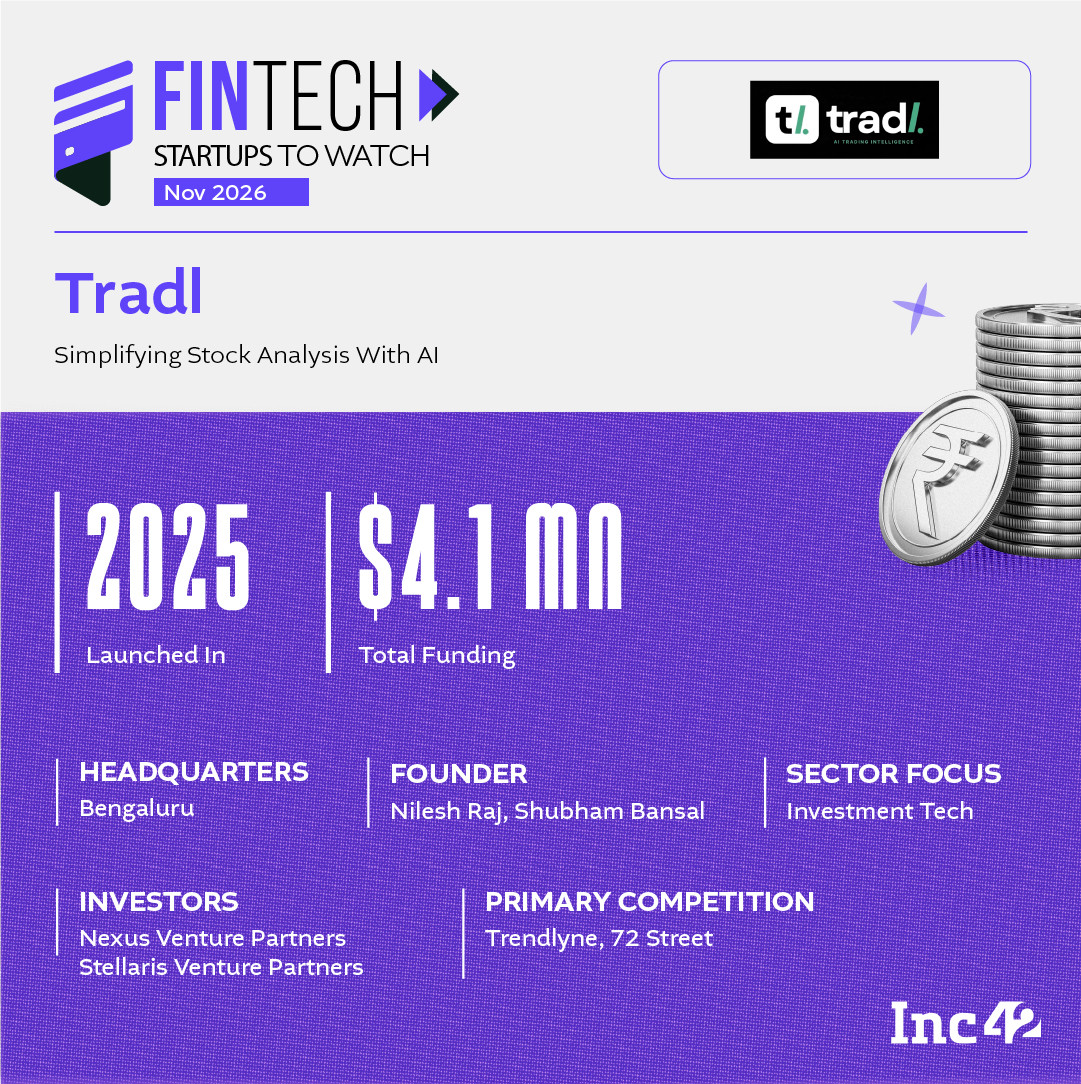
India’s retail investing boom has widened market participation. But individual traders still lack quantitative tools and sophisticated research that institutional investors rely on. This often leaves newcomers, overwhelmed by market noise, with very few avenues to turn raw data into actionable insights.
Bengaluru-based Tradl wants to close this gap by using AI to make institutional-grade market research accessible to retail participants
Founded in 2025 by Shubham Bansal and Nilesh Raj, the startup is building an AI-powered market intelligence platform that allows users to conduct complex financial analysis through natural-language queries.
The startup combines AI with a quantitative engine to help traders screen stocks, identify investment opportunities, analyse companies and backtest trading strategies.
But instead of manually configuring complex filters or writing code, users can simply describe their requirements in plain English. Tradl’s AI layer then translates these queries into executable instructions, which its quantitative engine processes against market data.
The platform also offers an AI-powered stock screener, sector rotation tracking, chart-pattern alerts, market insights and a personalised options chain for derivatives traders.
The startup recently raised $4.1 Mn from Nexus Venture Partners and Stellaris Venture Partners. In the long run, Tradl’s founders aim to move beyond assisting traders to workflow automation. It also plans to eventually move into agentic trading, enabling autonomous AI agents to execute trades under human supervision.
Edited by Shishir Parasher
The post Fintech Startups To Watch: Startups That Caught Our Eye In November appeared first on Inc42 Media.
This content is published by Inc42 and has not been created or edited by Hello Headlines. View original