Flipkart’s Losing Its Edge, And Walmart’s Patience
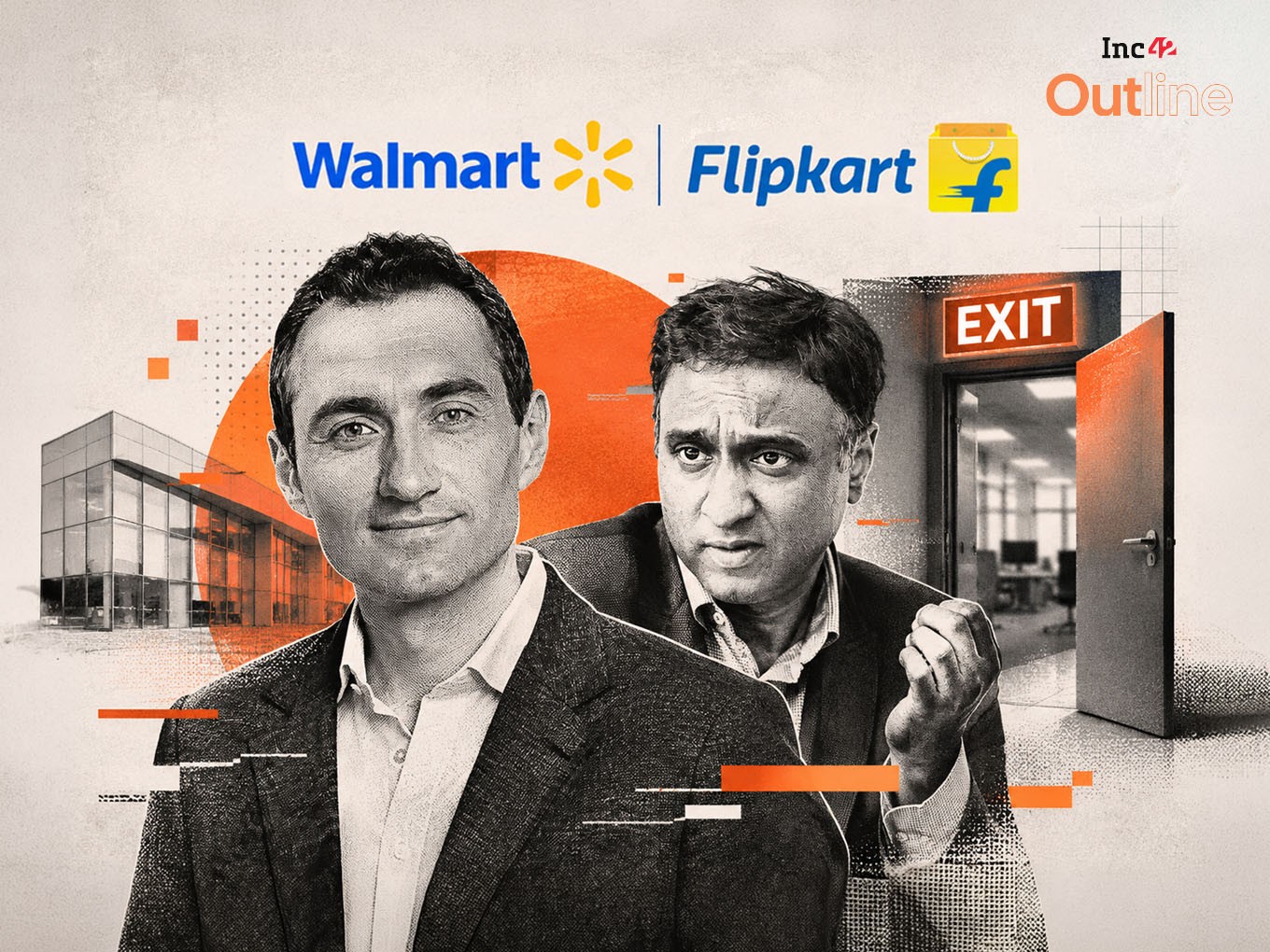
Earlier this month, Kalyan Krishnamurthy flew from Bengaluru to Walmart’s headquarters in Bentonville in Arkansas for what should have been just another quarterly review with Flipkart’s parent company. In just three weeks since then, the Flipkart CEO’s decade-long run at the top of India’s largest ecommerce company was over.
This week, Flipkart announced that Krishnamurthy would step down, with December 4 being his last day in charge of the company. Chief product and technology officer Balaji Thiagarajan would take his place and, along the Flipkart board, run the company until a successor is named.
Inside Flipkart, the decision news caught many off guard. While rumours had been doing the rounds in employee circles for days, only a handful of people at the top knew that Krishnamurthy had been asked to go. At a company of Flipkart’s size, a CEO handover usually takes months. This one was wrapped up in about a week.
Publicly, nothing seemed to be broken in the company yet questions lingered. Walmart International CEO Chris Nicholas thanked Krishnamurthy for his leadership and “the governance he instilled”. But, as Inc42 reported this week, Walmart had asked him to step down.
Walmart’s corporate affairs head Dan Bartlett called the meetings between Walmart’s board and Krishnamurthy “collaborative and constructive”, so then what triggered the reaction?
It was not a single thing, but several pressures piling up at once.
The IPO has been pushed to 2028 at the earliest, leaving Walmart, other shareholders and employees without an exit. Flipkart’s losses have not narrowed fast enough either compared to other marketplaces, and Flipkart has struggled to contain its losses even this fiscal, with both its loss-reduction target and the profitability goal set by Walmart looking increasingly out of reach.
That’s largely due to investments in new verticals, particularly quick commerce, but also a lacklustre festive season. Plus an internal probe into alleged financial irregularities, Walmart’s third at Flipkart in under three years, which is still running, also was a factor in Walmart’s discontent over what was happening in India.
Walmart has said the leadership departures “are not related to any investigation” and did not point to any one factor. But those in the industry believe it could very well be the fear within Walmart that Flipkart was losing its edge, despite having a higher share of the ecommerce GMV in India compared to its rivals.
India’s Value Shopper Find Many Homes
Flipkart’s pitch in the past several years has largely been to the value-conscious shopper in tier 2 and tier 3 India, the buyer who compares prices across three apps before ordering a ₹499 kurta or a ₹12,000 phone.
That was Flipkart’s territory, while Amazon focused on metros and premium buyers.
Meesho changed that. Its low-cost, small-seller model went after exactly this customer, and it worked. Meesho now calls itself India’s largest ecommerce platform by annual transacting users and orders, reporting 284 Mn transacting users and 819 Mn orders in Q2 FY27.
By value, though, Meesho still trails. The listed company accounts for about 10% of India’s ecommerce GMV, or the total worth of goods sold, against 50–60% for Flipkart, according to a May 2026 ICICI Securities report.
The gap comes down to the ticket size and the catalogue. Meesho built its business on low-ticket, everyday products, while smartphones, appliances and electronics make up 63–64% of Flipkart’s GMV.
Meesho, however, is winning on frequency and reach, which is where future GMV comes from.
Flipkart’s answer to Meesho in the form of Shopsy has not closed that gap as of now.
Meesho also did what Flipkart has not: it went public and created a benchmark for horizontal ecommerce marketplaces in India that Flipkart will be compared against if and when the latter comes to the market.
Meesho listed in December 2025 at a 46% premium to its issue price, and its net loss narrowed to about ₹1,358 Cr in FY26 from ₹3,942 Cr a year earlier.
Flipkart’s reliance on smartphones has also become its vulnerability.
Smartphones and mobile devices made up about 38–40% of festive GMV in the first two days of this year’s sales, according to Redseer. But with phone prices rising, festive season GMV fell 7–10% year-on-year in the first four days, and phones’ share of festive sales was expected to slip to 30% from 35% last year.
Walmart’s own numbers will show the Big Billion Days only in its Q4 results, as CFO John David Rainey said on the company’s Q3 earnings call, because the sale’s timing shifted this year. So we don’t yet know how well Flipkart has done in the most crucial part of the year.
A Battle With Amazon That Flipkart Couldn’t Afford
Krishnamurthy was seen as someone who could lead Flipkart into the post-listing life. But this became a huge overhang on the company. For one, Flipkart was not showing a clear path to profitability that many believe it should have done so by now, 20 years into its existence.
Analysts and ecommerce industry watchers believe that for most of the past decade, Flipkart’s strategy was defined by Amazon India.
Krishnamurthy made his name doing exactly that, out-discounting Amazon on high-value items such as TVs and phones in his early years. Flipkart was matching Amazon India on discounts, delivery speeds and premium categories, festive season after festive season.
The problem however is that the two companies are not playing the same game. Amazon is a global giant with no India IPO to answer to.
It can absorb losses here for as long as it chooses, and in fact, in recent years it has tightened its marketplace economics. Amazon Seller Services, its India marketplace arm, narrowed its net loss to ₹389.9 Cr in FY26 on revenue of ₹34,967 Cr. Even across all four of its India entities, Amazon lost ₹2,792.8 Cr.
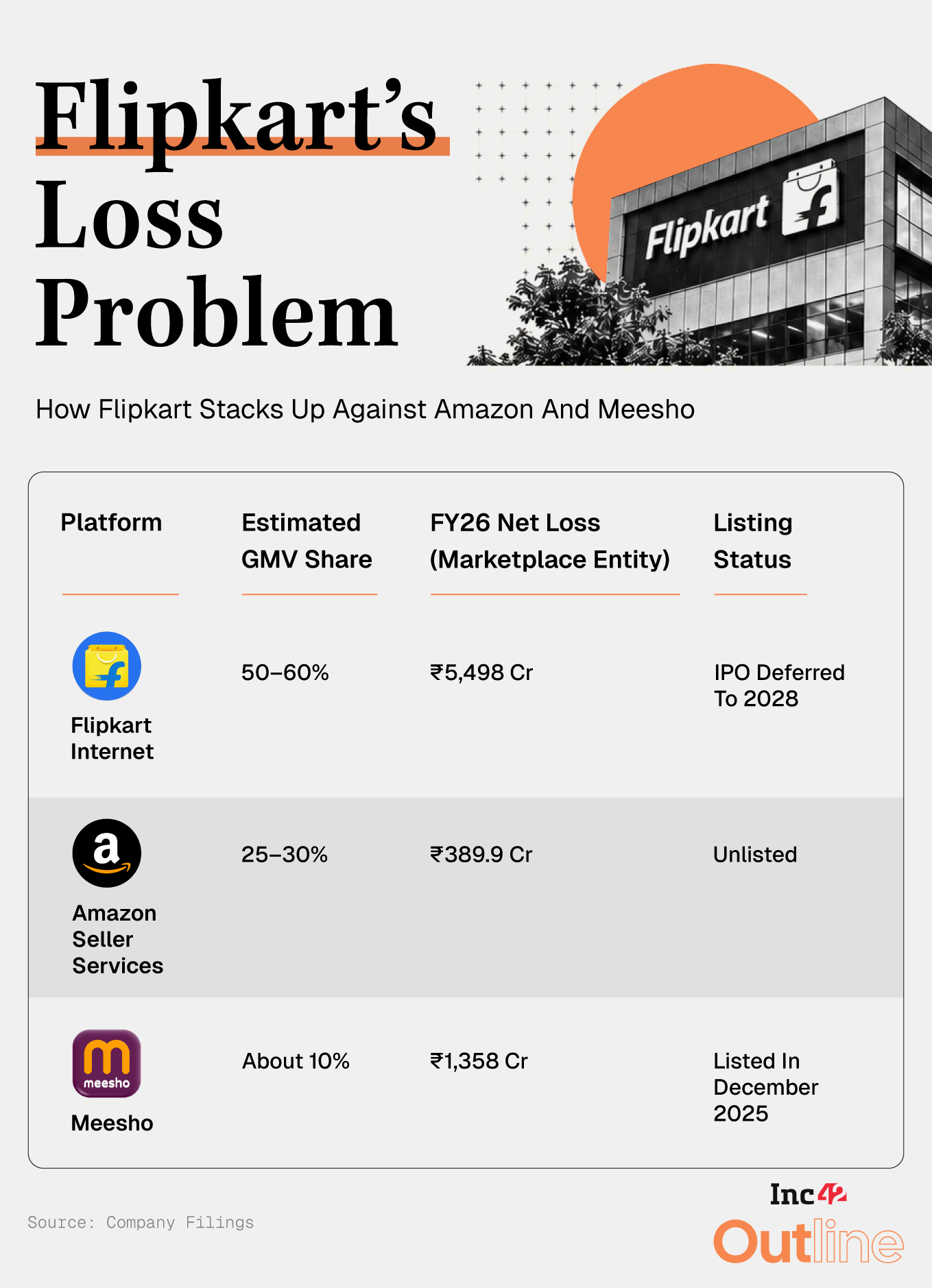
Flipkart’s numbers look very different. Flipkart Internet, its ecommerce marketplace entity, reported a net loss of ₹5,498 Cr in FY26, up from ₹1,694 Cr, although part of that reflects its redomiciling to India. At the group level, the consolidated net loss was ₹8,468 Cr. In other words, the market leader by GMV is losing far more money than its main rival.
The fact that Flipkart is yet to list and give an exit to its investors after the Walmart acquisition means the company is on a clock, whereas Amazon isn’t.
Walmart paid $16 Bn for its stake in 2018, and eight years on, it wants a listing that can return capital and give shareholders and employees liquidity.
But in a clear shift from Amazon as a target, Flipkart went after quick commerce in 2025. Flipkart Minutes drew in millions in investments as Flipkart chased the upside and joined the market to take on Blinkit, Zepto and Swiggy Instamart. It opened up other new fronts in fintech too, along with food delivery and microdramas, though these are considerably nascent.
Sources told Inc42 that Walmart questioned these bets, seeing them as factors that will kick the IPO further down the road, and more importantly, put the profitability target out of reach.
Walmart has reportedly asked Flipkart to reach EBITDA breakeven by the end of FY27, which is four months away. Whether Flipkart hits this mark is unclear but the new businesses are far from mature.
A Leadership Bench That Ran Thin
The third pressure point was the erosion in the company and the discontent among top management around ESOPs and the lack of a concerted focus.
Flipkart has lost at least 14 VPs and SVPs in a little over a year, including smartphones VP Kanchan Mishra, who led the category at the heart of Flipkart’s festive dominance. Group CFO Sriram Venkataraman’s exit was announced in March, and Myntra CEO Nandita Sinha left in April.
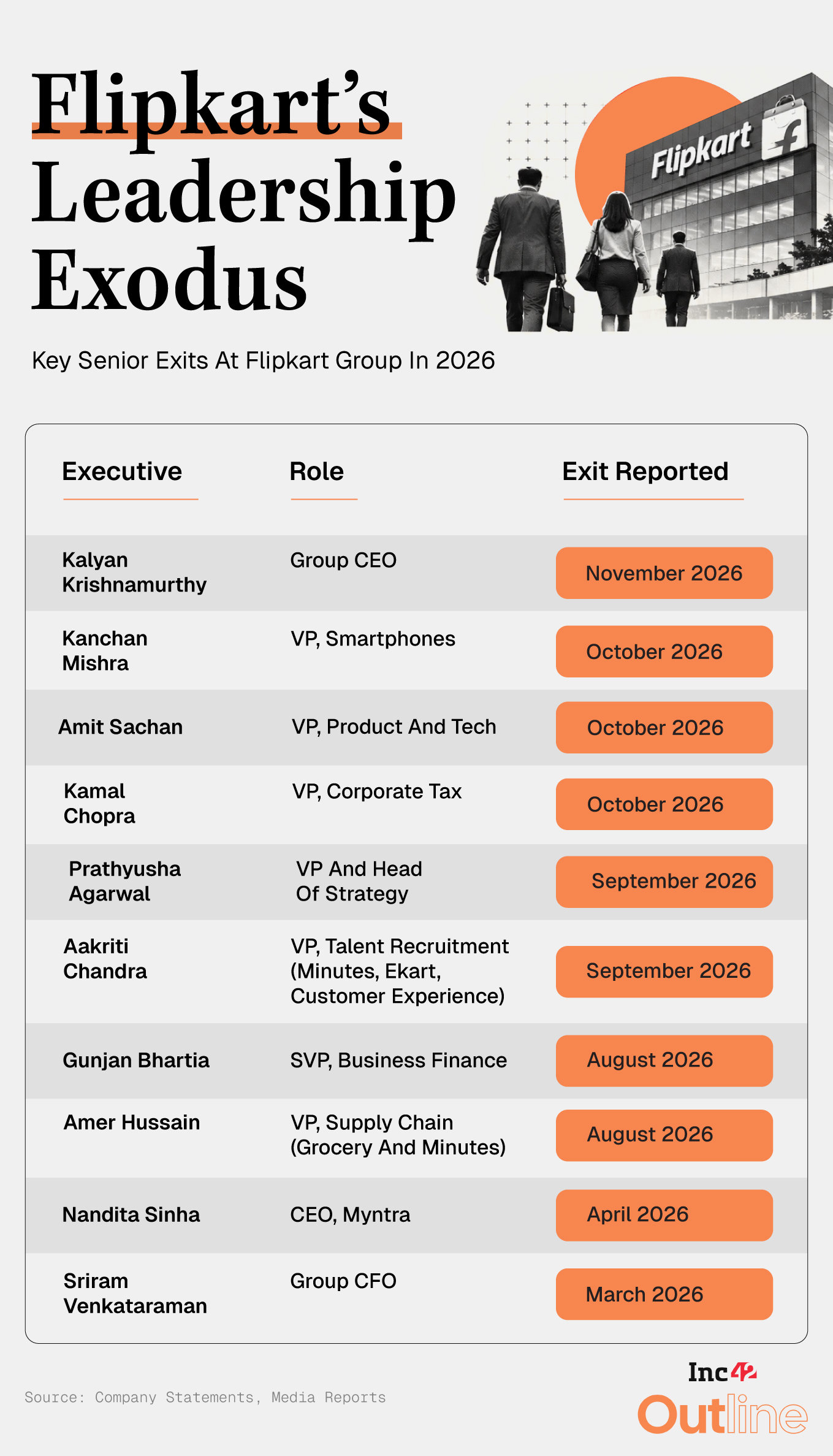
Many of those exits trace back to the delayed IPO. An IPO for a company like Flipkart, which has a 20-year history and a legacy of being the home to many other founders in India, will be a monumental step and a landmark event.
But some executives left Flipkart because they could see no way to cash out their stock options, sources said. More than 1,000 former employees have approached Walmart’s board seeking equal access to buybacks, and former executives including Mukesh Bansal and Ankit Nagori wrote to the board asking for a full cash-out. The pressure to IPO has never been higher.
Company insiders called Krishnamurthy a “hands-on” CEO who personally kept tabs on each business head, from supply chain and finance to fashion, quick commerce and mobiles.
Sources told Inc42 that key appointments ran through the CEO’s office, with sustained pressure on vertical heads to deliver growth.
When Sharon Pais took over Myntra in April, Flipkart’s announcement said she would report directly to Krishnamurthy. There was a clear consolidation happening that could take Flipkart towards an IPO.
That kind of control works when the business is winning. But when losses grow and new businesses continue to drain the coffers, it becomes harder to defend the strategy.
Walmart now appears to be tightening things on the leadership front. Reports indicated that the US parent firm plans to bring in a group CFO who would directly oversee finance, M&A and HR.
Walmart chief Nicholas is expected to meet Flipkart employees on November 30, when details of the leadership transition and an ESOP-linked cash payout are likely to be announced.
Whoever succeeds Krishnamurthy will inherit a company that is still the market leader by GMV but is losing ground in terms of new value shoppers. The big task will be to plug the gaps in the marketplace business, while also burning less money on businesses like quick commerce, which have shown traction.
The likes of Super.Money have shown promise when Flipkart has backed it with capital infusion. Will this continue to happen in the future or are we seeing the first sign of Flipkart’s retreat from new territories?
The CEO will also have to figure out what to do about the other new businesses while steadying the ship and settling the discontent in the air. More importantly, they will have to work against the clock when it comes to the all-important question of the Flipkart IPO.
[Edited By Nikhil Subramaniam]
The post Flipkart’s Losing Its Edge, And Walmart’s Patience appeared first on Inc42 Media.
This content is published by Inc42 and has not been created or edited by Hello Headlines. View original