Big spending, rushed preps: Nashik Kumbh aims to outmatch Prayagraj’s
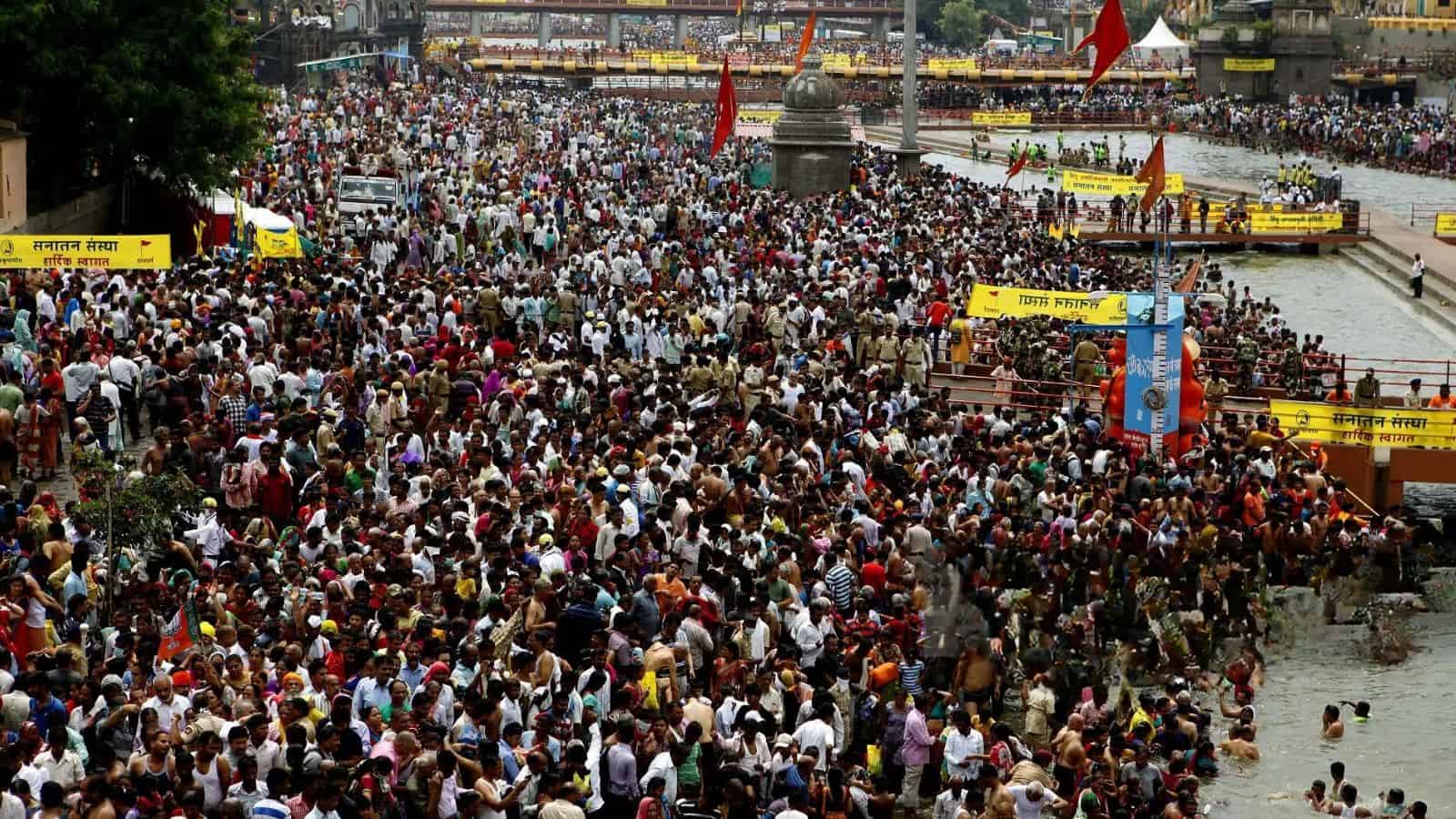
At two minutes past noon on Saturday, October 31, President Draupadi Murmu will hoist the laced saffron Dharmadwaj – a huge saffron flag – on a 51-foot flagpole near Ramkund on the Godavari River in Nashik, signifying the official commencement of the Kumbh.
This one-in-12-years Kumbh will, however, see the ritual bathing perhaps from a month before the first shahisnan, which has been renamed to ‘amritsnan‘. ‘Shahi’ is not a Sanskrit word. The first such best bathing day is on August 2, 2027.
An estimated 12 crore people will visit the mela scheduled to run over 21 months from 2026 to 2028. It will end on July 24, 2028. Officially, no explanation has come forth as to how this number was arrived at.
The Prayagraj Kumbh at the Triveni Sangam had about five times higher attendance – 66 crore visitors – held for 45 days, between January 13 and February 26, 2025.
The Kumbh is held at two locations: Ramkund in Nashik and Kushavarta in Trimbakeshwar. Given its long duration, the pressure on infrastructure is likely to be lower than in Prayagraj.
Trimbakeshwar, a temple town about 30 km from Nashik, is home to one of the 12 jyotirlingas. Both locations lie along the Godavari River. Although the pressure may be unevenly distributed between the two sites, splitting the crowds should make management easier.
The dispersal across two destinations and the long timeframe could be a blessing, as crowds would be thinner on most days, except during the Amrit Snan days. This would make crowd management easier for the authorities.
However, civic and police personnel, along with their superiors at various levels, may have to remain on their toes for many more days than their counterparts did during the Prayagraj Kumbh. The concern is whether this prolonged focus on the event could deprive the city itself of the attention it needs to serve its 2.5 million residents. Nashik, a poorly managed urban centre, deserves better even in normal times.
All efforts are underway, backed by a staggering allocation of over Rs 3,500 crore, to make the Nashik Kumbh Mela as spectacular as last year’s Prayagraj Kumbh, although the two events are not comparable in terms of attendance.
Maharashtra’s Kumbh in-charge minister, Girish Mahajan, admits that the 2015 Nashik Kumbh was conducted without major incidents with a budget of just Rs 350 crore. The previous Kumbh, held in 2003, had witnessed around 40 deaths in a stampede.
The preparatory work for this Kumbh had begun about a year and a half ago. Budgets are drawn up and funds allocated closer to the event. “It cannot be in any other way; that’s how it is,” he said.
Common sense suggests that since the Kumbh dates are fixed 12 years apart, and the requirements remain largely the same, with incremental changes to accommodate a likely increase in attendance, permanent arrangements should be in place.
Except for Ramkund in Nashik and Kushavarta in Trimbakeshwar, little else appears to be in place. The Sadhugram, where holy men stay during the event, roads, traffic arrangements, CCTV cameras and other infrastructure are yet to be completed.
The plan, it appears, is to finish the work by the time pilgrims begin arriving, about a month before the first Amrit Snan in August 2027. The period from October 2026 to July 2027 appears to be the window for executing major projects.
Nashik’s roads have been dug up, while much of the riverfront is closed and being revamped, virtually from scratch. The road widening leading to Trimbakeshwar has also caused considerable inconvenience to residents, including during their daily commutes.
Experience shows that infrastructure built at great cost often requires extensive renewal before every Kumbh. Little, apart from the river itself and the rituals, appears to be permanent.
It is significant that, just days before the scheduled inauguration of the Kumbh by the President, the Maharashtra Pollution Control Board issued a show-cause notice to the Nashik Municipal Corporation, asking why its bank guarantees should not be forfeited.
Water samples collected from the Godavari on October 5 were found to be substandard. The discharge of untreated waste into the river has been a perennial problem, and the civic body has 15 days to explain itself.
Here comes the bigger concern. The Pollution Control Board’s action follows a Bombay High Court order in a matter dating back to 2012, well before the previous Kumbh in 2015.
Mahajan told a television audience that as much as Rs 2,200 crore had been spent on wastewater treatment facilities and that only the final steps remained. He said these would be completed before the holy baths begin and that almost all the work had been done.
Yet the continued disregard for the purity of the river water over the years remains unexplained.
A final point concerns the curious silence surrounding the once-loud agitation against tree-felling, opposition to tree transplantation and demands for civil society participation in framing measures to protect the environment. It is unclear whether the authorities have stopped responding to these concerns or the protesters have grown weary. Either way, the agitation appears to have faded, while the state seems to be having its way.
Get the latest updates in Hyderabad City News, Technology, Entertainment, Sports, Politics and Top Stories on WhatsApp & Telegram by subscribing to our channels. You can also download our app for Android and iOS.
This content is published by The Siasat Daily and has not been created or edited by Hello Headlines. View original