‘The Sky Had No Stars’: Gurugram Student Builds Free Website To Check Light Pollution Using a Phone Photo
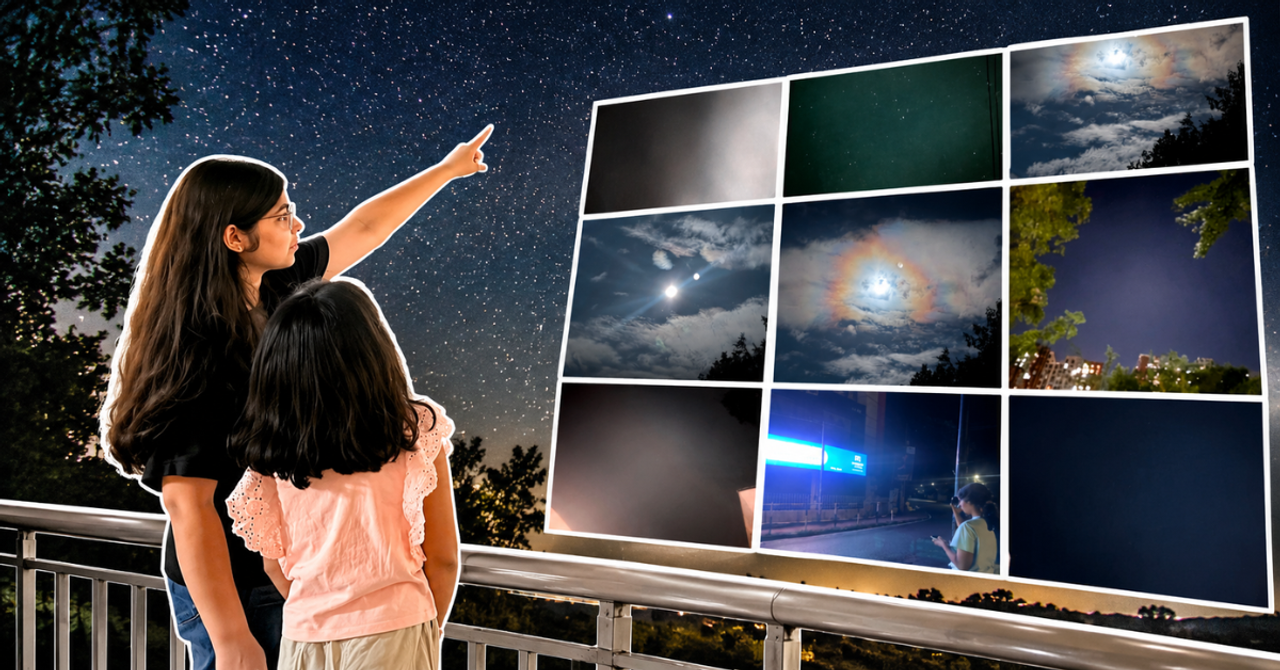
When Suhani Gupta and her sister spot more than seven stars from their balcony in Gurugram, they have a reason to celebrate. They step outside, open Stellarium, an astronomy app, and try to identify the constellations above them.
In a city where the night sky rarely offers a clear view of the stars, even a handful can turn an ordinary evening into an occasion.
“My sister and I get excited when we see more than seven stars in the sky,” Suhani tells The Better India.
The sisters initially assumed that air pollution was responsible for the limited visibility. After all, Gurugram frequently experiences haze. But visits to her grandparents in Udhampur, Jammu and Kashmir, offered Suhani a different perspective. The sky there appeared far more generous with stars.
The stars had not suddenly multiplied in the mountains. Something about the surroundings had changed.
That difference led Suhani to investigate light pollution — the excessive or poorly directed use of artificial light that brightens the night sky and makes celestial objects harder to see. Buildings, roads, commercial establishments and other sources of outdoor lighting can contribute to this glow.
The consequences extend beyond astronomy, affecting nocturnal wildlife, ecosystems and human exposure to darkness.

But how could a school student measure a problem that even many adults rarely recognise?
In May 2025, Suhani, now a Class 12 student, began teaching herself image processing and developing SkyQi, a free online platform that estimates night-sky quality using photographs taken on smartphones.
The project has since grown into a citizen-science initiative, attracting observations from users across dozens of countries.
In 2026, she took the investigation further. Using NASA satellite data, she examined changes in night-time radiance across 50 Indian cities between 2015 and 2025. Her analysis found that the median city's measured night-time radiance was 70% higher in 2025 than in 2015, while 47 of the 50 cities recorded an increase. Leh, known for its dark skies and astronomy tourism, showed the steepest rise in her dataset, at 546%.
The findings do not directly measure how bright the sky appears to someone standing on the ground. They do, however, raise questions about how urban growth, tourism and outdoor lighting are changing India's nights.
For Suhani, the aim is to make those changes easier to observe, understand and eventually address.
From a school astronomy club to a pollution problem
Suhani's interest in light pollution began in 2024, when she was part of her school's space society. During meteor showers and other astronomical events, members would gather on voice chat at around 3 am to watch the sky.
Observing the stars required patience. Participants would spend about 30 minutes outside, allowing their eyes to adjust to the darkness before attempting to identify celestial objects.
“While we generally do that to adjust to the moon’s brightness, the haze in our sky was much more, and that is kind of how I got into light pollution,” she explains.
She began watching YouTube videos and reading research on the effects of artificial light on human health, wildlife, ecosystems and astronomy.

“Unlike other forms of pollution, air, water, or even noise, light pollution came on gradually, so we never even knew it was taking over our skies,” she says.
Unlike a polluted river or a visible plume of smoke, an increasingly bright night sky can be difficult to recognise as an environmental change. New buildings, illuminated advertisements, streetlights and commercial spaces may appear to make a city safer or more developed. Yet the cumulative effect of unnecessary or poorly directed lighting can reduce the darkness that once allowed people to see the stars.
Suhani wanted to understand how this gradual change could be measured. She also wanted to find a method that did not require expensive equipment or specialised astronomical knowledge.
Can a smartphone measure the night sky?
Professional astronomers use instruments called Sky Quality Meters to measure the brightness of the night sky. These devices provide numerical readings that help observers assess how dark a location is. However, their cost can put them beyond the reach of students, amateur astronomers and community groups.
Suhani began exploring whether an ordinary smartphone camera could offer an alternative.
She was not entirely new to technology. She had previously worked with Arduinos and Raspberry Pi and built a visual aid for people who are blind using vision-language models and computer vision.
Her parents helped her develop the skills required for the project. Both are software engineers from BITS Pilani, and her mother had worked on image processing for Nokia phones.
“My mom taught me the concepts, and a lot more Python along the way,” Suhani says.

She supplemented these lessons with research papers, programming libraries and help from her father. She also used AI as a learning aid while trying to understand the techniques astronomers use to assess the night sky, including the Bortle scale.
The Bortle scale classifies night skies according to their darkness and the visibility of stars and other celestial objects. At one end are heavily light-polluted urban skies; at the other are exceptionally dark skies where the Milky Way and faint celestial objects are visible.
Suhani began developing SkyQi in May 2025. The first version assessed a photograph's overall brightness and converted it into a score.
But the results were unreliable.
A cloudy sky could be mistaken for a light-polluted one. A camera sensor could count bright pixels as stars, while overexposed photographs could distort the readings.
“I realised that one measurement wasn't enough,” she says.
She reworked the platform to assess three indicators: the number of visible stars, the difference in brightness between the horizon and the sky directly overhead, and the calculated brightness of the sky.
The platform compares these measurements to determine whether they broadly agree. If they do, it assigns a confidence level to the reading. If they do not, the result can be flagged as less reliable.
SkyQi went live in September 2025. However, making the platform available was only the beginning. Suhani soon found that its formula classified too many photographs, including some taken in towns, as almost perfectly dark because the calculation had reached its measurement ceiling.
She revised the method to account for information recorded by smartphone cameras, particularly shutter speed and ISO settings.
“Two phones can photograph the same sky and produce very different-looking pictures, and a longer exposure makes the sky look brighter, so knowing the settings lets me correct for that,” she explains.
When these details are missing, as can happen when photographs are forwarded through WhatsApp or edited, SkyQi uses a published world atlas of light pollution as a starting point and adjusts the estimate using information from the photograph.
It labels such results as ‘Estimated’. The platform also checks cloud forecasts for the location and flags observations that may have been affected by clouds.
The system is still evolving. SkyQi currently uses a shared calibration across phone models, while model-specific calibration remains part of Suhani's plans.
What makes a reading reliable?
Clouds can obscure stars while reflecting artificial light towards the ground. Moonlight can brighten the sky, while camera movement can blur stars or make them difficult to identify. Smartphone image processing can further alter the apparent brightness of a photograph.
So SkyQi does not rely on a single indicator. It compares the three measurements and assigns high, medium or low confidence according to how consistently they point towards the same conclusion.
A high-confidence reading does not guarantee that the result is correct. It means that the available indicators agree with one another.
Suhani has tested an earlier version of the platform against 104 reference night-sky images with known Bortle classifications. According to her, SkyQi's result was within one Bortle class of the reference approximately 65% of the time.
However, the tool has not yet been validated against a professional Sky Quality Meter.
“I do not possess a professional sky quality meter but one that I made by myself using an Arduino. Thus, I haven't compared it yet with a professional Sky Quality Meter,” she tells The Better India.
A few hundred photographs containing complete camera settings have been submitted since September, and Suhani hopes to use these observations to improve the platform's calibration.
For now, she describes SkyQi as a citizen-science tool rather than a substitute for professional instruments. Its value lies partly in helping people collect observations from different locations and, ideally, repeat them over time.
She recommends photographing the sky on clear nights, preferably when the Moon is not visible and at least an hour and a half after sunset. Users should move away from direct light sources, keep their phones steady, point towards an open sky and upload original, unedited photographs.
What did 50 Indian cities reveal?
Once SkyQi was underway, Suhani turned to a larger question: had India's night skies become brighter over the previous decade?
In 2026, she analysed NASA satellite data covering 50 Indian cities in 2015, 2020 and 2025. Her report found that the median city's measured night-time radiance was 70% higher in 2025 than in 2015. Forty-seven cities recorded an increase over the period.
Leh stood out, with satellite-observed night-time radiance rising by 546%, according to her analysis.
“Leh is one of the only dark sky places left in our country, and despite it being such a remote high-altitude place, we observe light pollution levels increasing,” she says.
The finding raises particular concerns because Leh and the wider Ladakh region are associated with high-altitude landscapes, astronomy and relatively dark skies.
Suhani points to urbanisation and the growth of tourism infrastructure as possible contributors to increasing artificial light. Hotels, homestays, restaurants and other facilities have expanded in places that were previously less developed.

This creates a paradox. Visitors travel to Ladakh to experience its night sky, but the infrastructure built to accommodate them can introduce additional artificial light.
Communities around Hanle, for instance, have developed homestays and astronomy-related tourism, with residents training to welcome visitors as astronomy guides, sometimes known as Astro Ambassadors. Protecting dark skies could therefore be important not only for astronomical research but also for a tourism economy that depends on them.
However, the figures require careful interpretation.
“The analysis that suggested a 546% increase was in satellite-observed nighttime radiance from 2015 to now, and while satellite radiance is not a direct measure of ground-level sky brightness, the stark increase suggests a drastic increase even in ground-level sky brightness,” Suhani says.
What's next for Suhani?
Suhani has made her report and the underlying city-level dataset publicly available, allowing other researchers and interested readers to examine the figures.
According to the latest figures she shared with The Better India, the platform has received 1,198 photographs from more than 490 contributors across 63 countries.
“I was initially skeptical of the reach SkyQi would attain and continue to remain amazed at how many people have tried the tool out,” she says.
India is currently the third-largest source of readings on the platform, after the United States and China.
“The ultimate aim of SkyQi has always been to find or build a community of people passionate about light pollution advocacy and spread awareness about it, and it has achieved exactly that,” she says.
She hopes schools and astronomy clubs will organise night-sky surveys in which students photograph the sky from the same locations month after month. Repeated observations could help participants identify patterns and locations that need more detailed investigation.
For now, the project asks people to do something simple: look up, take a photograph and pay attention to what the sky reveals.
“Light pollution isn't something we just have to live with,” she says.
The question that began on a Gurugram balcony has now expanded to 50 Indian cities and a growing international community of observers. What started as an attempt to understand why the stars looked different in Udhampur has become an effort to measure how artificial light is changing the night.
This content is published by The Better India and has not been created or edited by Hello Headlines. View original