Women need to be at the forefront of India’s water governance
India’s aquifers are under sustained pressure. The Central Ground Water Board’s 2025 assessment classifies 730 of 6,762 groundwater assessment units as over-exploited, meaning annual extraction exceeds the annually replenishable recharge. A further 201 units are classified as critical. In Punjab, Rajasthan, and Haryana, the stage of groundwater extraction stands at 156, 147, and 137 percent respectively, far outpacing the amount that is naturally restored.
While these figures are staggering, they also understate the damage that has already accumulated. A 2023 study of 736 over-exploited units found that 49 had lost more than half of their aquifer storage relative to average water levels between 1991 to 2000, a category the authors termed “severe long-term depletion”.
The dominant policy response to this crisis has been to build infrastructure. The Jal Jeevan Mission (JJM) has extended tap water connections to more than 81 percent of rural households. At the village level, the JJM operational framework centres planning on Village Action Plans, source mapping, and the operation and maintenance of in-village supply. These are necessary functions, but they do not regulate the pumping that drains the sources. Research on rural drinking water near Bengaluru shows panchayats repeatedly drilling deeper borewells to chase a water table that is falling largely because of agricultural extraction.
Meanwhile, what has received far less attention is the information gap at the core of water planning, or rather, what is counted as legitimate and ‘scientific’ knowledge.
Women’s knowledge of water is not counted
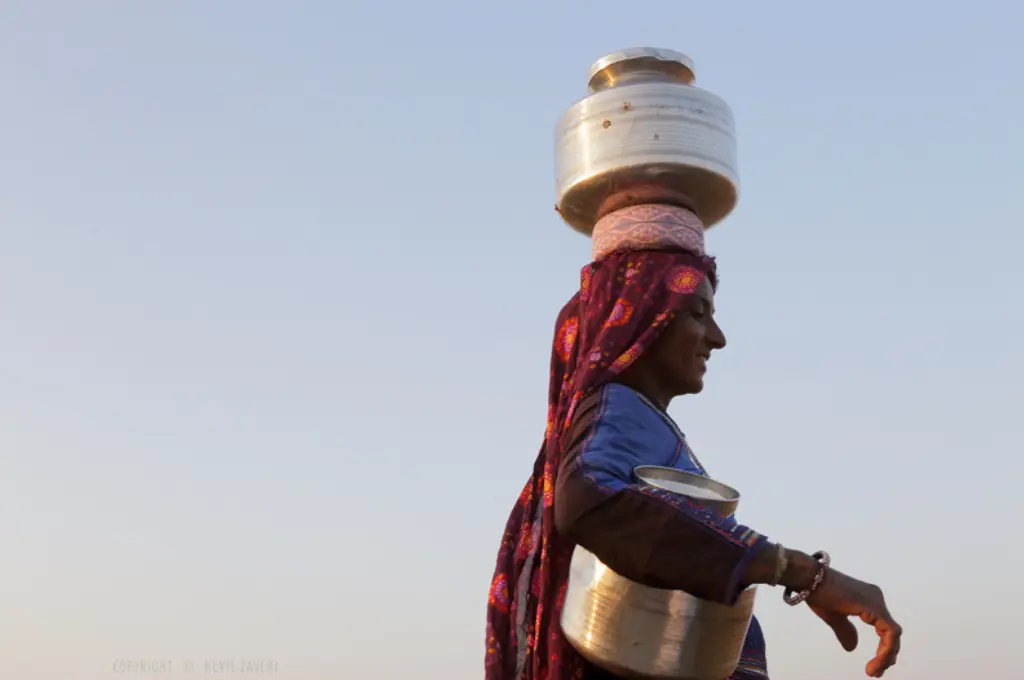
According to NFHS-5 (2019-21) data, women aged 15 and above are responsible for collecting water in around 71 percent of rural households. On a daily basis, they track availability in different ways: changes in travel time, which water sources stay reliable through a drought, and when a tank or spring begins to dry. Such observations are cumulative, built through interactions with the same water points over years, and can give a finer-grained picture of local variation than a one-time survey or a regional assessment.
Rani*, a farmer in a village in Chamarajanagar district in Karnataka, described how the rains in the area have changed. “This year the rain came late, and less of it than in earlier years,” she said. “We need a rainwater harvesting system. If we could dig trenches, or if the government supported this, it would really help.” Her account matched the 2026 monsoon, which arrived late and fell well short in June as El Niño conditions developed. Her observation carried a planning judgement about what recharge is needed and where, but that judgement has no obvious route into a water plan.
Local observation also captures causes, not just symptoms. In the Biligiri Rangaswamy Temple Tiger Reserve in Chamarajanagar, Soliga elders link the reduced flow of rainwater from hilltops into streams and waterholes to the spread of the invasive shrub Lantana camara. These observations can complement hydrogeological measurement about how particular sources behave under stress, information that regional assessments do not capture.
Despite their accuracy, such local signals are largely excluded from decisions about how water is allocated, extracted, and managed. A piezometer reading, a recharge estimate, or a borewell yield log can enter a planning document directly. A multi-year local record of which spring fails first in a drought is treated as ‘soft evidence’—anecdotal and ethically significant, but technically marginal.
Decentralisation without authority
India’s move toward decentralised water governance was intended to bring planning closer to affected communities. In practice, local institutions have been given responsibility for service delivery without having decision-making authority over the wider drivers of water availability. That creates a mismatch between what local bodies are expected to manage and what they are able to change.
A case from Karnataka case shows this pattern. In the Aralumallige and Doddathumakuru gram panchayats in Bengaluru Rural district, a 2025 study in PLOS Water found that groundwater depletion, driven largely by agricultural pumping, forced the panchayats to abandon failed wells and drill new, deeper ones. Government grants have historically paid for new wells, but the rising cost of pumping from greater depth falls on the panchayats, many of which are in what the authors call ‘electricity debt’. The panchayat carries the service-delivery failure but holds no authority over the agricultural extraction that causes it.
Women are invited into institutions that are themselves constrained, which makes their inclusion procedurally real but substantively narrow.
The closest India has come to giving villages a formal role in groundwater decisions is the Atal Bhujal Yojana, a pilot in 8,203 water-stressed gram panchayats across seven states. In the scheme, panchayats prepare water budgets and Water Security Plans that the gram sabha approves. At least a third of the members of the village committee involved are supposed to be women. This matters, because it brings women into discussions of demand and extraction rather than only limited to conversations about taps. But it is a time-bound pilot. Its plans are implemented through convergence with other schemes rather than through any power to limit pumping. It also only covers a small fraction of the country’s gram panchayats.
For women, this compounds the existing problem. They are invited into institutions that are themselves constrained, which makes their inclusion procedurally real but substantively narrow.
Participation at the lowest level of authority
JJM mandates that at least 50 percent of the members of Village Water and Sanitation Committees (VWSCs) be women, and official reporting records 24.80 lakh women trained to test water quality with field testing kits across 5.07 lakh villages. The question is not whether women are being included. It is what level of authority does that inclusion bring?
Under the JJM Operational Guidelines,VWSCs or Paani Samitis are responsible for planning and managing in-village water supply, operation and maintenance, and local quality monitoring. However, decisions regarding the regulation of groundwater extraction or the allocation of water between farming and domestic use sit with state groundwater authorities, irrigation departments, and water resource departments. Women are therefore formally represented where service delivery is managed, without equivalent influence over the decisions that determine whether a source has water at all.
Institutions can be formally open to women while rules, social hierarchies, and procedural norms keep them out of consequential decisions.
Irrigation institutions show a similar pattern. Water user associations (WUAs) are farmer bodies through which irrigators share distribution, management, and maintenance of canal water within a defined command area. A survey of 109 women in WUAs in Assam and Bihar found that only 1.8 percent said the rules and systems for women’s participation worked well. In Bihar, inclusion, at least on paper, is higher, given that having a woman member on WUAs is mandatory. However, women respondents in the survey stated that their involvement in WUA decisions was mostly limited to voicing their needs and concerns. Involvement in decisions on water distribution, pricing, and maintenance remained very low. Maharashtra similarly shows why quotas alone do not remove structural barriers. The Maharashtra Management of Irrigation Systems by Farmers Act, 2005 provides for women’s representation on WUA managing committees, but membership is attached to landholders and occupiers of land in the command area. Where land titles sit mostly with men, the quota is filled from a pool that already excludes most women. In the survey of Assam and Bihar cited above, only about 12 percent of women respondents owned land.
Taken together, these gaps illustrate what Bina Agarwal calls participatory exclusions: institutions can be formally open to women while rules, social hierarchies, and procedural norms keep them out of consequential decisions. In water governance, a second filter sits on top of the first. Even when women are present, their knowledge enters the record only if it fits the technical formats the institution already uses.
Ensuring inclusion wherever decisions are made
There is evidence that women’s inclusion at the right institutional level can change outcomes. A randomised study of gram panchayats in West Bengal and Rajasthan, where council headships were reserved for women by lottery, found that women-led councils invested more in drinking water facilities. The mechanism matters. In both states, women raised drinking water more often than men in their requests and complaints to the council, and women leaders invested in line with those priorities. Representation changed outcomes because it changed whose information shaped the agenda.
That being said, inclusion at the operational layer of the system, where decisions are about pipes and taps, cannot substitute for inclusion at the policy layer, where decisions are about aquifers, allocations, and extraction limits. At present, the bodies that regulate groundwater extraction, the irrigation departments that allocate canal water, and the committees that decide allocation in drought years generally carry no mandate for women’s representation.
Three changes would be realistic within existing institutions:
- JJM’s trained women water testers already report results to a national water quality information system. Adding a few simple fields on source behaviour, such as the date a source dried, changes in yield, and travel time, would turn a quality-testing network into a source-monitoring one at low cost.
- Atal Jal-style water budgets could be extended to all over-exploited and critical blocks and given formal weight, so that state groundwater authorities must consider them when notifying areas for regulation.
- District bodies that decide drought-year allocation could include elected women panchayat members or representatives of women’s self-help group federations from affected blocks, rather than an unspecified ‘woman member’.
Each of these carries costs. More reporting adds unpaid work for women who already carry the water, so there need to be provisions to provide women with an honorarium and a tangible use for the data. Second, water budgets carry weight only if states are willing to act on them against agricultural extraction, which is politically difficult while farm power remains cheap or free. Moreover, seats in district bodies do not, on their own, overcome the constraints of caste, land, and time.
Representation of rural women who collect water is a further, distinct ask. Seats reserved for women can easily be filled by women with land, education, and time, or occupied by proxies for male relatives. Mavathur in Karnataka’s Ramanagara district shows how this plays out in practice. Gram sabha meetings there are attended mostly by men and elders. Women are occupied with housework and childcare, and some leave early in the morning to work on distant coffee estates, returning only around 4:30 pm. A meeting held during the working day excludes them regardless of any quota.
Taking women’s water knowledge seriously would also require a shift in how expertise is defined in water governance. If the knowledge that women accumulate about local water systems is treated as anecdotal rather than as evidence, expanding their presence in formal institutions will not change how planning decisions are made. At the same time, institutions and decision-making processes also need to be designed in a way that makes women’s participation both possible and meaningful. This can start with small steps, such as scheduling gram sabha and committee meetings outside of working hours, so women are able to attend.
Women will continue to carry the water. The question is whether India’s water governance system will recognise, before the aquifers run out, that they also know it best.
—
Know more
This content is published by India Development Review and has not been created or edited by Hello Headlines. View original