Global by default, local by design: What Indian founders learned about scaling across borders
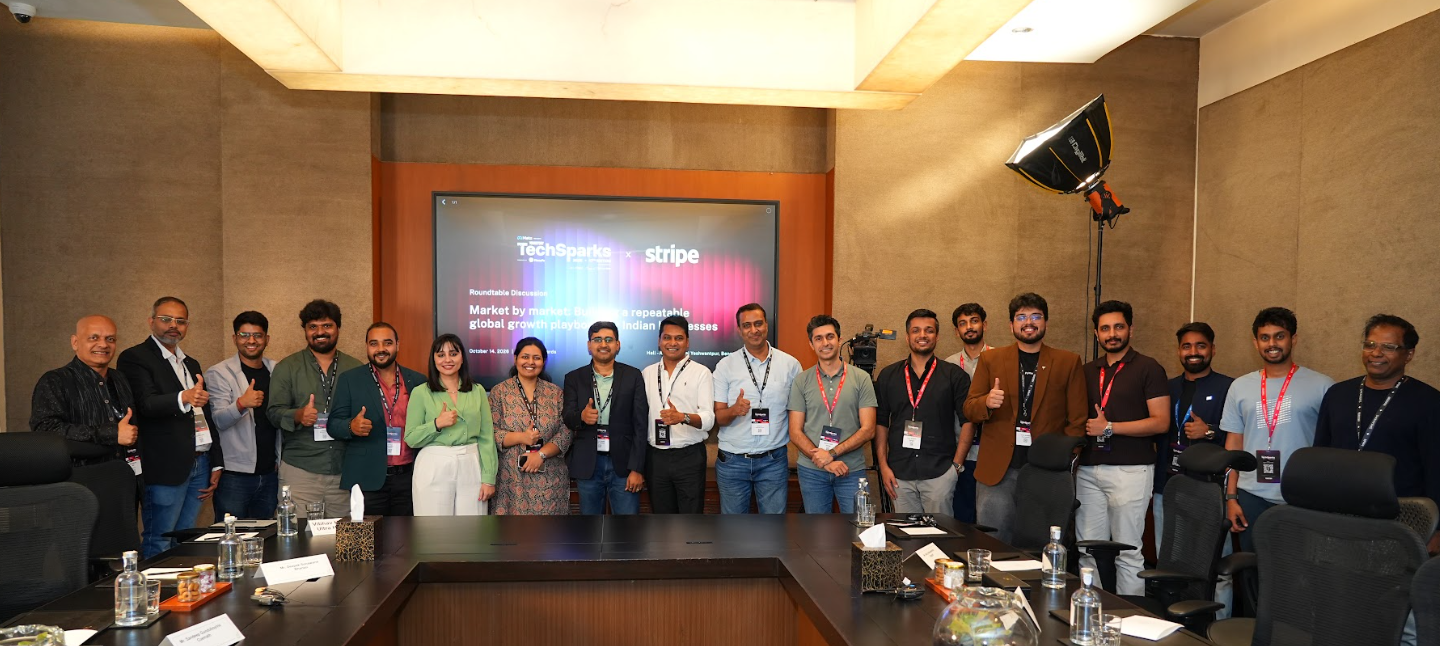
For many Indian businesses, going global does not begin with a grand strategy. It begins with a signup from a shopper in Texas, a lead from Dubai that lands at 2 a.m., or a customer in London who wants to pay in pounds. The first sale feels like proof. The harder question is whether the next market will follow the same path or demand starting from scratch. That question anchored a roundtable by Stripe on building a repeatable global growth playbook at TechSparks 2026, YourStory’s flagship event.
The table brought together leaders from organisations like Xoxoday, upGrad, Dodo Payments, Bhanzu, Borderless Access, Cuemath, FreshtoHome, Codingal, Codeyoung and Ultrahuman.
Representing the host was Manish Maheshwari, Managing Director, India, Stripe. The conversation was moderated by Madanmohan Rao, Research Director, YourStory.
Prove demand before crossing borders
The discussion opened with a shared instinct: start small and start by listening. Companies weigh customer acquisition cost, lifetime value, and operational scalability, along with whether reliable payment rails and local talent exist. One approach was to collect leads and call them before a product even existed, since online research rarely surfaces micro-level insight. A market that keeps asking for the same thing earns a place on the roadmap, while a single large client in one location is better treated as a customization. The first paying customer proves little, while repeat purchases and low dispute rates tell the real story.
Localize the edges, standardize the core
Anything that touches the end user, such as catalogs, curriculum and preferred payment modes like ACH in the United States or direct debit in the United Kingdom, can flex by market. Anything that moves money, including core fraud rules, stays standard. Legal and regulatory needs come first, followed by customer-specific requests, whether that means a bright red palette in China or tax-inclusive pricing in India. Pricing deserves equal care, as carrying Indian price points into the US took one team a long time to correct. Partnerships help too. In the UAE, a government tie-up won acceptance for credentials, while local payment partners improved affordability and brought in new customers.
Treat payments as a growth lever
Maheshwari offered a caution that resonated across the table: “Your payment failure or your checkout failure can be mistaken as a demand failure.”
Pricing in local currency is a big part of the fix, with Stripe’s data showing that 76% of customers prefer to pay in their own currency. Local payment methods and installments for large purchases help, as does a stack that is standard at the core but adaptable by country. Fraud control is a balancing act, because tightening rules too far turns away genuine buyers. Tracking chargebacks, refunds and failure rates by country also helps teams find leaks, such as overseas customers whose one-time passwords never arrived under Indian authentication rules.
Make compliance part of the product
Revenue brings obligations. US states set their own tax thresholds, Europe and India have data rules, and even text messaging follows different regulations in each country. Notices and penalties tend to arrive just as growth does, and one founder recalled how an India-only business shrank overnight after a regulatory shock. Stripe’s view was that a global stack chosen on day one costs less, since “going back and fixing it is far more expensive”.
Tools such as Stripe Atlas, helps businesses create a US entity,, set up local banking, accept payments and raise funds early in their journey, before international growth makes those decisions harder to revisit.
Let AI speed things up, with guardrails
AI is already compressing timelines. Content localization has become nearly 4X faster, with human verification and evaluation layers still in place, and engineers increasingly act as reviewers of AI-written code. Sales bots handle lead qualification and reminders across time zones, lifting funnel performance by an estimated 20-25%. Speed, however, raises questions of stability, safety and security, and cybersecurity was flagged as the topic most missing from the conversation.
Plant the flag where the pull is
Being global by default does not mean opening offices everywhere. One team that localized its curriculum and hired instructors and sales staff in Japan saw momentum fade within three months, because the effort amounted to a separate business. The lesson was to scale where strengths already exist, go deep, and then widen.
Audiences beyond the Indian diaspora need a different approach altogether, with local hiring, community events and even offline centers in the US to feel like a native brand.
A playbook still taking shape
Taken together, the repeatable playbook is clear: validate repeat demand, keep the money-moving core standard, localize what customers see, build finance and compliance muscle early, and enter markets where pull already exists.
Gaps remain. Paying individuals abroad, such as teachers, from an Indian entity is still expensive, and the infrastructure for it is thin.
As the evening closed, the shared belief was that the best learning comes from peers who work in the field. For Indian businesses, going global market by market is less a leap than a discipline, built one repeatable decision at a time.
This content is published by YourStory and has not been created or edited by Hello Headlines. View original