PM Modi is wrong, paper ballot MLC polls say nothing about EVMs
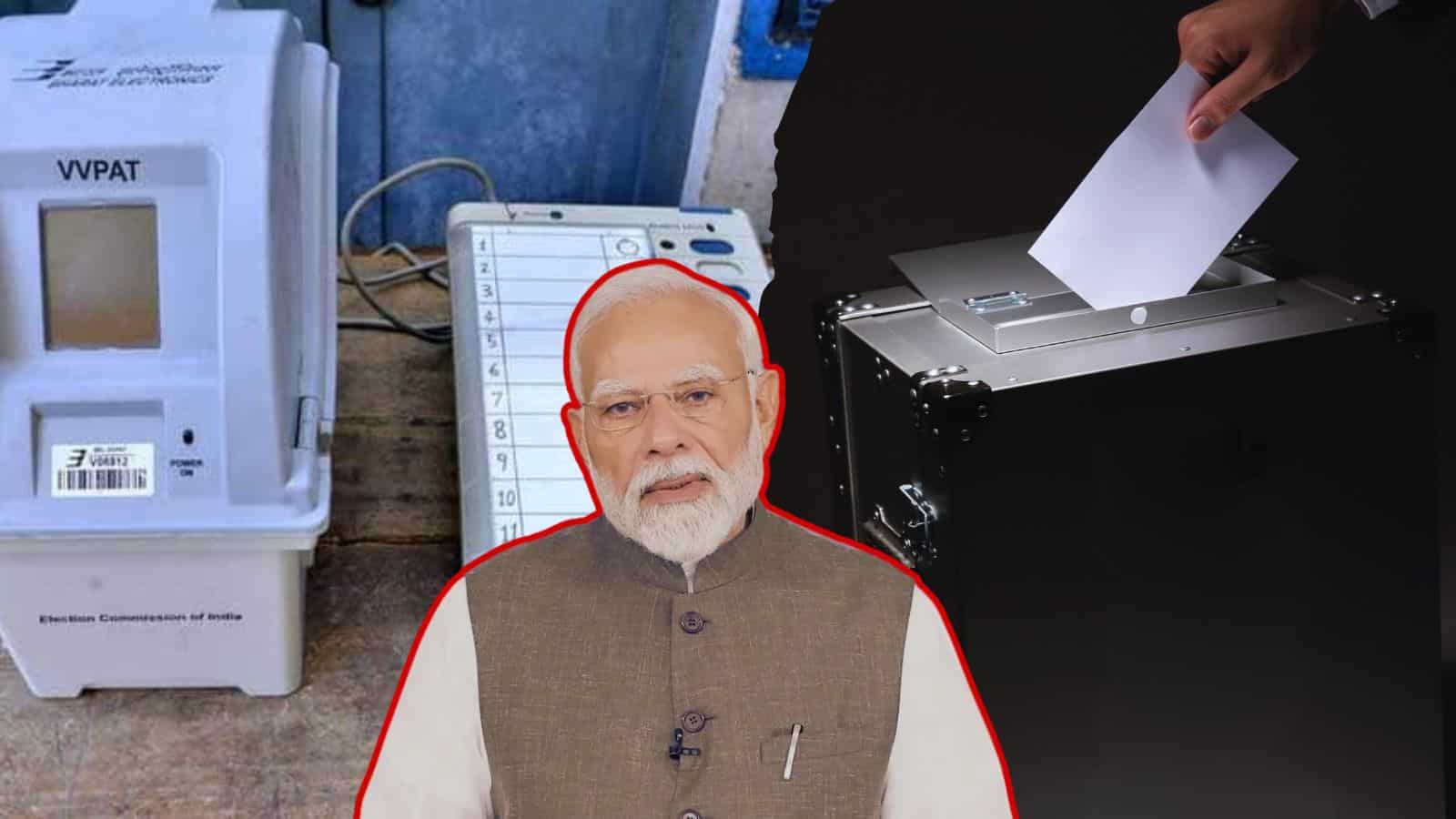
Dear Prime Minister Narendra Modi, you are wrong. An election to 28 Legislative Council seats held on ballot paper cannot settle the Congress’ complaint about electronic voting machines (EVM), because it was never the same kind of election.
The Congress allegation concerns the machines used in Lok Sabha and Assembly polls, where crores of voters press a button for a candidate of their choice. The council polls on October 23 involved none of that. No machines were used, because none could be.
Voters in these seats rank candidates in order of preference, which an EVM cannot record, and only registered graduates and teachers in each constituency can vote.
The electorate was different, the ballot was different and the count was different. Ballot papers were sorted and counted by hand, with candidates’ agents in the room.
A Congress defeat in such a contest says nothing either way about whether EVMs can be tampered with. Proving the machines are clean would mean comparing like with like, and a council poll of a few lakh graduates and teachers is not like a general election.
The Prime Minister drew the comparison anyway. On Wednesday, October 28, he posted on X, “MLC elections in 28 seats across 4 big states – Uttar Pradesh, Maharashtra, Bihar and Karnataka. Elections held using ballot papers. Guess how many seats Congress won?”
MLC elections in 28 seats across 4 big states – Uttar Pradesh, Maharashtra, Bihar and Karnataka.
— Narendra Modi (@narendramodi) October 28, 2026
Elections held using ballot papers.
Guess how many seats Congress won? 🧐
The answer he was pointing to was zero. Union minister Pralhad Joshi wrote that the result was the same, whether by button or ballot, and the Bharatiya Janata Party (BJP) president Nitin Nabin posted that the Congress score on ballot papers too was zero.
Late that night, however, sitting Congress MLC Abhijit Wanjari held on to the Nagpur Division Graduates’ seat. He beat the BJP’s Sudhakar Kohale by 3,271 votes in a city that houses the Rashtriya Swayamsevak Sangh (RSS) headquarters and is home to heavyweights Devendra Fadnavis and Nitin Gadkari.
Who actually votes in the MLC elections
Only two groups of people could vote for the 28 seats that went to the polls on October 23.
The first is graduates. Any citizen who lives in the constituency and has held a degree for at least three years can vote in a graduates’ seat. Being on the ordinary voter list is not enough, as they have to apply separately to be enrolled. These lists are drawn up afresh before each election, so even people who voted last time must sign up again.
The second is teachers. To vote in a teachers’ seat, a person must have taught for at least three of the past six years in a school or college in the state at secondary level or above. They too must enrol separately.
That keeps the numbers small. For instance, in Bihar, the four graduates’ seats had 4,92,594 electors, while the four teachers’ seats had just 40,253.
A Legislative Council is filled in other ways too. MLAs elect one-third of its members and local bodies such as municipalities and zila parishads elect another third. The Governor nominates one-sixth from fields such as literature, science, art and social service. None of those seats was part of this round.
How the votes actually work
Voters don’t pick just one name. They rank the candidates by writing “1” next to their favourite, “2” next to their second choice and so on. Only the 1 is compulsory.
To win, a candidate needs more than half the valid votes. For instance, in the Pune Teachers’ seat, 51,511 votes were valid, so the winning mark was 25,756.
Counting starts with the first choices. If someone crosses the 50 per cent mark, they win. If nobody does, the candidate with the fewest votes is knocked out and their votes are divided among the other candidates.
For example, three candidates, A, B and C, share 100 votes. A has 45, B has 35 and C has 20. Nobody has crossed 50, so C is knocked out. If 12 of C’s voters marked B as their second choice and 8 marked A, B ends up with 47 and A with 53. A wins, but B came much closer than the first round suggested.
The knocking out continues until someone crosses the halfway mark. If the ballots run out before anyone does, the candidate with the most votes is declared the winner.
That is what happened in Nagpur. There were 1,50,874 valid votes, so the halfway mark was 75,438. Sudhakar Kohale of the BJP led after the first count at 60,924 votes to Congress’ Abhijit Wanjari’s 56,630. When the smaller candidates were knocked out, their second choices went mostly to Wanjari, and thousands of ballots had no second choice at all.
Wanjari ended with 67,231 and Kohale with 63,960. Neither reached the mark, so Wanjari, with more votes, was declared the winner.
This round-by-round sorting by hand is why counting takes a day or more, and why the candidate leading early does not always win.
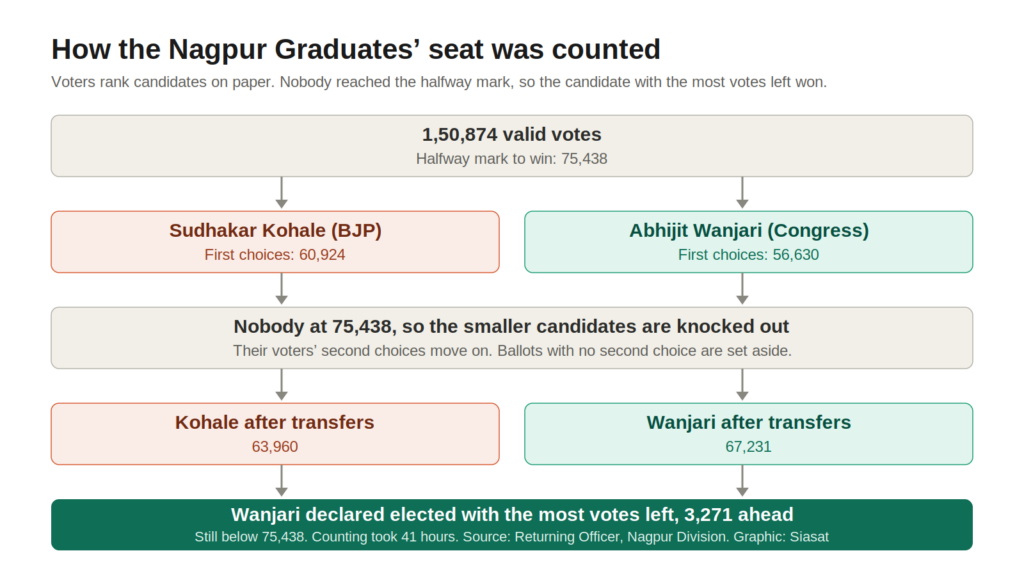
This round-by-round sorting by hand is why counting take a day or more, and why the candidate leading early does not always win.
Where the 28 seats went
In Karnataka, where the Congress is in power, the party suffered its worst defeat of the round. The BJP retained the North-East Teachers’, South-East Graduates’ and West Graduates’ seats, and its National Democratic Alliance (NDA) partner, the Janata Dal (Secular), took the Bengaluru Teachers’ seat from the Congress.
In Bihar, the BJP won three seats, the Janata Dal (United) one, the Rashtriya Janata Dal (RJD) one, Jan Suraaj one and Independents two. The Congress contested five seats and won none. Its sitting MLC Madan Mohan Jha lost Darbhanga Teachers’ to Jan Suraaj’s Suresh Prasad Rai by 324 votes. In several seats, the RJD and the Congress ended up fighting each other.
In Maharashtra, the BJP and Shiv Sena won one seat each, while the Maha Vikas Aghadi (MVA) won the remaining three, with Nagpur among them.
In Uttar Pradesh the Congress was not on the ballot. With the party out, the contest was between the BJP and the Samajwadi Party (SP). The BJP won seats including Meerut Graduates’, Meerut Teachers’ and Lucknow Teachers’, while the SP took the Varanasi (considered the stronghold of Modi) and Agra Teachers’ seats.
It should be noted that not just the Congress, but even the RJP, SP and MVA have raised doubts about the EVM voting process.
Congress questioning EVMs is still valid
The Congress had a bad week and most of the reasons were its own. It is not a verdict on EVMs. A few lakh registered graduates and teachers ranking candidates on paper is a different exercise from a general election.
Congress media chief Pawan Khera said that if the Prime Minister believes EVMs have no bearing on results, he should commit to holding all Lok Sabha and upcoming Assembly polls on ballot paper.
So, Mr Prime Minister, the question you asked is wrong. The better question is why you would treat a poll of graduates and teachers as a verdict on the machines that decide who governs India.
Get the latest updates in Hyderabad City News, Technology, Entertainment, Sports, Politics and Top Stories on WhatsApp & Telegram by subscribing to our channels. You can also download our app for Android and iOS.
This content is published by The Siasat Daily and has not been created or edited by Hello Headlines. View original