Two Plays, Two Worlds
As part of its centenary celebrations, the Rilbong Durga Puja Committee staged two Bengali dramas, Typist and Protarona, on 23 and 24 October, respectively.
Rilbong and Shillong at large, was once renowned for its vibrant theatre culture, and has long been celebrated as a cultural hub that hosted many eminent theatre artistes from Kolkata, including Utpal Dutt and Manoj Mitra. Changing times and our fast-paced, gadget-driven lives, with almost everything available on electronic media, may partly explain the waning interest in theatre.
Against this muted backdrop, the two quality productions, staged on consecutive evenings, came as a breath of fresh air, rekindling cherished memories among older residents of the locality and perhaps sparking the younger generation’s curiosity about this fast-dwindling art form—a silver lining indeed.
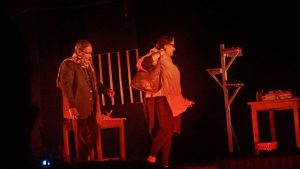
Typist is based on a play by American playwright Murray Schisgal, adapted into Bengali by the late Soumitra Chatterjee, the legendary Bengali actor. It features renowned theatre personality Debshankar Haldar and Poulami Chatterjee, daughter of the veteran actor, who also directs the production. They play Aniruddha and Indrani, respectively, both typists in a private concern. They sit facing each other in a typical office room, surrounded by files, with typewriters on their respective desks. Their bittersweet relationship gradually develops into one of mutual dependence and friendship, bringing them to the point of even confessing their love for each other, only to retreat into reality the next moment. The institution  of marriage proves too strong for the already married Aniruddha to defy convention.
The play explores loneliness, unfulfilled dreams and the existential travails of urban life through its two protagonists. It is, in a way, the story of the vast majority of us, caught in the mundanity and stagnation of existence. We dream of breaking free from the drudgery of everyday life, escaping the madding crowd for some distant haven beneath the blue sky, where we can breathe freely and live on our own terms, only to see those dreams shattered time and again.
Confined only to an office room, this one-act play conceals several layers of meaning beneath the surface of urban life’s myriad complexities. The typewriter and its incessant clatter symbolise the monotonous, joyless existence of the protagonists. The rhythm of the machine quickens when Aniruddha and Indrani are in sync with their natural impulses; it slows when they are downcast or caught in each other’s conflicts. The unvarying click-clack of the keys reinforces the monotony of urban existence, with its repetitive complexities and pervasive apathy.
The existential dilemma manifests itself in various forms throughout the drama. The four odd phone calls made by the protagonists in each other’s absence, mundane though they may appear, bring this dilemma into sharp focus. Indrani shares a sibling rivalry with her married elder sister and professes indifference towards her. Yet, when she calls her mother and mentions her sister, supposedly her parents’ favourite, she reveals her underlying insecurity—an existential dilemma.
Aniruddha, on the other hand, calls his wife to seek forgiveness for his misdemeanour the previous night. His remorse reveals a dutiful husband, susceptible to the prick of conscience—another facet of the same dilemma. He dotes on his two children, keeps their photographs in his wallet and speaks of them glowingly to Indrani, whose facial muscles betray a fleeting twitch at the mention of his family. Is it an unacknowledged possessiveness towards Aniruddha that prompts this subtle reaction from the lonely woman?
 When Aniruddha subsequently proposes to Indrani in an emotional moment, her face lights up, the absurdity of the suggestion eluding her, even if momentarily. Their hope of tying the knot without any strings attached, with a utopian dream destination in mind, remains a mirage. Indrani even thoughtlessly offers to speak to Aniruddha’s wife to secure her consent. The dream is destined to remain unfulfilled, like the umpteen impossible dreams we nurture in our worldly lives.
Soumitra Chatterjee, a known admirer of Tagore, comes into his own, moving beyond the American source material when Aniruddha, dreaming the impossible, suddenly breaks into Tagore’s “Ami Chanchalo Hai, Sudurero Piyasi” (“My restless heart is thirsty for the distant horizon”) in a loud, uninhibited voice. This is one of the drama’s high points, underlining the yearning of both Aniruddha and Indrani to break free.
The lighting, sound, costumes and stage props, with minimal but necessary changes in make-up, trace the characters’ evolution through different stages of their lives, spent in the same office they had so
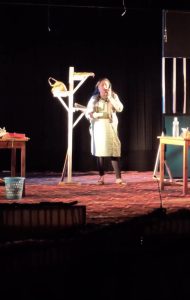
often wanted to leave, and perhaps in the same room. Nothing changes, save their physical age and the monotonous sounds of the typewriters: click, click, click… In the last scene, Aniruddha appears as a grey-haired man, wrapped in a muffler, while Indrani, long past her prime, has failing eyesight and a shuffling gait. Life, after all, must go on in its own rhythm, even if dreamlessly and drearily.
Typist is a thought-provoking play, elevated to great heights by the brilliant performances of its lead pair. It is sure to linger in the viewers’ memory for a long time.
Protarona, the second play, is also a Bengali adaptation of English playwright Harold Pinter’s Betrayal.
Infidelity, dishonesty, psychological deception and moral erosion form the crux of this tale of a love triangle involving Pola (Poulami Chatterjee), Arindam (Sudip Mukherjee) and Rajat (Padmanava Dasgupta), Arindam’s closest friend.
The imbalance between give and take characterises many modern relationships, where trust suffers and  deceit prevails. Adultery, a malaise of modern urban life, can destroy marital bonds like a corrosive acid. Here, Pola and Rajat carry on a five-year affair, betraying their spouses – Arindam and Juthika, respectively.
In a dramatic revelation, Pola confesses her affair to Arindam, who has long suspected the relationship, while Rajat remains oblivious to his friend’s suspicions. The two friends meet over drinks and lunch, as the truth gradually unfolds through body language, cryptic dialogue, and rising tempers. Meanwhile, Pola, a mother of two, continues her secret meetings with Rajat, who is also a father.
Lies beget lies, and relationships rest on the fragile foundations of deceit, duplicity and pretence. With its non-linear narrative, the play explores the darker side of the human psyche, quite at variance with Typist, staged the previous evening. Besides the three protagonists, two boys and a girl flit in and out of the scenes, portraying their younger selves through wordless dance and expressive postures. This lends  the production a neo-artistic touch, perhaps unfamiliar to a large section of the audience. The silent movements offer an innovative dimension, particularly when those youngsters change the stage sets and props through coordinated hand movements. This is perhaps the most striking takeaway from this somewhat abstract production.
Both the plays from the same production house explore different themes, executed with aspiring acting and direction by Poulami. Just like any other art form, theatrical performances and their overall presentations may or may not resonate with audiences entirely, but may leave them wondering about new ideas and concepts.
(The author Is a retired Commissioner of Income Tax, presently based in Shillong)
This content is published by The Shillong Times and has not been created or edited by Hello Headlines. View original