Wildlife at risk as Singur water levels fall, environmentalists seek minimum storage in Manjeera
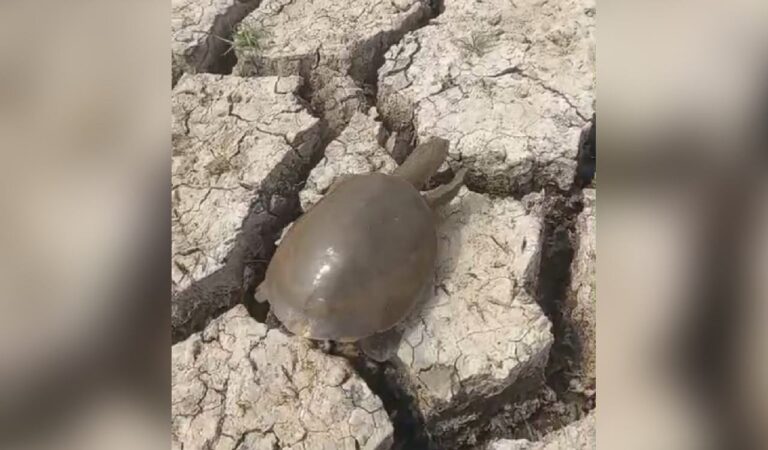
Sangareddy: The video of Indian Flapshell Turtle, which appeared to be searching for a water source walking across cracked soil of river Manjeera near Manoor, is just a reflection what could be the fate of the birds, crocodiles and other beings that made river Manjeera as their home when the officials draws out all the water from Singur.
Singur project had just 2.60 TMC ft of water now against its full storage capacity of 29.91 TMC ft. While the HMWSSB and Mission Bagiratha officials were planning to draw water leaving just 0.87 TMC ft of water, the dead storage, until December last, the question certainly arises what would be the fate of the birds, Mugger Crocodiles, Smooth Coater Otters and other living beings that inhabited Manjeera.
Even though the Indian Flapshell Turtle survives four to five months without food and water, and Mugger Crocodile survives for little more than that, but it is not the case of all the other beings living in the river. As the officials decided to just leave 0.87 TMC ft of water for the other being survive, the Singur and Manjeera dams are expected to go dry entirely before the mid-summer.
Manjeera Wildlife Sanctury is home for nearly 300 bird species which include several winter and summer migrant birds. Thousands of these birds have made Singur and Manjeera as their home along the river course. Of these 300 bird species, 82 were water birds which would not be able to survive without water for even for a few days. According to a report prepared by the officials while seeking Ramsar site tag for the Manjeera Wildlife Sanctury, it is home for 57 fish species, 31 reptiles,18 invertbrates, and 14 amiphibian species.
Manjeera is also known for its rich floral diversity. There were 88 species found in the river which includes 37 trees, 26 shrubs, 17 aquatic plants and 8 grass species. Manjeera is not only a breeding centre for Mugger Crocodiles (Crocodylus palustris).
It is also a home for seven different species of mammals including Smooth Coated Otter, Indian Flying Fox , Hanuman Langur (Semnopithecus sp.) Rhesus Macaque , Jungle Cat , Indian Jackal , Wild Hare, and Wild Pig. To save all the beings that made Manjeera home, environmentalists urged the government to keep at least 0.5 TMC ft of water in Manjeera dam and 1.5 TMC ft of water in Singur which would last until the onset of next monsoon in June 2027.
This content is published by Telangana Today and has not been created or edited by Hello Headlines. View original