100+ Fashion Students in Haryana Turn Fabric Waste Into Art Without Using a Single Needle or Thread
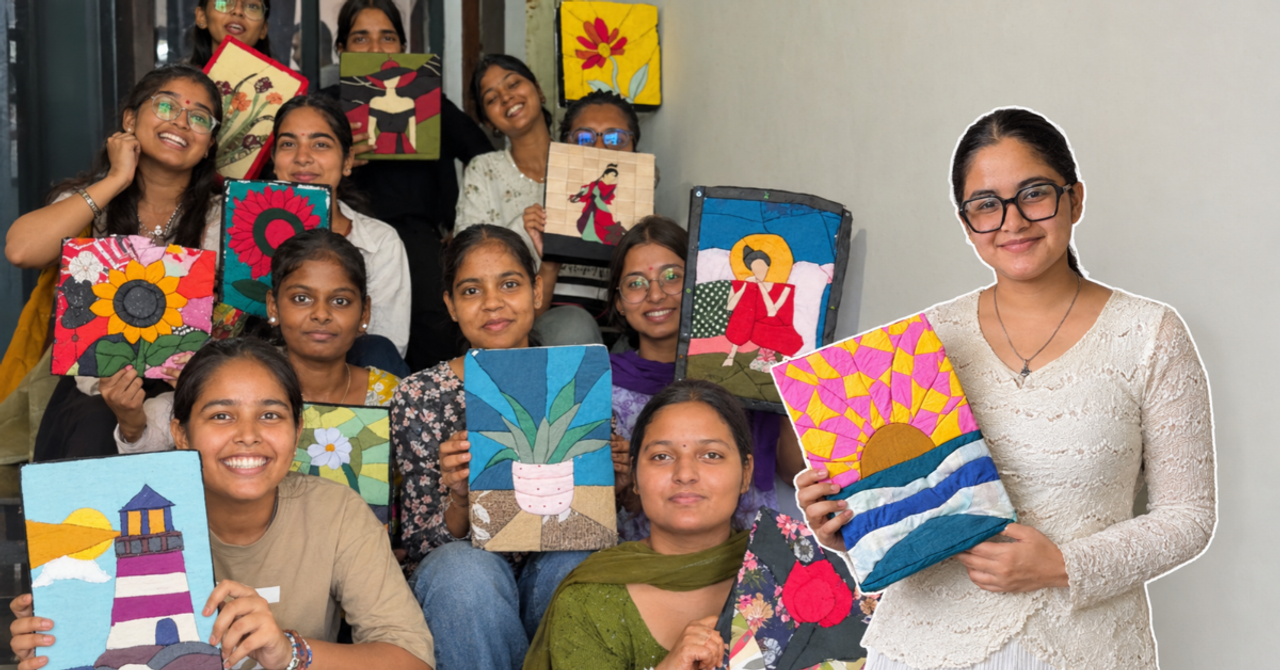
A scrap of patterned fabric becomes a flower petal. Another, tucked carefully into a narrow groove, forms the sleeve of a Geisha holding a lantern. Across the classroom, students lean over thermocol sheets, trimming fabric, testing colour combinations and adjusting tiny pieces until their designs begin to take shape.

At Budha College in Karnal, Haryana, more than 100 first-year Fashion Design students spent seven hours turning discarded fabric into colourful artworks, using a Japanese art form called kinusaiga. There were no needles or threads involved. Instead, the students tucked fabric scraps into grooves cut along their sketches, creating original designs featuring flowers, landscapes, animals and abstract patterns.
Guided by their teachers, Harshita Singh and Komal, the students used fabric collected on campus to explore how leftover materials could find a new purpose.
Turning fabric scraps into artwork
Before picking up their fabric scraps, the students began with colour theory. They explored which shades, textures and patterns worked well together before deciding what they wanted to create.
Once they had settled on a design, they sketched it onto a thermocol sheet and carefully cut grooves along its outlines. Then came the task of bringing the sketches to life.

The students sorted through the discarded fabric, searching for pieces that suited their designs. Each piece had to be cut to size and pressed into the grooves, with care taken around every curve and corner. A small adjustment could change how a pattern looked or how neatly a piece of fabric fitted into place.
View this post on InstagramA post shared by Budha College • Learn By Doing (@budhacollege)
For Reya, a first-year fashion design student from Tamil Nadu, the assignment was an opportunity to experiment with an unfamiliar art form. She chose to create a Geisha holding a lantern, using fabric collected on campus to complete the design.
“By upcycling waste fabric sourced from campus into the thermocol board, I created a piece I was genuinely proud of,” she says.
Jahnvi, another first-year student from Jaipur, enjoyed experimenting with different colours, textures, and patterns. The exercise, she says, helped her explore art from a different perspective.
Learning by doing
The activity brought several aspects of fashion design together in one exercise: colour theory, an understanding of textures, material selection, and the patience needed to work with intricate details.
For Harshita Singh, a faculty member in fashion design, the aim was to help students put classroom concepts into practice while giving them room to experiment with their own ideas.
“As a mentor, I appreciate their patience, dedication, and creativity, because art is not just about creating something beautiful; it is about patience, passion, and enjoying the process,” she says.

The exercise also reflects Budha College's emphasis on practical learning. The skill-based institution, affiliated with Kurukshetra University, encourages students to build their abilities through assignments and projects alongside classroom instruction.
According to CEO Abhinav, the broader aim is to help students become aatmanirbhar, or self-reliant, by developing practical skills they can carry forward after graduation.
From a classroom assignment to millions of views
The finished artworks found an audience well beyond the classroom. Reels featuring the students' creations crossed 3.5 million views on Instagram, giving the first-year students an unexpected opportunity to share their work with a much larger audience.
Reshmi, a student from Bangladesh, said the activity gave the class a chance to express its creativity while working with discarded materials. Laxmi from Odisha initially found the technique difficult but said it became easier and more enjoyable with practice.

The artworks were created as part of a classroom assignment. They are not for sale and are not linked to a commercial venture or social cause. The focus was on learning a new technique, experimenting with materials, and understanding how fabric could be reused creatively.
By the end of the seven-hour exercise, the students had turned leftover fabric into individual works of art, each shaped by their choices of colour, pattern, and design. And without using a single stitch, they had found another way to work with material that might otherwise have been thrown away.
All images courtesy of Budha College
This content is published by The Better India and has not been created or edited by Hello Headlines. View original