Store Memory: D2C In The Age Of Experiential Retail
Remember the charm of walking into a Crossword store, picking up a book and spending hours reading it without anyone expecting you to buy it? With cosy reading corners, a café on the side and occasional author interactions, it gave book lovers a place to unwind, explore and lose themselves in stories. Or Hamleys, where little eyes light up and young hearts skip a beat at the sight of colourful toys and a magical world that feels straight out of a storybook.
Brands such as Pepperfry have also made shopping more personal by letting customers experience how furniture and décor would look and feel in fully furnished living rooms, bedrooms and dining spaces. Chumbak, meanwhile, brings its playful personality to life through colourful interiors and distinctive designs that make its stores as vibrant as the products on display. Of course, how can one forget Decathlon?
Long before experiential retail became a buzzword, these stores gave customers several reasons to visit beyond simply making a purchase.
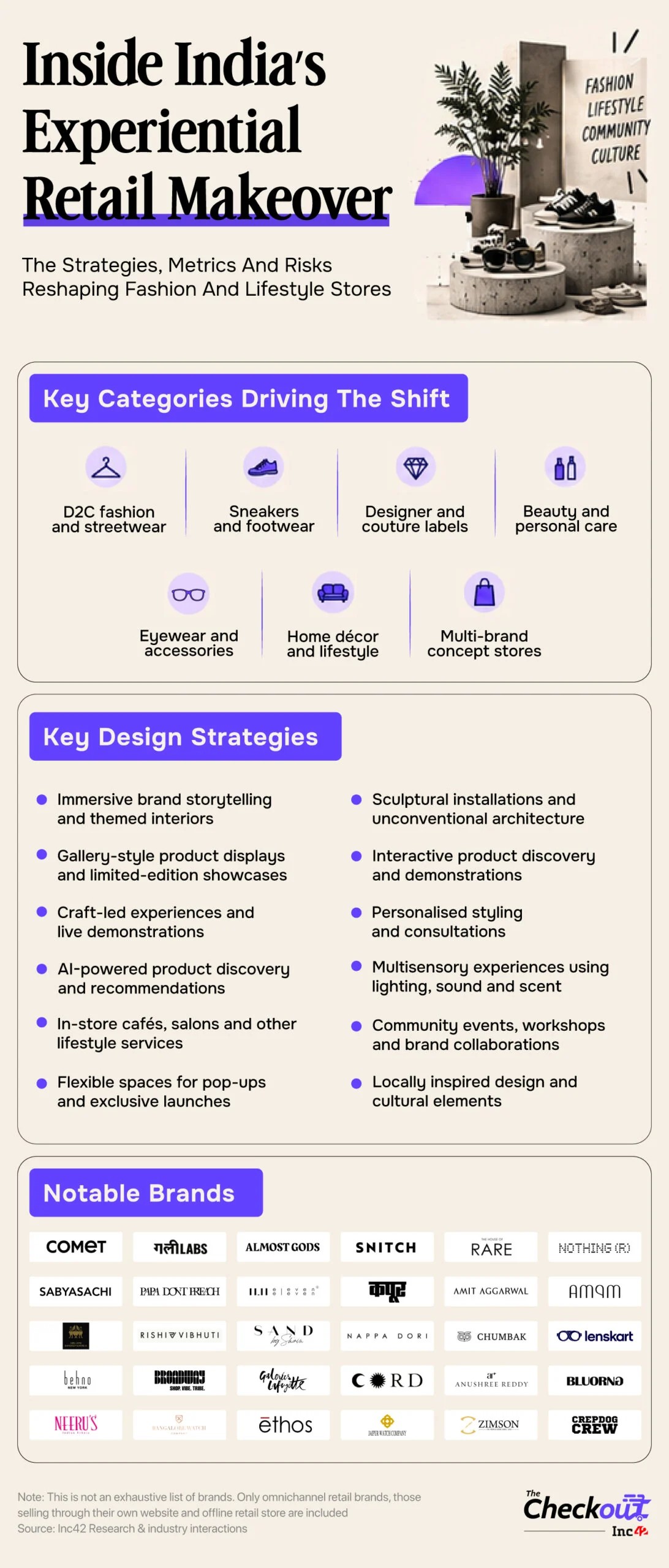
Now, a new wave of fashion and lifestyle brands is borrowing this playbook to take experiential retail a step further. Rather than simply creating attractive spaces or encouraging product discovery, brands such as Gully Labs, Comet, Nothing, Almost Gods and Broadway are experimenting with store design and riffing on traditional retail motifs to bring their brand identity to life.
Take Comet’s flagship store in Bengaluru’s Indiranagar, for instance. With shattered walls, suspended rock formations and sneakers seemingly emerging from concrete, the space resembles the aftermath of a comet crashing to the ground rather than a conventional footwear showroom.
Yet, the experience isn’t just about aesthetics. Instead of crowding shelves with inventory, Comet displays a curated selection of sneakers, with additional sizes stored in concealed drawers. Its dedicated section, The Vault, showcases sold-out sneakers like museum exhibits, even though they are no longer available for purchase.
The D2C sneaker brand spent around seven to eight months designing and building the store, working with an architecture firm to bring its unusual concept to life.
While store design has increasingly become a way to communicate brand identity, build communities and create unique experiences, how are brands balancing creative ambition with the unit economics realities? And can their distinctive retail experiences become a lasting competitive advantage?
Reinventing The Storefront
For years, the conventional retail store followed a familiar pattern. Products occupied shelves, promotional displays highlighted the latest collections, and layouts were designed to move shoppers towards the billing counter.
That formula works, but does not really motivate customers, who can buy almost anything from their phones, to make the effort to visit a store. The reason is simple. They are looking for more than a transaction.
The influence of this thinking is visible at Broadway, a multi-brand fashion and lifestyle retailer housing more than 200 brands. Rather than relying entirely on merchandise displays, it has integrated services and activities that encourage customers to explore products in different ways.
For example, its stores feature salon experiences for beauty product trials and sampling, alongside dedicated stages where brands can organise events and interact with their communities. It also offers AI-assisted analysis to help shoppers identify shades and products that suit their skin tones and complexion, with stylists able to recommend products accordingly.
However, the process involves continuous experimentation. “A service that appears attractive during planning may not necessarily appeal to customers once introduced. These decisions are refined based on customer behaviour rather than treated as permanent elements of the original design,” said a sectoral expert.
But the push towards experiential retail is not being driven by changing consumer expectations alone. For digital-first brands, it is also becoming a question of customer acquisition.
Ujwal Sutaria, founding partner at VC firm TDV Partners believes the rising cost of digital advertising is making physical stores an increasingly interesting brand-building channel.
“Digital acquisition costs in India have become brutal, and a store on a 100 ft road can work as a better ad than any Instagram budget,” Sutaria said.
This is particularly relevant for brands selling premium products. For a shopper considering a pair of sneakers north of ₹5K, the opportunity to examine the product, understand its craftsmanship and experience the brand firsthand could help overcome hesitation that digital advertising alone may struggle to address.
Are There Execution Challenges?
According to Mitali Juneja, creative director at architectural design planning and studio, Studio Ordonnance, the architecture firm behind Comet and Almost Gods’ stores, most established retailers still prefer conventional formats.
The hesitation may not be financial. In larger organisations, proposals have to go through multiple levels of approval. Also, many decision-makers could be wary of committing to unfamiliar or unconventional ideas.
On the flip side, founder-led brands have greater flexibility to experiment, offering the reason why some of the more visible experiments are emerging from younger brands rather than established retail chains.
Next, even after a concept is approved, a transition to a physical space can be difficult. Unconventional installations often require techniques that local fabricators have little experience with.
For Comet’s suspended rock structures, for instance, Mitali’s team had to repeatedly guide workers accustomed to making traditional sculptures.
To minimise errors, detailed working drawings and inspections at different construction stages are needed. Architects must also adapt designs to the property’s structural limitations, including ceiling heights and building specifications.
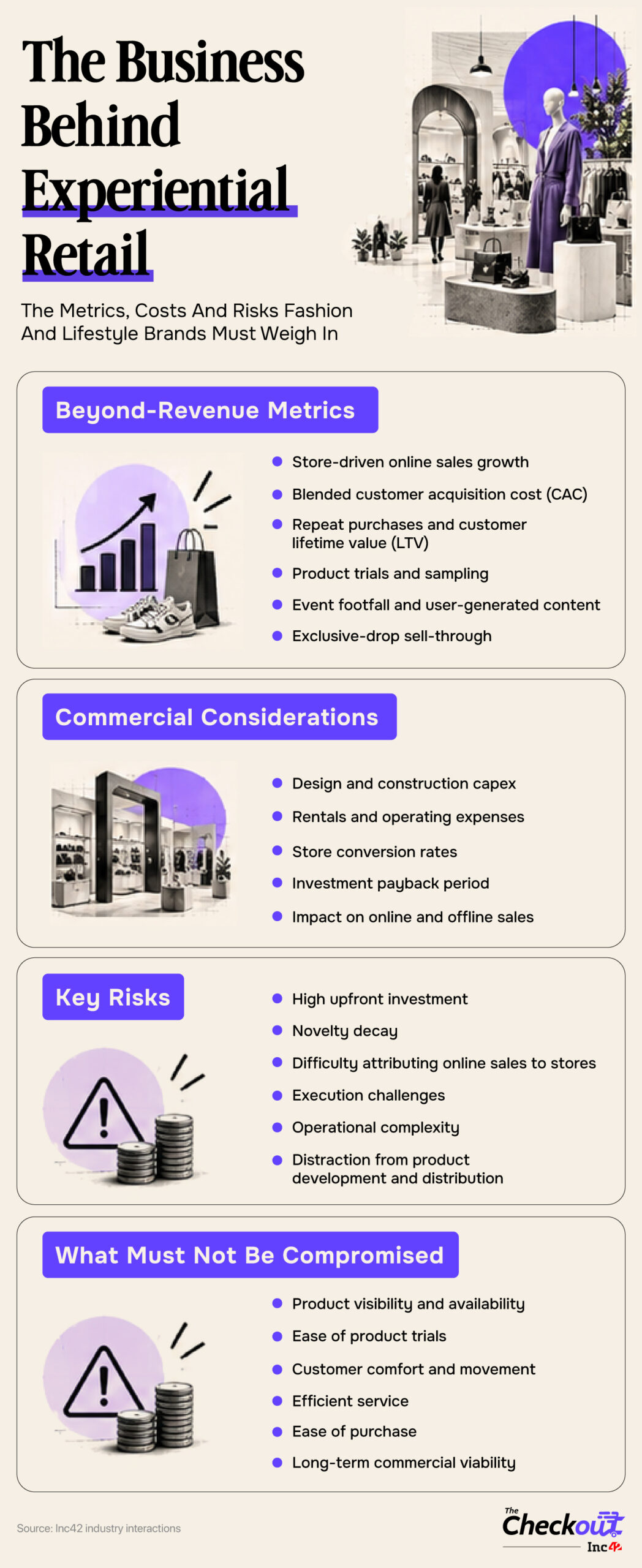
However, she believes the bigger challenge is balancing creativity with functionality. Product visibility, customer comfort and the ease of trying or purchasing merchandise cannot be compromised simply to create an unusual-looking store.
The goal, therefore, is not just to deliver an impressive space, but one that works equally well for the brand and its customers.
Can The Experience Pay For Itself?
For fashion and lifestyle brands already grappling with high rentals and operating costs, the question is whether a distinctive store can generate enough value to justify the additional investment.
Sutaria believes that looking at store-level sales alone misses the wider contribution of experiential retail. A customer may discover a sneaker brand offline, try its products and eventually purchase online. Similarly, a store event could generate interest well beyond its immediate neighbourhood.
“Store P&L alone is the wrong lens. I’d look at the halo effect: Is online traffic and conversion rising in nearby pincodes? What’s the blended CAC for customers who discover the brand in-store? Do they repeat more often?” Sutaria explained.
However, the challenge is establishing whether these interactions generate additional business or simply create visibility. For multi-brand retailers such as Broadway, this becomes even harder, as product trials, sampling and engagement with individual brands may not immediately translate into sales.
Yet, the investment can pay off. According to Comet cofounder Utkarsh Gupta, its Indiranagar flagship achieved a seven-month capex payback despite costing 20–50% more than a conventional store. He also claims it records the highest conversion rate among footwear stores on that high street.
However, Sutaria cautions that the economics must ultimately justify the experience. “If the store lowers blended CAC and improves repeat rates enough to lift brand-level LTV, the capex is justified. Otherwise, it’s just an expensive billboard.”
Can Every Store Be A Flagship?
Even if an experiential store delivers strong returns, replicating the same concept across dozens of locations can be expensive and time-consuming.
Comet is addressing this by standardising most of its design elements while experimenting at select locations. According to Gupta, nearly 90% of the brand’s design elements are scalable, allowing it to retain a consistent identity without repeating the seven-to-eight-month development process required for its first flagship.
However, Sutaria also believes that most single-brand D2C companies will follow a different approach. “The scalable version is a hub-and-spoke model: one or two flagships build culture, while smaller formats and shared-shelf platforms drive reach. That’s why Broadway is interesting. Its 40,000 sq ft Bandra flagship houses 200+ brands, spreading the cost of the experience across multiple businesses.”
Such shared formats could offer emerging fashion and lifestyle brands access to product discovery, sampling and community engagement without requiring each to build an expensive standalone store.
Still, expansion is not the only challenge. An elaborate store can lose its novelty, while excessive investment in physical retail can divert resources from product development and distribution.
Juneja of Studio Ordonnance believes some experimental design elements will eventually disappear because they are impractical. However, she expects the broader shift towards stores that express a brand’s identity to continue.
The real test, therefore, will be creating spaces that remain distinctive without compromising the shopping experience or the economics of running a retail business.
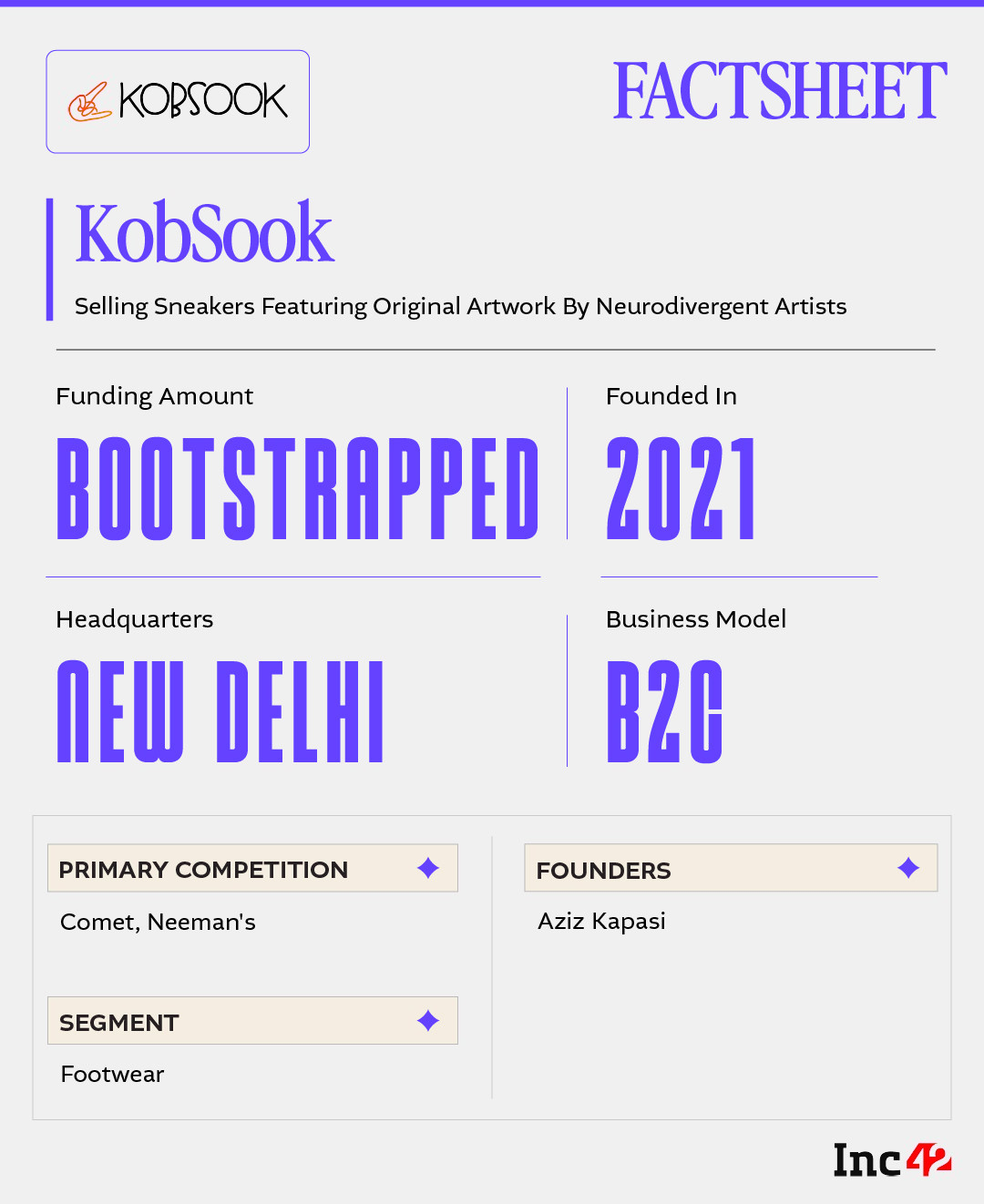
THE STARTUP SPOTLIGHT | HOW KOBSOOK IS BRINGING NEURODIVERGENT ARTISTS TO SNEAKER DESIGN
- KobSook turns original artwork by neurodivergent artists into limited-edition canvas sneakers. The brand works with AEMP (Inclusive Accessible TechEd) as a training partner to help artists develop skills in design and other business operations.
- Its portfolio spans high-tops, low-top sneakers, loafers and slip-ons for men and women, with designs featuring doodles, abstract patterns, colourful checks and other original artwork. Products listed on its website span roughly ₹1,700 to ₹2,500 at sale prices.
- KobSook produces limited quantities of each design rather than relying on mass production, and also accepts requests for customised designs. The brand sells through its own website and ecommerce marketplaces including Myntra, Amazon, AJIO and Flipkart.
The Deep Dive
Ecommerce Buzz
- L Catterton Bets On Glance: The consumer-focused investment firm has invested in InMobi-backed Glance to support the latter’s US expansion. Currently, Glance uses agentic AI to drive product discovery and purchases across smartphones and connected TVs, including through partnerships with Samsung, Motorola and DIRECTV in the US.
- Myntra Swings To Loss: Flipkart-owned Myntra reported a net loss of ₹581.8 Cr in FY26, reversing a ₹546.3 Cr profit a year earlier. This came on the back of its operating revenue falling 13.5% to ₹5,242.5 Cr.
- Swiggy’s Pivot To Inventory Model: Swiggy will begin shifting Instamart to an inventory-led model by mid-Q3 FY27, with the transition expected to take 2–3 quarters and improve contribution margins by 80 basis points. The move comes as Instamart’s adjusted EBITDA loss widened to ₹895 Cr in Q2 FY27
- PharmEasy Veterans Raise ₹63 Cr: Founded by five former PharmEasy executives, Chapter Homes raised ₹63 Cr at a valuation of nearly ₹1,000 Cr. The startup plans to expand beyond its HOKIPO home furnishings brand into cookware, home décor and small kitchen appliances, using AI and a shared supply chain to scale its portfolio.
The Operator Question
How can pop-up shops at festive carnivals (Durga Puja/Diwali/Christmas melas) help unconventional new-age lifestyle brands? What is the cost involved? Is it worth the investment? How should brands measure the ROI?
Speaking to Inc42, Cure By Design founder Daanish Matheen spoke about the pop-up shop aspect of D2C retail. The startup offers hemp-based CBD oils, balms and pain-relief solutions, alongside personal care and nutrition products such as shampoos, face washes, serums and food items.
For unconventional lifestyle brands like Cure By Design, festive pop-ups offer an opportunity to reach new audiences, build trust, and increase brand awareness. Since cannabidiol (CBD) is still an emerging category in India, these events allow the brand to educate consumers, address misconceptions, and encourage first-time purchases.
Costs vary depending on the event, location, and footfall, with expenses including stall rentals, staffing, logistics, and branding.
We’ve participated in pop-ups occasionally but have reduced them significantly since opening our retail stores in Bengaluru and Chennai. Permanent stores provide better customer engagement, stronger credibility, and more consistent conversions.
For us, ROI goes beyond immediate sales. We evaluate customer acquisition costs, leads generated, repeat purchases, and long-term customer value. Ultimately, pop-ups are worthwhile when they attract the right audience and build lasting customer relationships rather than simply generating footfall.
The post Store Memory: D2C In The Age Of Experiential Retail appeared first on Inc42 Media.
This content is published by Inc42 and has not been created or edited by Hello Headlines. View original