From college to central Delhi, what protests taught me about solidarity
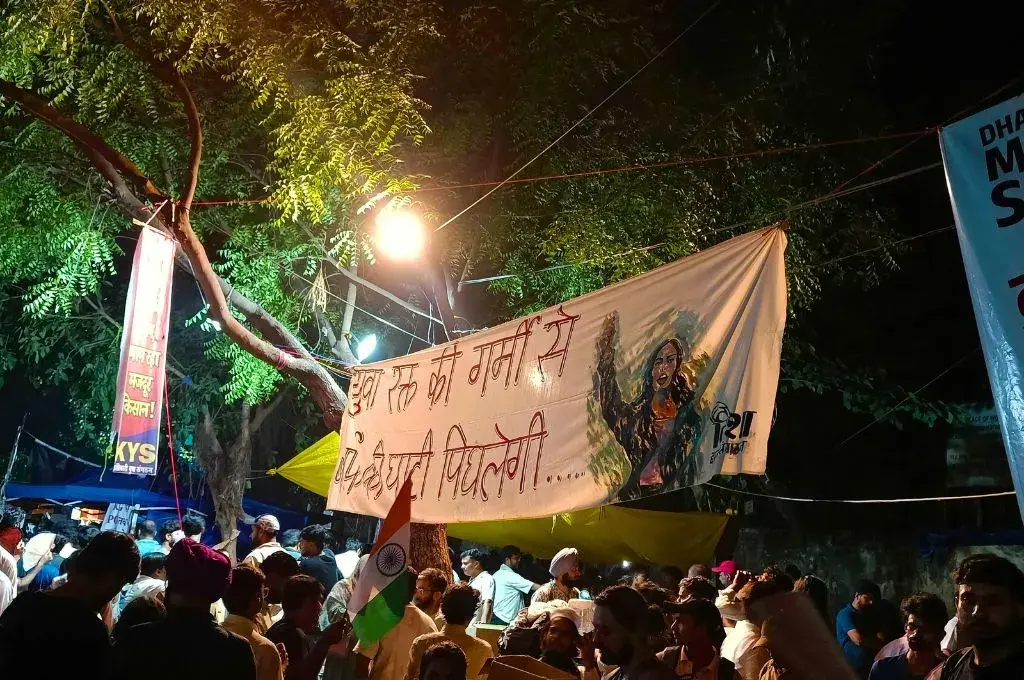
The protests in Delhi have reminded me that collectivising is never only about what happens on the street. It is also about what people do for one another when the space to express dissent or demand rights itself becomes unsafe.
From young men forming human chains around female students to shield them from the police’s lathis, to people organising to defend women who were being targeted online and speaking out against the harassment and brutality faced by protesters—strangers have stood by one another. Across social media, people have been sharing information about rights, what to do if detained, and whom to call. They have also been offering pro bono services and discussing, in the midst of everything going on, how to protest peacefully and safely.
In the past few months, I also saw this spill over into ‘non-protest’ spaces, including a job-posting group I was part of, which normally exists for nothing more political than circulating vacancies. Suddenly, people were using it to share helplines, legal information, and safety resources. Nobody had asked them to. There was no formal structure or organisation directing it. People simply recognised that someone else might need help and stepped in.
That, to me, is collective care at its most tangible. Not a neat framework we apply to movements afterwards, but something people practise instinctively when they realise that staying safe, staying hopeful, and staying together are also part of the struggle.
My first education in this came a decade earlier, just kilometres away from the heart of Delhi’s current mobilisations, and it came the hard way.
Writings on the wall
In March 2015, three of my friends and I started an anonymous campaign called Pads Against Sexism on our college campus. We put up sanitary pads across the university campus with messages against patriarchal attitudes and gender-based violence written on them. The pads were taken down by the administration within days. But the campaign travelled anyway—first to universities around Delhi, then to campuses across the country, and into the national press.
Soon after, we were served a show-cause notice by our university. I want to be honest about what that period was actually like, because the story gets told as a triumphant one, but it did not feel that way from the inside.
When you are nearing the end of your degree and a notice arrives with the university’s letterhead on it, you do not know what will happen next. You only imagine how badly it could end. Would I be expelled? Would this follow me to higher education? Had I just traded my degree for a conversation about menstruation?
I still remember the particular texture of that anxiety—how it reached far beyond the walls of the institution, as a constant, low hum under everything.
Four confused, frightened, very passionate young people suddenly had a community holding them.
And then came something I had not expected. People from activist spaces across the city got in touch. Journalists came to cover our story independently; lawyers offered their time pro bono and helped us draft our response to the show-cause notice. This was 2015, before social media was what it is now. So much of the support we got came directly, person to person, someone finding our name, someone who knew someone and connected the dots back to us. On campus, seniors we had never spoken to reached out; our peers thanked us for the conversation the campaign started. Discussion groups began in the college spaces and circles we were not a part of.
Four confused, frightened, very passionate young people suddenly had a community holding them. None of those people were obligated to support us. They did it because they recognised something of themselves in what we were trying to say and because they knew, from their own histories, that this is precisely how movements survive.
That is the lesson I have carried over the years: Resistance is sustained by relationships. Fear does not disappear when it becomes collective. But it certainly becomes easier to carry when you know you don’t have to carry it alone.
Even as we were forming new connections through the network of support and solidarity that sprung up around us, the response of those closest to us was quite different. At 20, we had acted on what we believed in, without fully understanding the weight of what standing up for those beliefs might come to mean. The question of whether we had done the right thing became harder to ignore. And it had a lot to do with how the circumstances around us were changing.
The shrinking of a public self
Pushbacks came from the dinner table. Family and friends were not hostile but genuinely bewildered: why this topic, of all topics? Why speak about it publicly? Not ‘you are wrong’, so much as ‘you are exposed’. That was my first real lesson in how differently people can hold the same world, and how power doesn’t need to come from the state or in an official letter to shape what you think you are allowed to say.
As the political environment changed throughout my twenties, I watched the people around me get quieter. Not because their beliefs had been shaken, but because the calculus of visibility had changed.
Communities learn to shrink to survive. That learning is transmitted from parents to children, between friends, in small instructions that are never codified as such. Adjust the name. Adjust the clothes. Adjust the tone. Be the acceptable version of yourself, the one that does not attract too much attention.
Having since spent time working in the mental health space, building programmes with organisations across the country, I do not think this is discussed enough as a mental health question, but it is one. People from marginalised communities have reported experiencing a poorer state of mental health, and socio-economic differences do not fully explain this disparity.
There is a specific cost to spending your ordinary days performing a smaller, safer self. It is not a singular action or event you can point to; it builds and accumulates. In a 2024 study of Muslim students in Delhi, for instance, one student shared how she’d consciously changed her language, avoided using familiar Islamic expressions and adopted a more ‘Western’ vocabulary to avoid stereotypes and to make her peers more comfortable. I can’t count how many people I know who do the same, including myself.
Perhaps this is part of what makes mental health political: the conditions that make someone feel they must flatten parts of themselves to belong are not individual failings, but shaped by the world around them.
Showing up as ourselves, and for one another
In the years following 2015, I went from organiser to participant. I kept showing up, but differently, with more awareness of consequence and less of that 20-year-olds enormous, unreasonable belief.
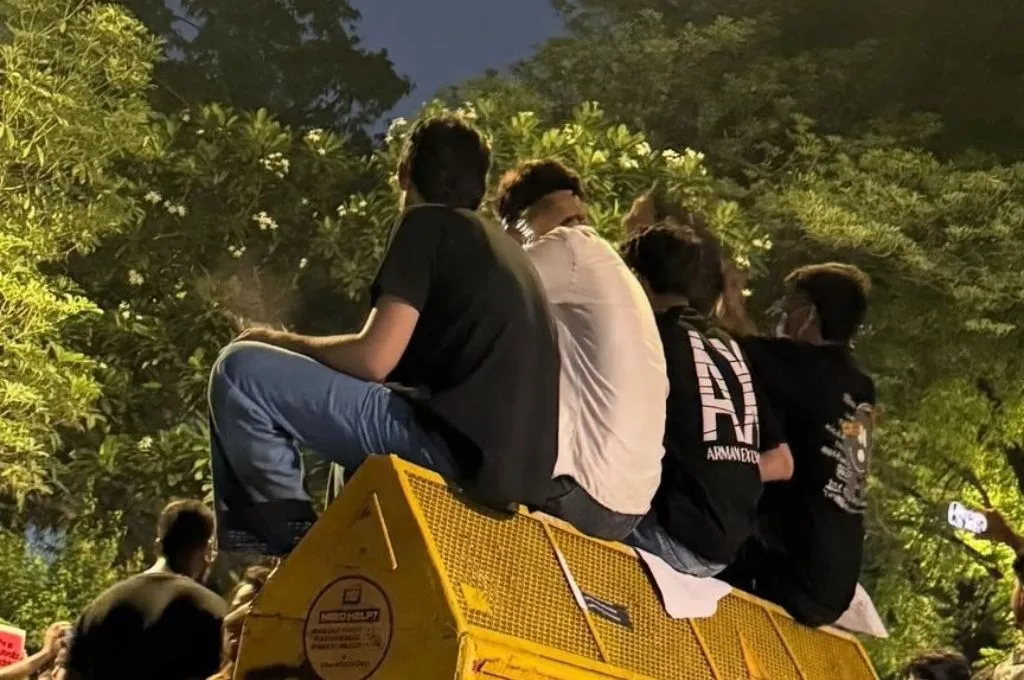
And then, standing in those crowds in July 2026, I watched people do the exact opposite of what all of us had been trained to do. People were there as their full selves. Not the edited version calibrated for other people’s comfort. It was Delhi like I hadn’t seen in a while. Around me, young students made reels to lighten the weight of why they were there, women occupied space fearlessly, people made it feel safe and ensured that lone protesters like me weren’t by ourselves. People were sending food to protest sites for complete strangers, and restaurants were opening their doors to protesters.
By the time I stepped into these protest spaces a few months ago, I had spent years learning to take up less room.
I think of Junaid, who was not hiding or making himself smaller, as he became a fixture at the protest site, handing out food to protesters. I also remember the disproportionate consequences he faced because of his participation and how people mobilised online to amplify what was happening and speak up in support.
That visibility was not incidental to the protest; it was produced by it. People were there as their full selves because they were surrounded by such solidarity.
By the time I stepped into these protest spaces a few months ago, I had spent years learning to modulate, to take up less room, to be legible and unthreatening. Then I was standing in a crowd of thousands, shouting slogans with so many. Something shifts in you when that happens. You come into yourself in a way that is very hard to explain to anyone who has not needed it.
That is what care does—it protects you from harm, and it gives you enough room to stop managing yourself.
The protest sites did both. Care was visible in the way the crowd parted when someone needed air. The shared water bottles, food, and phone chargers. People were always there to help. A friend of mine had gone alone, and because the internet had been cut off in the area, I was worried. I stayed on a call with her until she reached the protest site. Once she got there, a group of young women took her in and helped her find her footing in a place where she knew no one. When a few women took the lead in the narebaazi, others gathered around them, making sure they had the space to speak and hold their ground, while the rest listened. And when there were reports of lathi charges in some areas, information travelled quickly through the crowd, alerting people to where it was happening and which spaces were safer.
The young people were building, in real time and without funding or frameworks, exactly the kind of support systems we otherwise spend years writing proposals about. They were not doing it because they had been trained in psychosocial support. They were doing it because they were together, and because together, care is the obvious thing to do.
The views expressed are personal.
—
Know more
- Understand what well-being looks like in struggles for social change and justice, in this interview with activists Kumi Naidoo and Louisa Zondo.
- Learn about the stories of young people who came to Delhi to participate in the July 2026 protests.
- Read about a person’s experience of growing up in Delhi’s Jamia Nagar locality amid social and political shifts.
This content is published by India Development Review and has not been created or edited by Hello Headlines. View original