Why People Paint Themselves as Tigers & Dance Through the Streets of Kerala & Karnataka
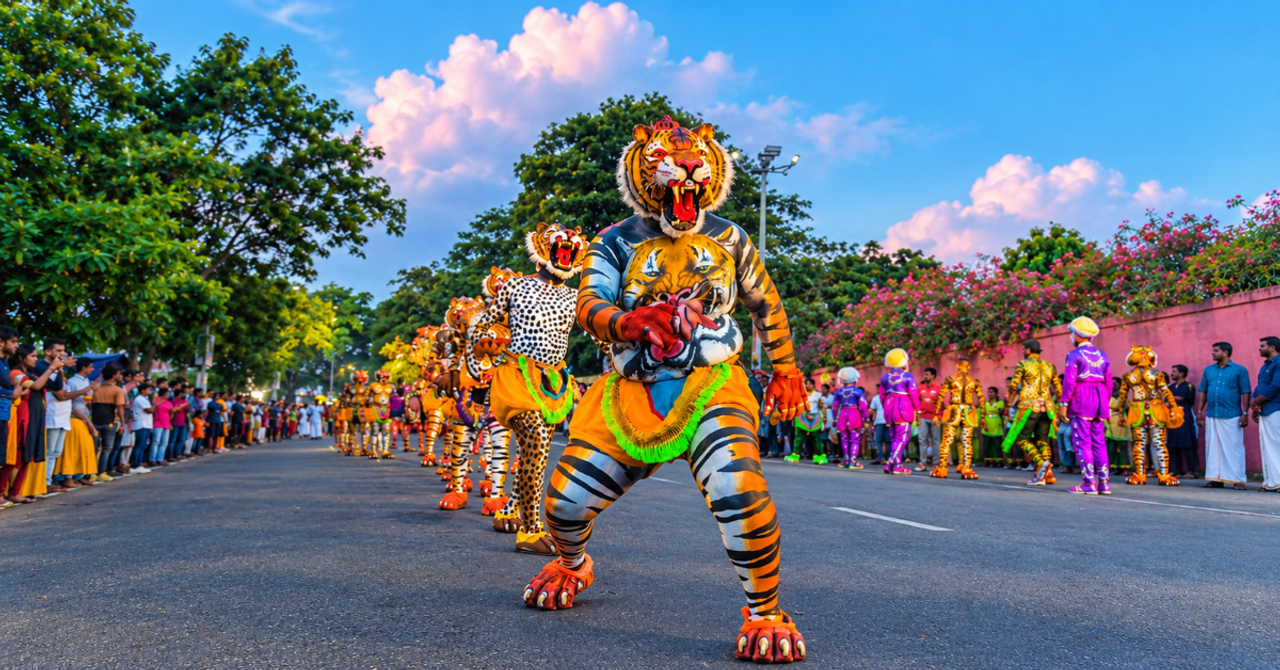
What happens when a wild animal steps out of the forest and into a festival?
Every year, during Onam, the streets of Thrissur in Kerala transform into a sea of painted tigers. Yellow, black and red stripes flash as performers prowl, pounce and dance to the pounding rhythms of traditional drums.
This is Pulikali, literally ‘play of the tigers’, a folk art believed to be more than 200 years old.
But the tiger's journey into cultural life does not end in Kerala.
Along Karnataka’s coastal belt, performers take to the streets as painted tigers during Pilivesha, a traditional dance rooted in the region’s cultural and ritual practices.
Two states. Two tiger dances. These performances are not conservation programmes, and dancing as a tiger does not automatically make someone more tolerant of the animal in the wild.
Yet research into cultural traditions and wildlife offers a starting point for exploring how folklore, ritual and collective memory can shape the way people live alongside wild animals.
A tiger dance shaped by communities
Pulikali is believed to have developed more than 200 years ago during the reign of Maharaja Rama Varma Sakthan Thampuran, ruler of the erstwhile kingdom of Cochin from 1790 to 1805.
According to the Government of Kerala’s tourism department, the tradition is associated with Onam celebrations in Thrissur and the performance of hunters pursuing tigers.

Its history also carries a story of cultural exchange. Kerala Tourism traces an early association with a procession connected to the Pancha-taking ceremony of the Pattani Muslims. Local historical accounts also credit Muslim soldiers stationed near the British cantonment in Thrissur with helping popularise the performance.
Today, Pulikali is performed on the fourth day of Onam, known as Naalaam Onam. Artists spend hours having their bodies painted in elaborate tiger or leopard patterns before dancing to percussion instruments such as the chenda, thakil and udukku. Specialised troupes from across Thrissur assemble for the celebration.
In coastal Karnataka, the tiger enters ritual
A related tradition can be found in Tulunadu, the cultural region of coastal Karnataka. Pilivesha, a folk dance in which performers dress and paint themselves as tigers, features prominently in public festivities, including celebrations associated with Krishna Janmashtami and Dasara.
In a 2024 research report published by the Wildlife Conservation Society–India, researcher Rohan Sharma examined Pilivesha through interviews with performers, organisers and subject experts.
Titled Celebrating Nature-Culture Relationships: Documenting Cultures and Traditions of Tiger Folklore in Coastal Karnataka through the Annual Pilivesha Celebrations, the 24-page study explored the tiger’s place in local folklore, its association with divinity and power, and the historical connections between animal reverence and traditions such as Bhutaaradhane.

The report argues for recognising the links between cultural practices and human relationships with wildlife. It also calls for conservation approaches that take traditional knowledge and local beliefs seriously, rather than treating communities and nature as separate worlds.
This does not establish that participating in Pilivesha directly reduces fear of tigers or prevents conflict. Rather, it documents a cultural relationship through which the animal occupies a place in community life beyond its biological presence in the landscape.
Respect for an animal in folklore does not automatically translate into tolerance when it threatens livestock or human safety. But cultural meanings can influence the way people understand and respond to wildlife.
Beyond the spectacle
Tigers already face pressures from habitat loss, poaching and the fragmentation of forests. As human settlements, agriculture and infrastructure expand into wildlife habitats, encounters between people and large carnivores can also become sources of fear, economic loss and conflict.
But with traditions such as Pulikali and Pilivesha, when people gather to dance as tigers, the animal becomes more than a distant image in a wildlife documentary. It enters public memory through stories, rituals, music and shared experiences.
The lesson from Kerala and coastal Karnataka, then, is that coexistence begins with understanding the many ways people make sense of the animals around them.
Sources:
‘Celebrating Nature-Culture Relationships: Documenting Cultures and Traditions of Tiger Folklore in Coastal Karnataka through the Annual Pilivesha Celebrations’: By Rohan Sharma, Published in 2024
‘Sharing Spaces and Entanglements With Big Cats: The Warli and Their Waghoba in Maharashtra, India’: By Ramya Nair, Dhee, Omkar Patil, Nikit Surve, Anish Andheria, John D. C. Linnell, Vidya Athreya, Published on 23 June 2021
‘Pulikali’: By Kerala Tourism
This content is published by The Better India and has not been created or edited by Hello Headlines. View original